Portuguese
  Spanish


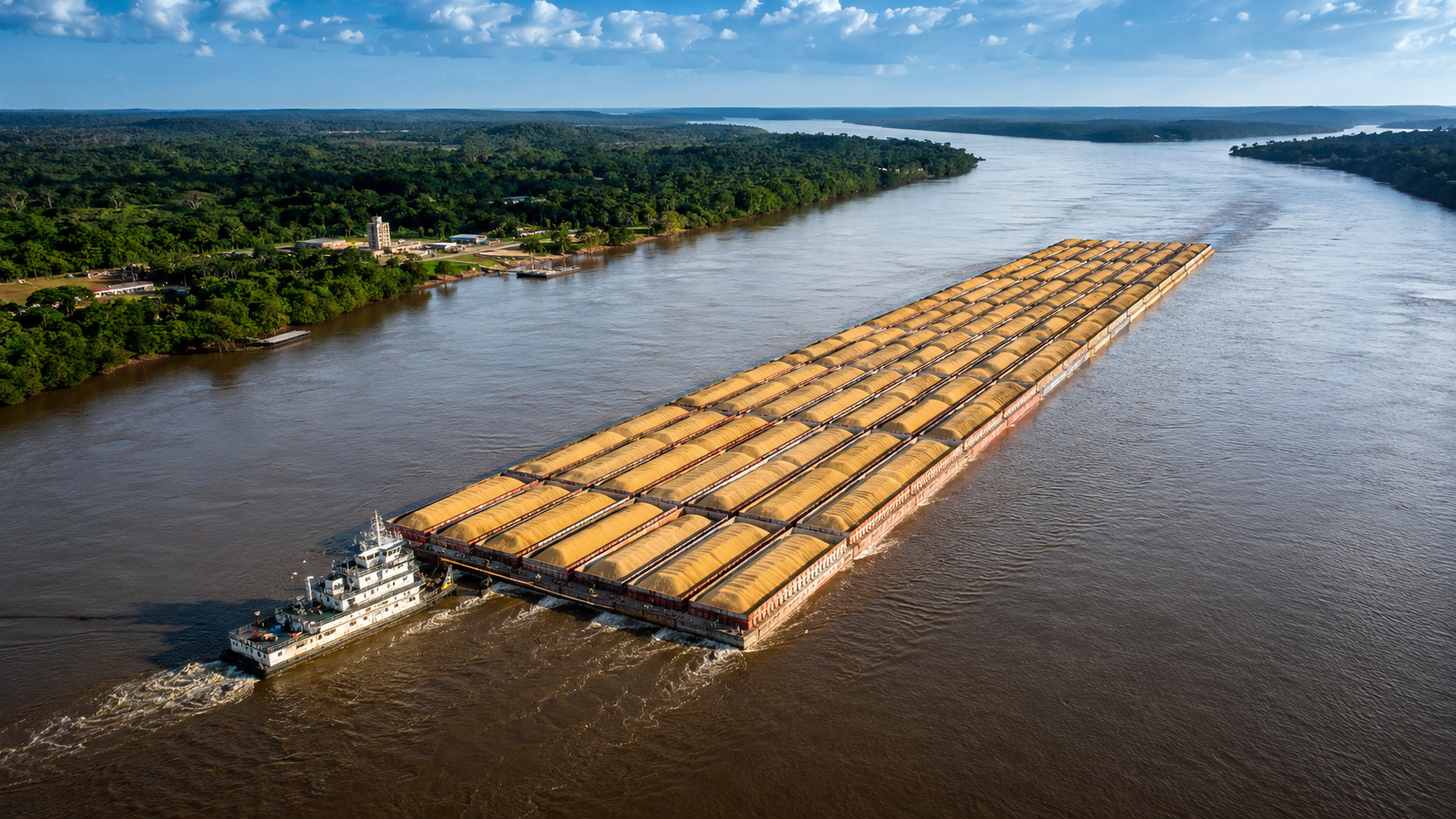


The journey along the Tapajós River helps to understand how Miritituba became a logistical shortcut, how the grain road reduces pressure on trucks, and why the Northern Arc gained strength in the export of corn and soy
A convoy of 36 barges crossed the Tapajós River with 110,971 tons of corn and placed Miritituba at the center of a route that shortens the path between the Midwest and the northern ports.
The operation simply shows how an Amazonian river began to function as a grain road for cargo produced far from there, in states like Mato Grosso, Goiás, and Mato Grosso do Sul.
The information was released by Cargill Brazil, a company operating in food and agribusiness. The operation took place between Miritituba and Santarém, in Pará, with 36 barges moved by a pusher with 6,400 HP.
-
Stingless Bee Honey from Brazil Can Cost Up to $120 a Liter, Surprises with Flavors of Wood, Citrus, and Even Cheese

-
Woman Claims to Have Spotted a Technical Pattern in Recent FIFA Tournaments, Predicts Possible World Cup Winner
-
Chevrolet Offers Chance to Win a 2026 Sonic RS for Free via WhatsApp
-
Earthquake vs. Tsunami: Which Causes More Destruction and Why One Can Be Even More Dangerous


Convoy of 36 barges carried tons of corn at once along the Tapajós River
The operation took place in July 2025 and drew attention due to the size of the cargo. It was 110,971 tons of corn transported in a single trip between Miritituba and Santarém.


The barges were pushed by a tugboat with 6,400 HP. In simple terms, this number indicates the engine power used to move the composition along the river.
This type of transport allows a lot of cargo to be gathered in a single trip. Therefore, the waterway gains importance when it comes to transporting corn and soy from producing regions to export points.
Miritituba became a logistical shortcut because it connects the Midwest to the path of the northern ports
Miritituba gained strength on the logistics map because it receives cargo coming from the Midwest. The city functions as a transit point between agricultural areas and the river route through Pará.
This path helps reduce the dependence on long road trips to ports in the South and Southeast. With the waterway, part of the cargo follows by water to Santarém.
The result is a more strategic route for agribusiness. Miritituba becomes a logistical shortcut because it brings corn and soy production closer to the northern terminals.
Grain road via the Tapajós River shows the strength of the waterway in the Amazon
The Tapajós River appears in this operation as a true cargo road. Instead of the cargo only traveling by road, the corn also takes the route by water.
This change helps explain why waterways are important for grain transportation in Brazil. They can move large volumes and connect distant regions with river terminals.
The image is straightforward: grains produced in the Midwest travel down an Amazonian river to an export point. This scene sums up the importance of the grain road via the Tapajós River.
Volume equals almost 2,500 trucks and makes the scale of the operation clear
The 110,971 tons of corn become easier to understand when compared to truck transport. The volume equals almost 2,500 trucks, a comparison that shows the strength of the convoy.
This equivalence helps the reader visualize the size of the operation. Instead of just imagining tons, one can think of thousands of heavy vehicles on the roads.
With this, the case shows why a waterway can change the logic of transportation. A single river convoy can carry, at once, a load that would require a huge line of trucks.
Santarém Terminal received the cargo and strengthens the export route via the Northern Arc
The journey ended at the Santarém Solid Bulk River Terminal, operated since 2003. This terminal receives grains transported by the waterway and is part of the structure used for export.
The annual capacity of the terminal was expanded to 4.9 million tons after expansion completed in 2018. This data shows how the structure has grown to accommodate the flow of agricultural cargo.

Cargill Brazil, a company operating in food and agribusiness, detailed the key points of the operation, including the route, the volume, the barges, the pusher, and the Santarém terminal.
Northern Arc gains space because it offers another outlet for corn and soy
The case reinforces the importance of the Northern Arc for grain flow. This route expands the options for cargo leaving the Midwest and heading to northern terminals.
For corn and soybeans, having more transportation routes is an advantage. The cargo is not limited to long road routes to other regions of the country.
In practice, the waterway helps transform river cities into important points of foreign trade. Miritituba and Santarém fit into this logic as parts of a corridor used to move grains on a large scale.
The convoy of 36 barges that carried 110,971 tons of corn via the Tapajós River demonstrated how the Amazon can also function as a logistical route for Brazilian agribusiness.
The operation placed Miritituba at the center of the route that connects the Midwest to the northern ports and reinforced the importance of waterways to reduce pressure on roads and enhance the competitiveness of grains.
Do you think Brazil should invest more in waterways like the Tapajós River to transport grains, or should highways still be the priority in this logistical dispute?