






 Portuguese
  Spanish


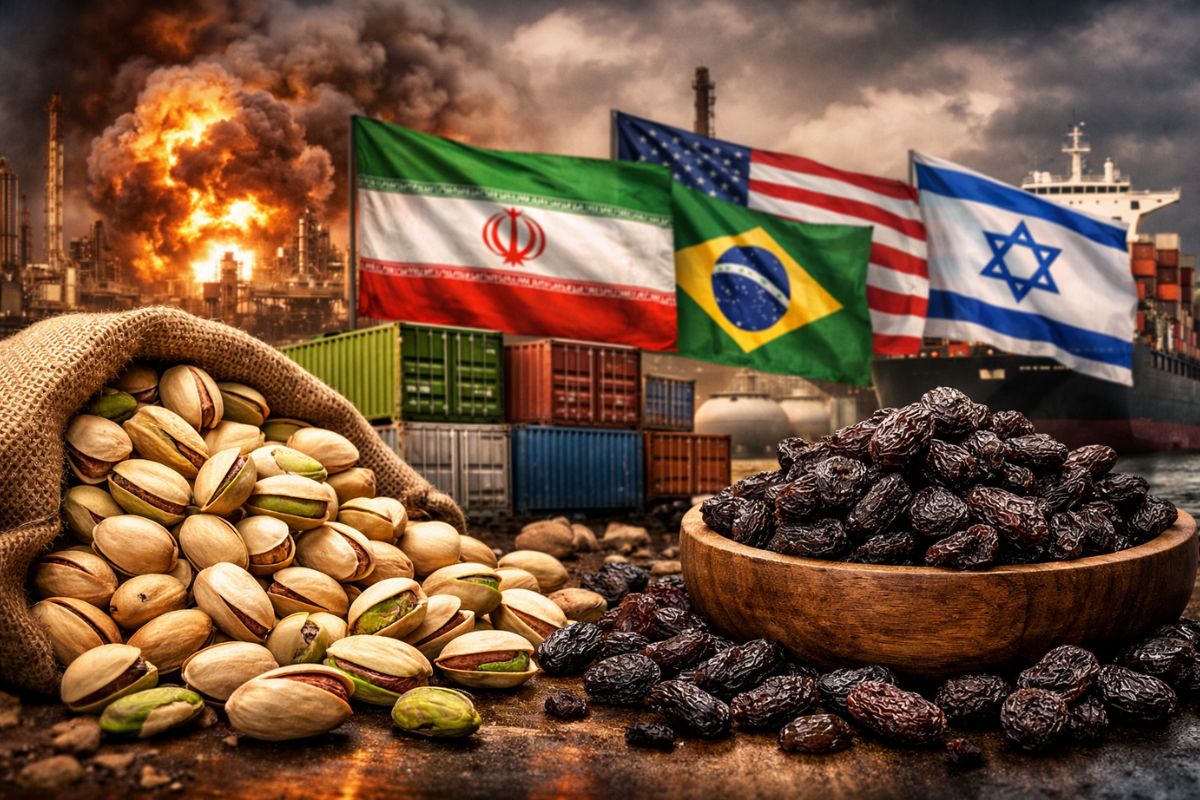


After Attacks By The US And Israel, The Iranian Government Announced The Suspension Of Exports Of Food And Agricultural Products Until Further Notice And Activated An Emergency Plan To Prioritize Internal Supply. For Brazil, The Direct Impact Mainly Falls On Pistachios And Raisins, The Main Imports In The Country Today.
The decision to suspend exports of food and agricultural products puts Iran’s internal supply at the center of priorities amid the conflict with Israel and the United States. According to the communication released, the measure is valid until further notice, signaling that the country intends to keep essential items for the daily life of the population within its borders.
On the Brazilian side, the focus is specific: Brazil does not import essential food from Iran, and the most relevant agricultural purchases are concentrated on pistachios and raisins. This does not eliminate indirect effects, but it helps to understand why the news weighs more for some sectors of commerce than for basic food consumption.
What The Suspension Of Exports Means In Practice
When a government announces that the export of food and agricultural products is prohibited until further notice, the main message is one of control: reducing the exit of strategic items to protect internal supply.
-
iFood Takes 99Food and Keeta to Brazil’s Antitrust Authority Over Aggressive Discounts and Prolonged Losses, Raising Concerns of a New Delivery Market War

-
Brazilian Brothers Transform Dairy Business into Latin America’s Best Cheese, Boosting Revenue from $80,000 to $4 Million

-
He Left Construction, Partnered with His Wife, and Turned a Homemade Gelato Hobby into Brazil’s Largest Chain with 240 Stores and $100 Million Annually
-
Brazil Faces Caregiver Shortage Despite Having 34.1 Million Elderly, Highlighting a Major Challenge for Families


In simple terms, everything that could normally be shipped to other countries depends on an official change in orientation to circulate again.
This type of decision also changes market behavior. Importers, distributors, and industries that rely on items originating in Iran may face uncertainty about deliveries, deadlines, and contracts, as the rule shifts from “when it ships” to “if it can ship.”
Even without numbers, the effect is clear: predictability decreases, and the supply chain becomes more sensitive to any new announcements.
Why Iran Activated An Emergency Plan
The announcement was directly associated with the conflict and the priority of securing essential goods for the population. By activating an emergency plan, Iran signals that it treats the availability of food and agricultural products as an internal security issue, especially during times of external pressure and instability.
In practice, emergency plans usually involve reinforced coordination between government, logistics, and oversight, because the goal is to avoid shortages and peaks of consumer insecurity.
Even without detailing specific measures, the justification presented points to a focus: maintaining the domestic flow of basic items and reducing the country’s vulnerability to immediate shocks.
What Brazil Buys From Iran And Why It Matters
For Brazil, the most objective information is the profile of purchases: the main agricultural imports from Iran are pistachios and raisins, while essential foods are not part of the core of these purchases.
This helps to separate two layers of the news: the risk to basic food for Brazilians tends to be limited, but the sectors that work with these specific items may feel the impact more directly.
Pistachios and raisins frequently appear in value chains that go beyond “in natura” consumption: confectionery, baking, processed foods, and even the premium product retail.
If Iran halts the export of food and agricultural products, the most likely effect, within what commercial logic allows us to infer, is a search for alternatives in other markets and a reorganization of suppliers to maintain stocks and meet contracts.
Possible Effects On Commerce And Households, Even Without Basic Food Running Out
Even when the affected item is not essential, interruptions in exports of food and agricultural products can generate indirect repercussions.
One of them is repricing due to expectation: when a relevant source temporarily exits the market, buyers tend to compete for other suppliers, which can raise costs and pass part of this on to consumers in products that use these ingredients.
Another point is time. As the suspension was announced until further notice, the horizon is uncertain: it could be brief or could be extended.
The duration matters because stock is finite, logistics have schedules, and contracts typically work with forecasts. If there is a quick resumption, the impact tends to be more localized; if it takes longer, the market may adapt more profoundly, substituting sources and reshaping purchasing routes.
The suspension of exports of food and agricultural products by Iran, combined with the activation of an emergency plan, demonstrates how conflicts can quickly cross the military boundary and reach daily life through supply and commerce.
For Brazil, the focus falls on pistachios and raisins, while the purchase of essential foods does not appear as a central dependency, but instability can reverberate in specific chains and in niche prices.
In your view, measures like this tend to protect the local population or end up spreading insecurity and price increases in international trade?
And here in Brazil, have you noticed variation in the price of pistachios, raisins, or products that use these ingredients?




Pistache na Europa oriental e oriente médio custa 1/3 do preço do amendoim. É considerado coisa de pobre. Não sei de onde tiraram que pistache é chique. Com o preço de um potinho no Brasil, lá se compra 25 kg.