






 Portuguese
  Spanish


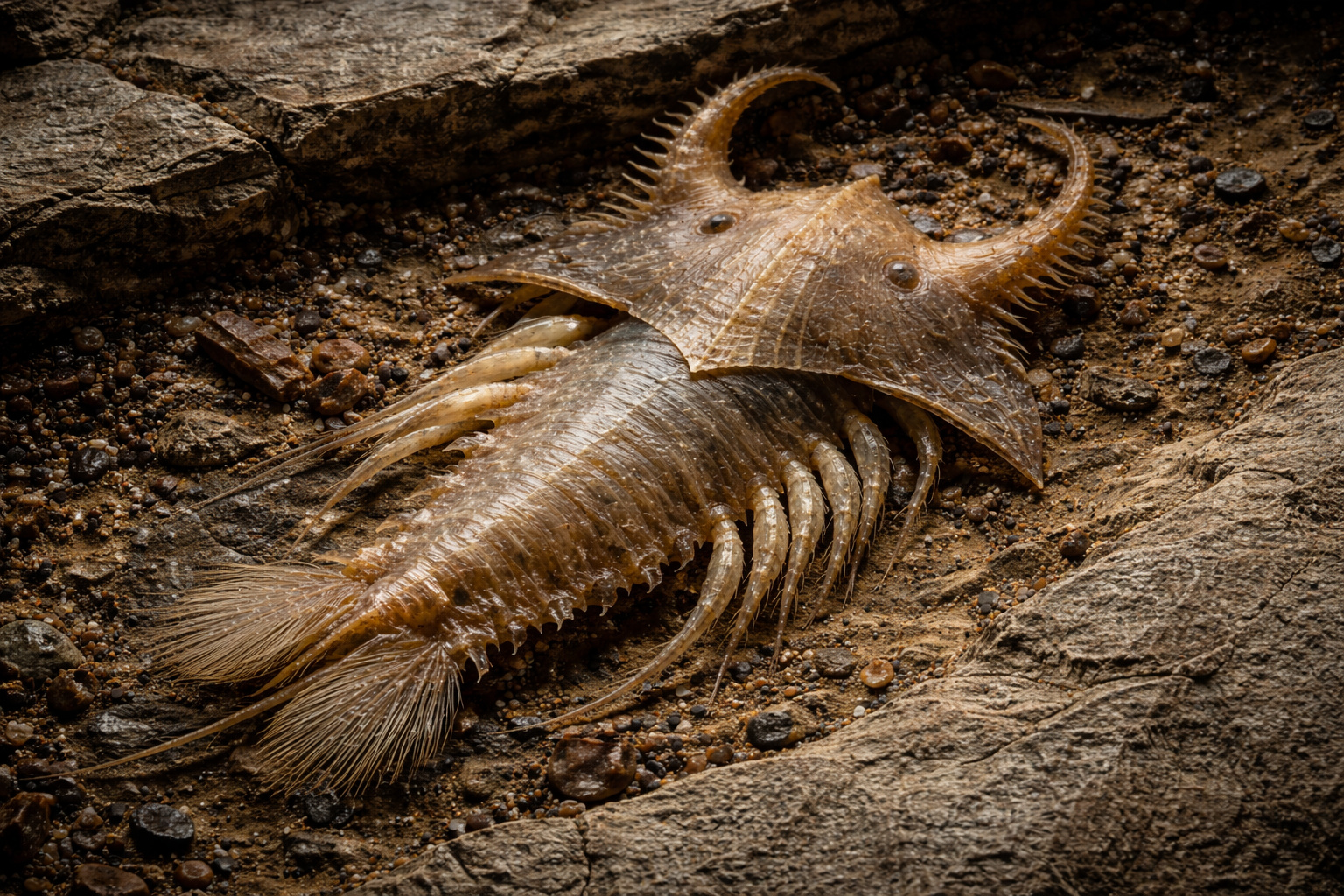


Rare Fossil Found in Southern Canada Reveals a Marine Arthropod from the Ordovician Period, with Exceptional Soft Tissue Preservation and Characteristics Never Before Seen in This Type of Record
Recently, a paleontological discovery of great scientific relevance caught attention in Canada. Researchers identified a marine animal without eyes and with a completely soft body, with exceptional preservation and an estimated age of approximately 450 million years.
The finding occurred near the eastern shore of Lake Simcoe, in the southern province of Ontario. Since then, experts have been analyzing the specimen with caution, especially due to the rarity of the type of conservation observed.
Moreover, the area of the discovery informally receives the name of “Paleo Pompeii”. This quarry stands out as a nursery of marine fossils. Over the years, the site has gained recognition for preserving ancient organisms under unusual conditions compared to other fossil sites from the same period.
-
Few people know, but China photographed for the first time Earth’s “quasi-moon,” a small asteroid that accompanies our planet around the Sun and may be a fragment torn from the Moon millions of years ago.

-
China delivers a giant crane ship capable of lifting 2,200 tons at once, transporting structures of up to 10,000 tons, and operating in semi-submersible mode for offshore projects.
-
One of the most devastating El Niños in modern history did not only bring heat: amidst droughts, destroyed crops, and lack of supplies, 50 million people died across three continents, and scientists see in this past a brutal warning for a hotter planet.

-
EcoFlow’s Portable Fridge Offers 43 Hours Off-Grid, Reaches -25°C, App-Controlled, Solar-Powered for Camping and RV Adventures



Scientific Classification Reveals New Extinct Species from the Ordovician
After detailed analyses, paleontologists classified the specimen as Tomlinsonus dimitrii. The species belongs to an extinct group of arthropods known as marrellomorphs. These organisms inhabited the oceans during the Ordovician period, between 485 and 443 million years ago, a phase marked by intense diversification of marine life.
The animal measures about six centimeters in length. Additionally, it features an ornamented cephalic shield, with two curved horns covered in feather-like spines. At the same time, the body shape resembles that of a primitive spider, a characteristic that reinforces its classification among extinct marine arthropods.
Rare Preservation of Soft Tissue Surprises Experts
According to Joseph Moysiuk, a PhD student in ecology and evolutionary biology at the University of Toronto and a researcher at the Royal Ontario Museum, the discovery contradicted the initial expectations of the scientific team.
In a statement made in 2024, the researcher explained that the team did not expect to find a soft-bodied organism in this location. As he pointed out, fossils generally preserve rigid structures such as bones and shells, while soft tissues almost never withstand geological time.
Furthermore, according to Moysiuk, only a few locations in the world manage to preserve soft-bodied organisms for hundreds of millions of years. Therefore, the Canadian find holds great scientific relevance.
Comparison with Other Fossils Reinforces Exceptional Nature of the Find
Meanwhile, other fossils abundant in the same region, especially those of echinoderms, display mineralized body parts. These structures offer greater resistance to degradation over time.
In contrast, the new specimen draws attention precisely for lacking rigid structures. This factor reinforces the uniqueness of the fossil site in southern Ontario and directly contributes to the advancement of understanding rare fossilization processes.
Scientific Relevance Broadens Understanding of Ancient Marine Life
From a paleontological point of view, the discovery broadens knowledge of marine biodiversity during the Ordovician. Furthermore, the find provides new clues about the evolution of arthropods and the environmental conditions that allowed for the preservation of soft-bodied organisms hundreds of millions of years ago.
At the same time, the discovery reinforces the ongoing scientific importance of the quarries in southern Canada, which continue to reveal crucial information about the history of life on Earth.
Given such rare and well-preserved fossils, to what extent can sites like “Paleo Pompeii” redefine what science knows about the planet’s early marine ecosystems?


