Portuguese
  Spanish


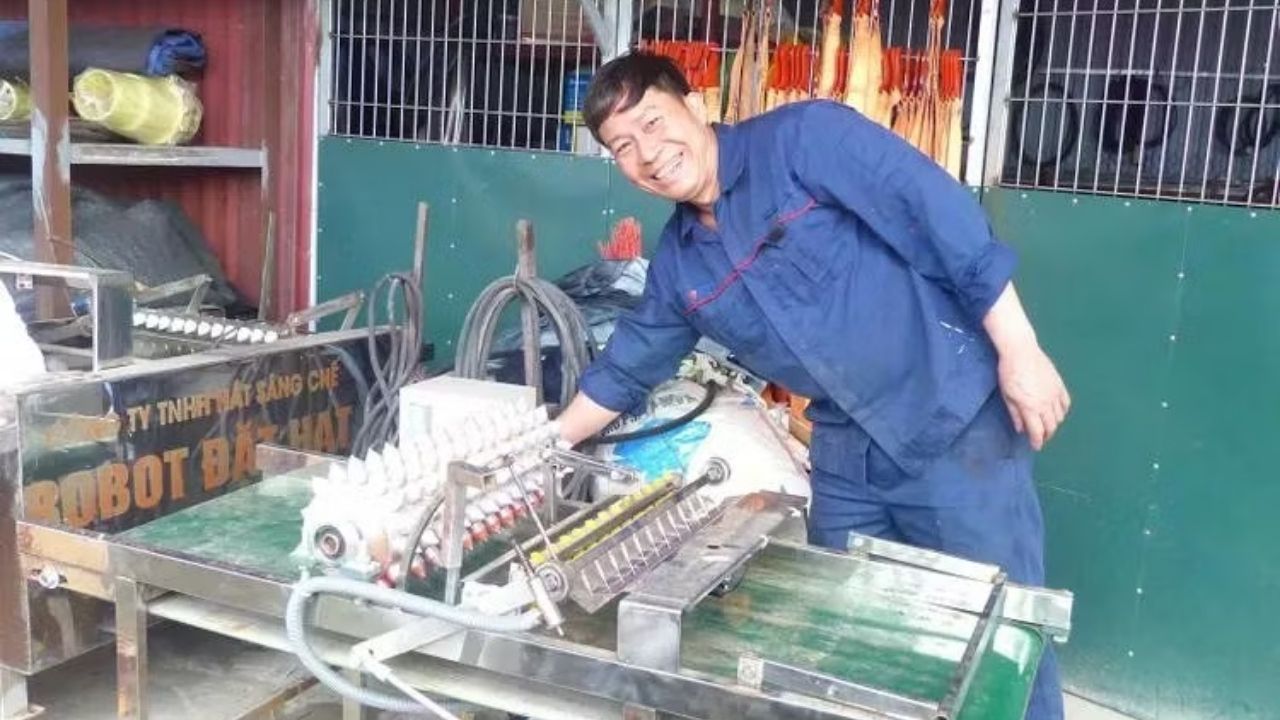
Pham Van Hat, known as the barefoot inventor, created an agricultural robot in Vietnam after an experience in Israel, where he developed a machine capable of performing almost like 40 workers. The Seeder Robot is now exported to 15 countries, while the workshop gathers more than 60 solutions for farmers in the agricultural, forestry, and fishing sectors.
The agricultural robot created by Pham Van Hat put the Vietnamese inventor’s name on the map of practical rural machines. Without formal engineering training and with a background linked to the field, he became known in Vietnam for the Seeder Robot, equipment manufactured locally and exported to 15 countries.
According to VietnamPlus/VNA, in a report published on May 22, 2026, Hat’s story begins in the commune of Tan Ky, in Hai Phong, northern Vietnam. The article reports that the inventor developed more than 60 machines for agriculture, forestry, and fishing, after a decisive experience in Israel.
Failure on the farm became a turning point
Before gaining recognition, Pham Van Hat faced a heavy business setback. In 2007, he invested 1.5 billion Vietnamese dongs in a 10-hectare vegetable farm aimed at safe vegetable cultivation, but the market was not yet absorbing this type of product as he expected.
-
3,000 Sheep Maintain 900 MW Solar Farm Transforming Texas Fields into Energy for Data Centers

-
Distant Galaxy Shaped Like a Giant Jellyfish Sheds Gas, Forming New Stars as It Moves Through Hot Cosmic Gas

-
Nearly 40% of Treated Water in Brazil is Lost Before Reaching Homes; Companies Use Satellites, AI, Helium, and Innovative Tech to Improve Access in Remote Areas
-
Steel Sphere Cylinder Achieves 14% Damping in Tests, Functions Without Sensors or Electricity, and Can Reduce Vibrations in Skyscrapers, Bridges, and Sensitive Equipment with US Patent Registered



In 2010, the business failed and left a debt of 4 billion dongs. The episode is not presented as an easy formula for overcoming, but as a breaking point in the inventor’s journey, who decided to seek work in Israel to earn income and observe agricultural technologies in a desert climate country.
Experience in Israel revealed a problem in the field
During work on a vegetable farm in Israel, Hat observed the repetitive effort of manually spreading fertilizers over large areas. The task required many people, time, and physical wear, a scenario that sparked the idea of creating a mechanical solution.
It was in this context that he proposed an automatic fertilizer distributor integrated into the farm’s routine. After tests and adjustments, the third version worked satisfactorily and delivered productivity equivalent to almost 40 workers, according to the report.
Machine paved the way for research and patents
The result changed Hat’s role within the farm. Instead of remaining only in manual labor, he began working in research and machine improvement, received a salary increase and a bonus of 10,000 dollars, as well as support to register patents for some innovations.
This stage was important because it connected practical observation, real need, and technical development. The future agricultural robot was not born from an abstract proposal but from problems seen in the field, where time, cost, energy, and maintenance make a difference for those who depend on rural production.
Return to Vietnam brought focus on local farmers
Even with opportunities abroad, Hat returned to Vietnam in 2012. The decision, according to the report, was motivated by the desire to apply knowledge first to Vietnamese farmers, adapting machines to local conditions instead of copying expensive or less accessible models.
Back home, he restarted in a simple corrugated sheet workshop. There, he focused on equipment that could solve practical field problems, with more mechanical operation, lower energy consumption, and maintenance more suitable to the rural reality of Vietnam.
Seeder Robot gained market outside Vietnam
The most prominent product was the Seeder Robot, an agricultural robot developed to replace more expensive imported models dependent on multiple electronic components. The proposal was to deliver precision and durability with a simpler structure and lower cost.
The invention gained international recognition and reached markets such as Japan, the United States, Canada, Germany, and New Zealand. The leap shows that a machine designed for local farmers can compete outside the country when it solves a problem objectively.
More than 60 inventions expanded the workshop
After the Seeder Robot, Hat expanded his work to other agricultural, forestry, and fishing machines. The list mentioned in the report includes grain loaders, herb harvesters, pesticide sprayers, and vegetable harvesters.
Three years after returning to Vietnam, he paid off the debts and expanded production. The work philosophy reported by VietnamPlus is straightforward: develop what farmers really need, not just manufacture what the workshop already knows how to produce.
Inventor also created a solution for urban safety
Besides the field, Hat began working on a mechanical emergency escape solution for tall buildings. The idea arose in response to fires in small apartment buildings and karaoke houses, focusing on a system that does not depend on electricity.
During tests in a five-story building, the equipment reportedly evacuated 30 people in one minute and 26 seconds, according to the report. Hat claims he refused an offer of 30 billion dongs from a Chinese company for the technology, arguing that Vietnamese should benefit first from the invention.
What this case shows about innovation in the field
The story of Pham Van Hat shows that rural innovation doesn’t always start in big laboratories. In his case, the path involved direct observation, simple workshop, local adaptation, and creation of machines focused on productivity, cost, and real use in the field.
Do you believe the future of agriculture depends more on large technology companies or inventors who are closely familiar with farmers’ problems? Leave your opinion in the comments and join the discussion.