Portuguese
  Spanish


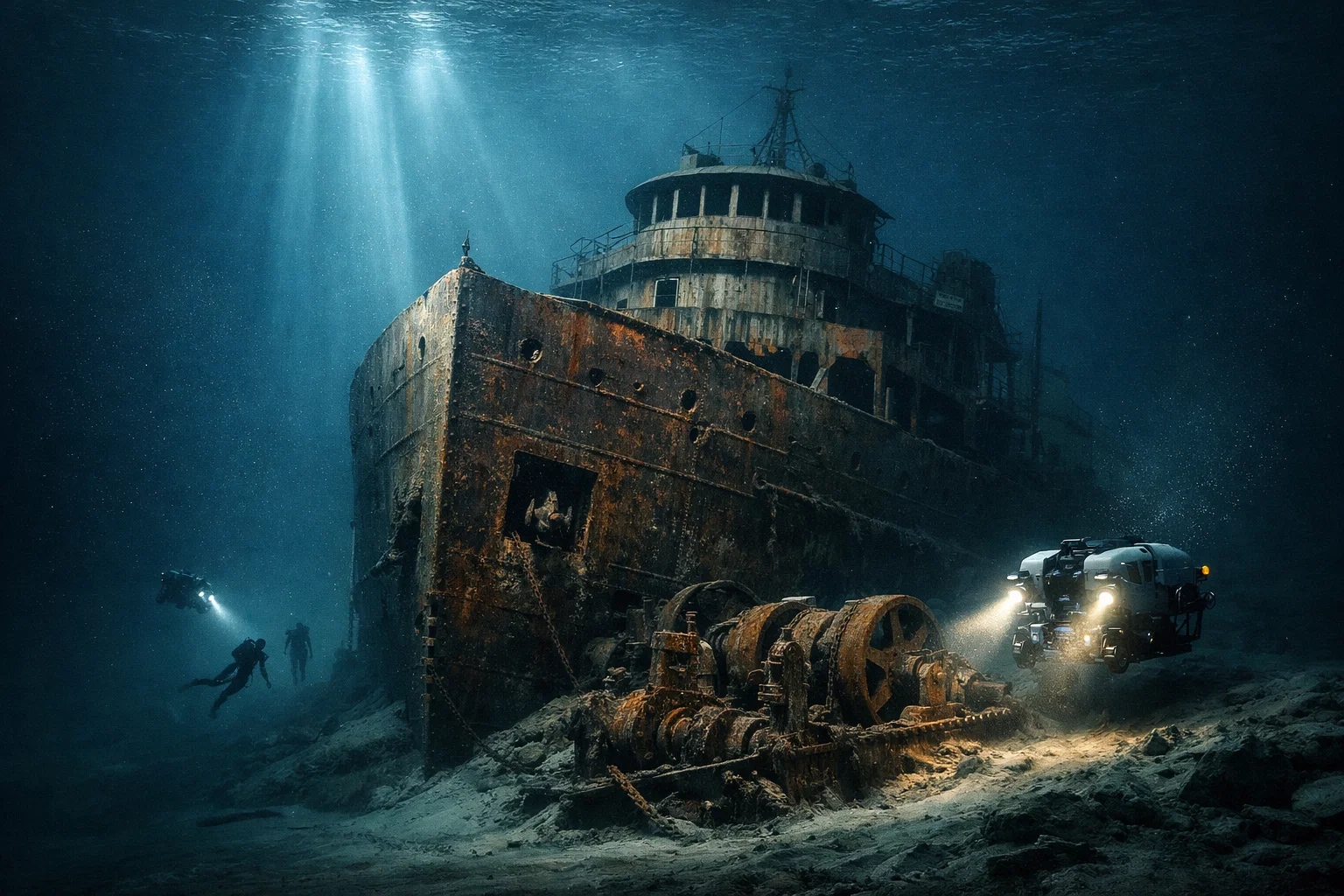


Cargo Ship From 1867 Identified After 156 Years by National Museum of the Great Lakes and Specialized Divers: Finding Exposes the Behind-the-Scenes of Interrupted Operation and Reignites the Debate About One of the Most Strategic Trade Routes in North America
A cargo ship from the United States, with more than a century and a half of history, has reemerged from the depths of Lake Erie. And it is not just any vessel forgotten in time. It is the Clough, a three-masted freighter built in 1867, which operated for only one year before disappearing into the waters in September 1868. Now, its official location has been confirmed by specialized teams.
Behind the discovery lies more than archaeology. There is technology, human risk, and a delicate chapter that still resonates among divers and researchers in the maritime sector.
The Industrial Enigma That Remained Submerged for 156 Years in the Heart of One of the Most Strategic Trade Routes in North America
The Great Lakes have always been industrial arteries of the United States. Iron, coal, stone, and grain crossed these waters, powering entire cities.
-
Engineers spend a decade building a $2.3 million bridge, but the project features a surreal curve, becomes a joke, and ends with seven suspended.

-
7-year-old boy acts without hesitation and saves his 1-year-old brother from drowning in the family pool in Texas: the boy’s courage impressed the sheriff and he may now receive an official police commendation.

-
The forgotten Atari stock that seemed like something out of a movie: millions of sealed cartridges were buried underground and were sold for very low prices.

-
Collector adapts forklift electric motor in a Kombi Corujinha pickup, hides 16 batteries under the bed, and makes the Brazilian classic run silently with up to 90 km of range.



The Clough was part of this machinery. At 38.1 meters, roughly equivalent to a twelve-story building lying flat, the vessel transported stone at a time when American infrastructure was advancing at a rapid pace.
Built in 1867, the ship sank on September 15, 1868. Since then, it has become just another invisible point on the region’s underwater map.
For decades, estimates suggest that hundreds of vessels remain scattered across the lakes. Each new identification reignites economic and scientific interest in this naval cemetery.
The Underwater Operation That United Museum and Explorers and Ended Marked by an Irreparable Loss
The confirmation of the Clough’s identity was announced by the National Museum of the Great Lakes in partnership with the group Cleveland Underwater Explorers, known as CLUE.
The project also had a personal weight. The founder of CLUE, David VanZandt, died in 2024 during a dive related to the identification of the vessel. According to reports released to the local press, he suffered a medical issue while submerged.
The tragedy exposed a point little discussed outside the sector: underwater archaeology requires extreme technical preparation, rigorous protocols, and faces real risks even for experienced professionals.
This episode adds a human layer to a discovery that could have been merely historical. Now it also carries a legacy.
The Secret Behind the Identification of a 19th Century Ship in Deep Waters
Finding does not mean identifying. The work involves cross-referencing historical records, structural dimensions, and detailed analysis of the hull configuration.
In the case of the Clough, specialists analyzed the typical construction pattern of the period, the size compatible with the records from 1867, and features related to stone transport.
According to experts, the comparison between historical archives and direct underwater observation is what allows for transforming an anonymous hull into a name recorded in history.
This process shows how 19th-century naval engineering still serves as a technical reference for current researchers.
Another Giant From the Past Reappears in Lake Michigan and Reinforces a Silent Dispute Among Great Lakes Explorers in the United States
Days before the announcement in Lake Erie, another finding made headlines.
In Lake Michigan, near Racine, the location of the passenger steamer Lac La Belle was confirmed, which sank in 1872 after a storm.
The discovery was attributed to explorers Paul Ehorn and Bruce Bittner, with support from divers recruited to collect evidence.
The sequence of findings ignites a silent rivalry among specialized teams. Each group seeks to map and document vessels before others do.
There is no official number released about how many ships are still awaiting identification, but the region is considered one of the largest underwater archives of naval engineering in the world.
Why These Shipwrecks Matter Beyond History and the Direct Impact on the Maritime Industry and Technical Tourism
It is not just about historical curiosity.
Each identified vessel strengthens specialized tourism, attracts investments for museums, and expands studies on ancient construction techniques.
In addition, detailed mapping contributes to modern nautical safety, avoiding interference with submerged structures.
The Lake Erie and Lake Michigan make it clear that the industrial past continues to influence the economic present.
The discovery of the Clough draws attention because it combines three powerful factors: historical heritage, recent human risk, and the impressive size of a freighter that remained hidden for 156 years. It is not just a ship found. It is a chapter of American engineering that has resurfaced.
And you, do you believe there are still giant vessels waiting to be revealed in the Great Lakes? Leave your opinion in the comments.