





 Portuguese
  English
  Spanish
  4 min of reading
  0 comments


6,000-Year-Old Ancient Cylinders Found in Mesopotamia Show the Birth of Writing and Offer New Perspectives on History
Researchers from the University of Bologna have announced a discovery in ancient Mesopotamia that may bridge the gap between ancient symbolism and the emergence of writing.
The study explores ancient cylinders about 6,000 years old, used to seal accounting documents, and proposes that these symbols played a crucial role in the creation of “proto-cuneiform writing” in Uruk, an ancient city located in present-day Iraq.
The Origin of Seals and the First Writing
The central question that motivated the research was: Did ancient seals influence the creation of signs in the region’s first writing? The authors of the study argued that, despite the connection between these people and the development of writing being long considered, a detailed analysis of specific images is still underexplored.
-
With 1 trillion yuan in investments, China is creating from scratch a “city of the future” almost the size of London to relieve Beijing and transform the project into part of the legacy of supreme leader Xi Jinping.

-
A love letter written 540 years ago reappears thanks to artificial intelligence and reveals a surprising story of passion, family conflicts, a dowry dispute, and difficult choices that challenged the rules of medieval England.

-
Archaeologists discover network of millennia-old tunnels under mountains revealing advanced engineering of a lost civilization
-
Meet Jack, the baboon who started by pushing a railwayman’s wheelchair, became an official station employee, guided trains for 9 years without making mistakes, and became one of the most moving stories ever seen on the tracks.





According to the study, one of the world’s earliest writing systems may have been shaped by these prehistoric images.
The cylinders, which served to mark official transactions, were used to record administrative information in northern Mesopotamia, particularly from the late seventh millennium BC.
In addition to serving a practical function, the seals facilitated the circulation of goods and cultural thoughts, connecting different regions. However, proto-cuneiform, the writing system in question, arose exclusively in southern Iraq.
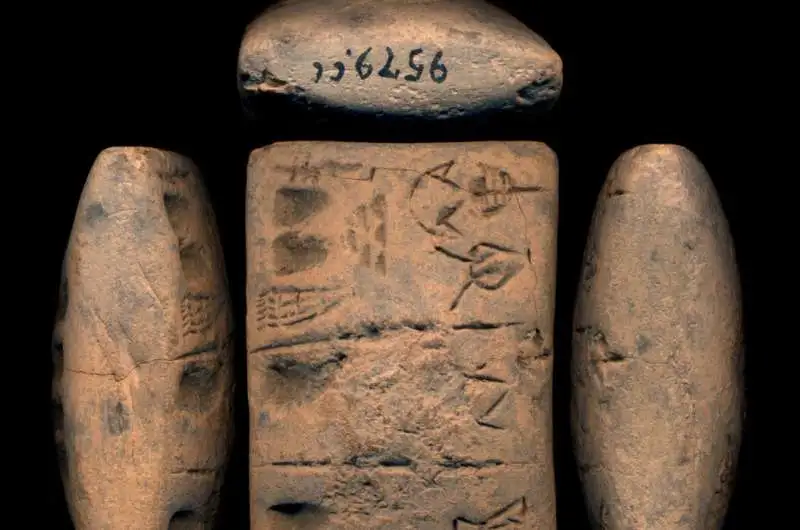
Cuneiform Digital Library Initiative
Uruk: Cultural and Economic Center
Uruk, one of the earliest cities in Mesopotamia, flourished as an influential center during the fourth millennium BC and exerted its dominance throughout the region, from southwestern Iran to southeastern Turkey.
During this period, the use of cylinder seals to authenticate transactions gained significance in the administration of products such as textiles and grains. These accounting practices were directly linked to the emergence of proto-cuneiform, a writing system with hundreds of pictographic signs.
Comparison Between Seal Designs and Proto-Cuneiform Signs
Kathryn Kelley and Mattia Cartolano, researchers at the University of Bologna, conducted a comparative analysis between images of the seals and proto-cuneiform signs. “We focused on ancient seals created before the development of writing.
Our analysis spans from older images to those from the proto-literate period,” the authors state.
The methodology allowed for the identification of a series of specific designs representing fabrics and ceramics, which evolved to become proto-cuneiform signs. “We observed a direct connection between these ancient designs and the development of proto-cuneiform writing in southern Iraq.
These symbols retained their original meanings, now incorporated into the writing system,” Kelley and Cartolano conclude.
Controversies and Perspectives on the Study
Despite the study offering an innovative perspective, it is met with skepticism. The publication Live Science highlighted that other specialists questioned this direct link, with some stating that this idea had been dismissed by archaeology three decades ago.
The controversy largely stems from the fact that other theories about the origin of writing suggest that the practical need for accounting, rather than symbolism, was the initial driving force behind the development of writing.
The Relevance of Seals for Written Communication
Regardless of the disagreements, the research raises important questions about the evolution of human communication. The study suggests that pre-literate seals, in addition to serving a practical function, also carried a symbolism that transcended generations, shaping the onset of writing.
The significance of these designs emerged over the millennia, eventually integrating into a more advanced communication system.
The University of Bologna asserts that this is the first time a direct link between seals and proto-cuneiform writing has been established based on solid foundations.
This idea challenges the notion that writing emerged solely as a response to administrative needs. Instead, the study proposes that the symbolism already present in pre-literate society may have influenced the creation of the first written signs.
Implications for the Future of Archaeology
The debate surrounding this study illustrates how archaeology is in constant transformation, with new findings and theories reevaluating concepts once considered definitive.
By connecting prehistoric people to the emergence of writing, this research not only enriches our understanding of the evolution of communication but also raises new questions about the origins of human thought and its expressions.
Ultimately, the analysis of seals may offer a window into the past, revealing aspects of the economic and cultural relationships between ancient civilizations.
Understanding the transition from symbolism to writing allows for a deeper insight into how humans developed a written language to record and share knowledge, laying the foundations of history as we know it.







Be the first to react!