





 Portuguese
  English
  Spanish
  4 min of reading
  0 comments


Middle Empire Tomb In Ancient Egypt Houses Precious Jewels And Offers A Rare Glimpse Into Several Generations Of The Same Family
Recently, archaeologists discovered a 3,800-year-old tomb in the Luxor region of Egypt. The discovery surprised the scientific community, as the tomb housed the remains of eleven individuals, possibly belonging to the same family lineage of Ancient Egypt.
This discovery brings new knowledge about the funerary rituals of Ancient Egypt, as well as highlighting the prosperity and unification of the Middle Empire, one of the most important periods in Egyptian history.
The Context Of The Discovery Of Ancient Egypt
A team of archaeologists is working in the South Asasif necropolis, near Luxor, one of the world’s richest sites of destroyed remnants. In this location, the remains of five women, two men, three children, and one unidentified individual were found.
-
Elderly celebrate tourism benefit in 2026; program that already excites thousands promises to offer trips at reduced prices, popular destinations, special slots, and little-known advantages for those who want to travel for less in Spain.

-
Mining advancement puts the forest of giant trees in Brazil on alert, with clandestine airstrips, mercury, and excavators 1.5 km from the red angelins up to 88.5 meters in the Amazon.

-
A forgotten wooden bridge on a highway in Rio, marked by compromised planks and visible fragility, has become a symbol of neglect for residents who need to pass through the area to maintain their routine.

-
In Brazil, a condominium threatens to fine a resident who puts a Brazilian flag on the balcony during the World Cup and election year.




The analysis by the funeral investigators indicates that the burials took place during the 12th and 13th dynasties, around 1981 to 1640 BC.
The deceased were originally wrapped in linen and placed in wooden coffins, a typical attire of the time. However, a flood occurring after the burials inflicted significant damage to the remains, hindering the archaeologists’ work in fully identifying the bodies.
The Middle Empire Period
The discovered tomb dates back to the period known as the Middle Empire (around 2030 to 1640 BC), a time when Egypt was unified, allowing advancements in various areas such as arts, architecture, and religion.
This unification brought great prosperity to the Egyptian people, enabling the development of more sophisticated religious and funerary practices.
This is the first Middle Empire tomb found in the South Asasif region, which makes the discovery even more significant.
Funerary Artifacts: Jewels And Copper Objects
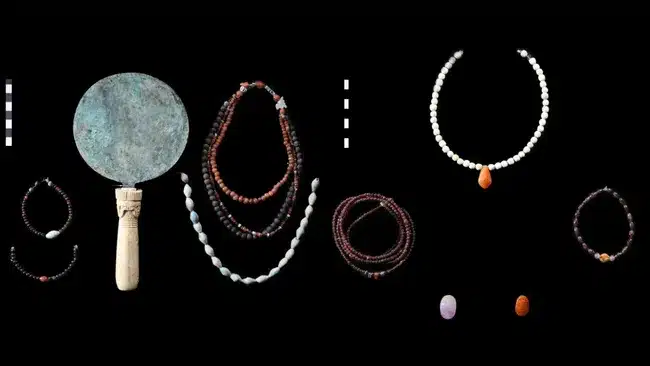
Among the artifacts found, archaeologists highlight pieces of jewelry such as necklaces, bracelets, bangles, and scarab rings. These adornments hold important symbolic value, as in Egyptian culture, jewelry carried religious and protective significance for the dead.
Additionally, two of the burials contained mirrors made of a copper alloy with ivory handles, objects of great value at the time. One of the handles depicts Hathor, a goddess associated with fertility and love, indicating the strong belief in the afterlife and the protective power of the deities.
The “Ba” Amulet And The Spiritual Meaning
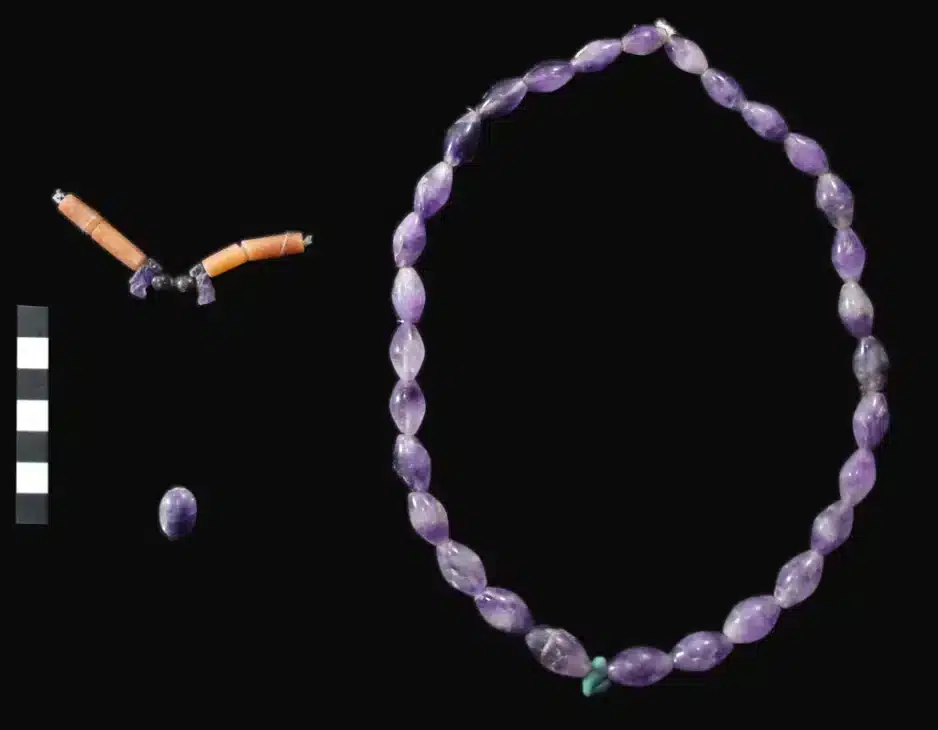
One of the most intriguing artifacts is a necklace with amethyst beads and a “Ba” amulet in the center. In ancient Egypt, the “Ba” was considered an essential part of a person’s soul, often represented in the form of a bird.
This amulet was used to ensure that the spirit could travel between the world of the living and the dead, a central concept in Egyptian spirituality.
The Fertility Figurine
Another highlight of the discovery was a fertility figurine made of green-blue faience. The figurine has truncated legs adorned with jewelry and diamond-shaped markings. The head of the piece has openings, where beads were likely inserted to represent hair.
Although the “hair” has been lost over time, archaeologists found nearly four thousand clay remains nearby the figurine.
This figurine represents a symbol of fertility, suggesting that the Egyptians believed the dead first needed the protection of such amulets for a full life in the afterlife.
Jewelry and symbols of fertility were common in Egyptian burials, demonstrating the importance of preserving lineage and the continuity of life after death.
The Importance Of Amethyst
Wolfram Grajetzki, an Egyptologist and researcher at University College London, explained that the use of amethyst was a hallmark of personal adornments in the Middle Empire.
He noted that this precious stone was highly valued at the time, as it was considered a source of power and spiritual protection.
Luxor, which in ancient times was known as Thebes, was a culturally and religiously significant center. However, Grajetzki highlighted that many of the Middle Empire tombs in the region were destroyed in later periods, especially during the New Empire when Thebes became the capital of Egypt.
Therefore, the discovery of this tomb is special as it brings valuable information about a period that is often obscured by destructions and remodelings that occurred in the following centuries.
The Cultural Legacy Of The Middle Empire In Ancient Egypt
This discovery reinforces the importance of the Middle Empire for understanding Ancient Egypt. The period is known for its political and economic stability, which allowed the development of sophisticated artistic and religious practices.
The jewelry, amulets, and figurines found in the tomb reveal a glimpse into the daily life and beliefs of the Egyptians at that time, as well as highlighting the respect and care dedicated to the dead.
The artifacts found are also essential for understanding the evolution of funerary practices. The presence of objects related to protection and fertility reinforces the Egyptian belief in the continuity of life and the power of the gods to ensure the prosperity of the deceased in the afterlife.
The discovery of the tomb in Luxor represents an important step for archaeology and for understanding ancient Egyptian culture. The study of the funerary artifacts found offers a new perspective on the life and spirituality of the Egyptians during the Middle Empire, a period of great historical relevance.





Be the first to react!