






 Portuguese
  Spanish


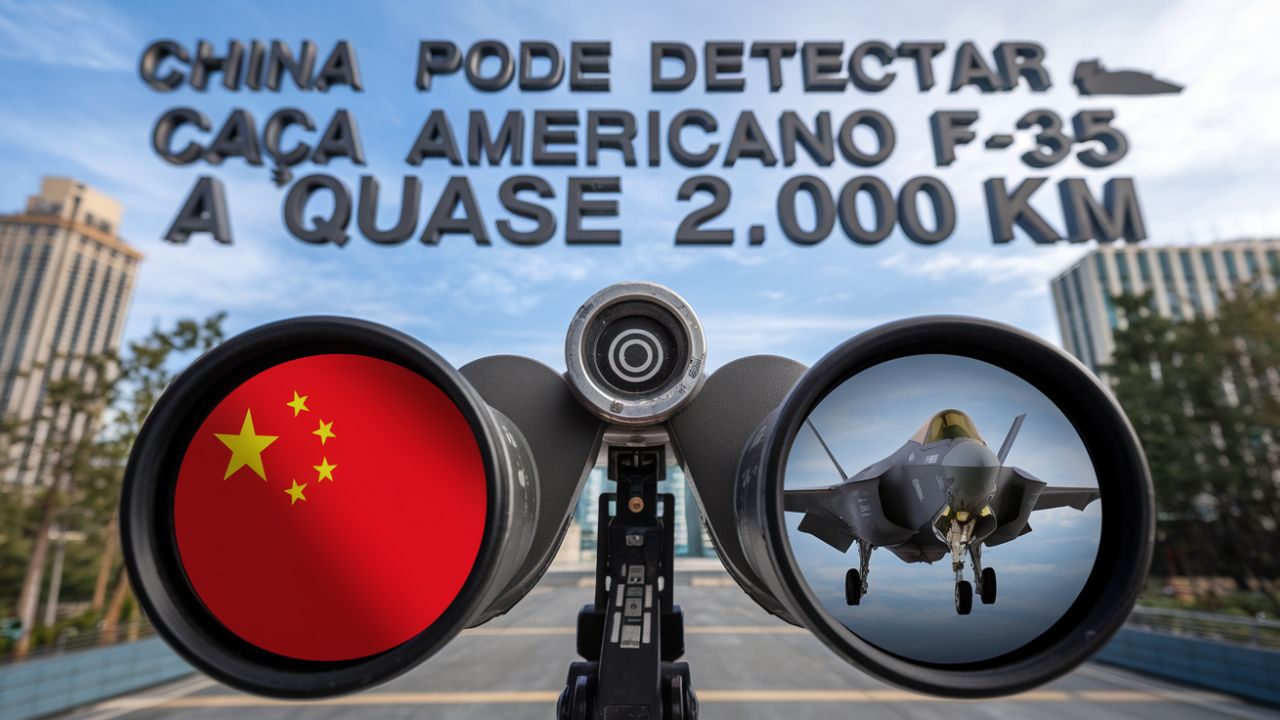


Study Reveals That China’s Stratospheric Airship, Equipped With Advanced Infrared Sensors, Can Detect The F-35’s Thermal Signature At Nearly 2,000 Km, Compromising US Stealth Technology And Changing The Military Balance In The Pacific.
In the skies, war has always been a game of hide and seek. The United States heavily bets on the stealth of the F-35 to avoid detection, but China may have found a loophole. A new study suggests that a stratospheric airship from China can identify this fifth-generation fighter from nearly 2,000 km away. But how is this possible? And what are the implications for the military balance in the Pacific?
A New Threat To F-35 Stealth?
Stealth technology was designed to make aircraft “invisible” to radar, reducing their electromagnetic signature. The F-35, one of the most advanced fighters in the world, uses a special coating that absorbs radar waves, making it extremely difficult to detect. But there is a problem: this stealth works well against radars, but not against infrared sensors.
This is where the new study from Chinese scientists comes in. They analyzed the thermal signature of the F-35 and discovered a weak point: the engine exhaust. While the aircraft’s fuselage can stay cool, the heat output from the engine reaches nearly 1,000 Kelvin (about 727°C), emitting intense infrared radiation. This creates a thermal “trail” visible to advanced sensors.
-
Queen Guitarist Brian May Collaborates with ESA Scientists to Study Asteroids Bennu and Ryugu Using 3D Simulations

-
Largest Known Single-Piece Meteorite, Weighing 60 Tons, Puzzles Scientists with Its Intact Fall and Lack of Visible Crater

-
Oceanographer Turns Abandoned Fishing Nets from Brazilian Waters into Bags, Creating Jobs and Earning Over $7,000 Monthly

-
Australia deploys poisoned sausages and uses traps, shooting, and fences in a battle against invasive cats that kill over 1.5 billion native animals annually, threatening more than 200 species.




China’s Stratospheric Airship And Its Detection Technology
The study was conducted by the Changchun Institute of Optics, Fine Mechanics and Physics (CIOMP), which plays a key role in China’s missile and space programs. Researchers found that by positioning an airship at 20 km altitude, equipped with advanced infrared sensors, it would be possible to track the F-35’s thermal signature at impressive distances.
Detectors use materials like mercury-cadmium-telluride, which are extremely sensitive to infrared radiation. The sensors operate in the wavelength range of 2.8 to 4.3 micrometers, where there is less atmospheric interference, ensuring accurate thermal signal capture.
How The Airship Detects The F-35 At 2,000 Km Away?
The key to this detection lies in the thermal contrast. The F-35 can evade radars, but its heat exhaust continues to shine like a beacon to infrared sensors. The Chinese airship, by operating at high altitudes, has a privileged view of the battlefield, capable of capturing the fighter’s heat from different angles.
- From behind or the side: detection occurs at 1,800 to 2,000 km due to the intense heat from the exhaust.
- From the front: detection drops to 350 km, as the F-35’s frontal thermal profile is lower.
This approach could neutralize part of the advantage of stealth technology from the United States, making fighters like the F-35 more vulnerable to Chinese air defense systems.


