Portuguese
  Spanish


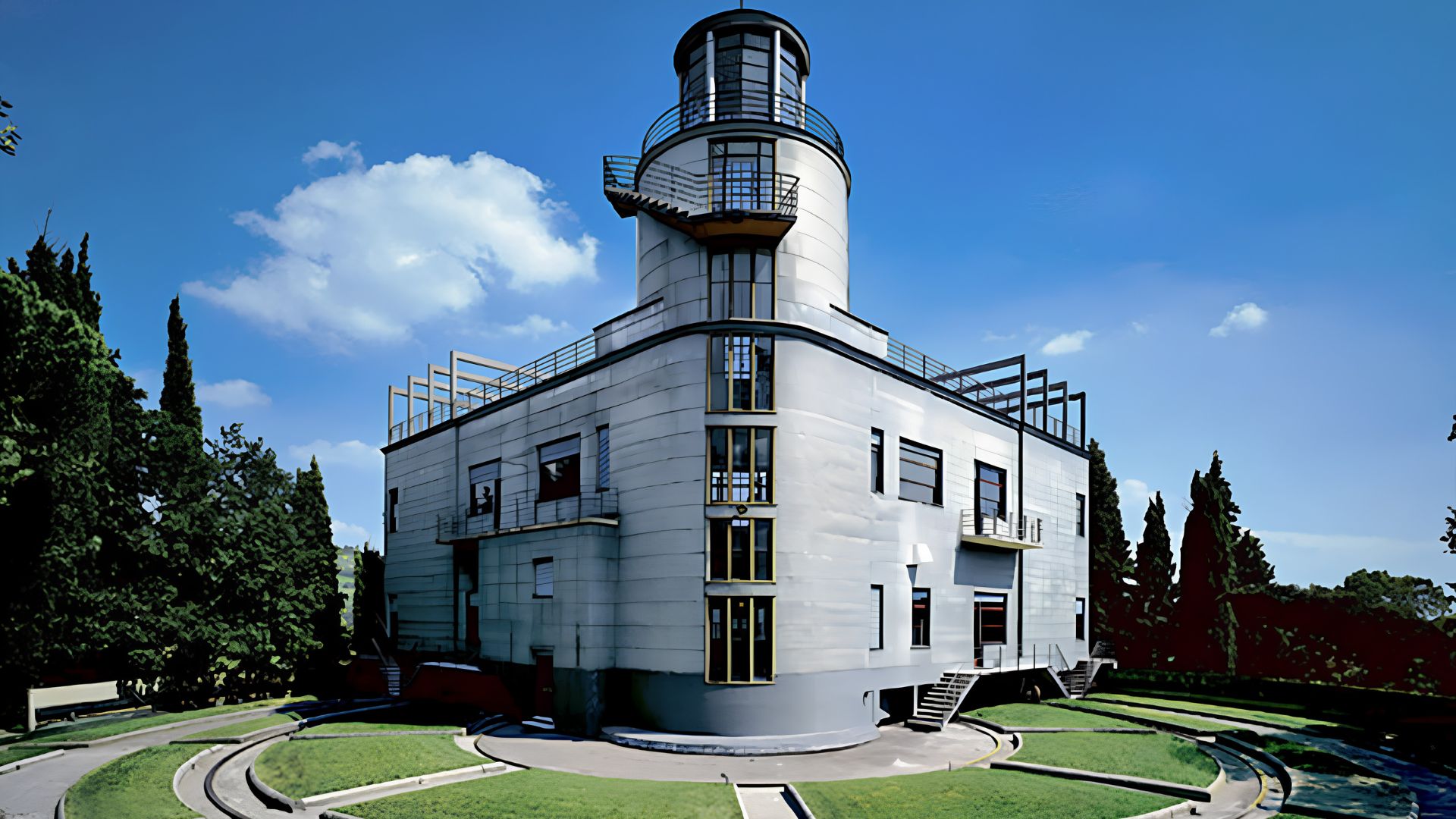

Villa Girasole is an Italian mansion from the 1930s that rotates on tracks to follow the Sun with 1,500 tons in motion.
Built in 1935, in Marcellise, near Verona, Italy, the Villa Girasole is one of the most improbable houses of the 20th century: an entire mansion designed to slowly rotate and follow the path of the Sun. Created by engineer Angelo Invernizzi, with participation from , the residence transforms architecture into a machine, using tracks, motors, and a central tower as the axis of rotation.
The name “Girasole” means sunflower in Italian, and it was not chosen by chance. The house was designed to change position throughout the day, seeking natural light, warmth, and view, as if it were a living structure driven by mechanical engineering.
Villa Girasole was born as a mansion-machine before smart architecture existed
Villa Girasole was created at a time when automated houses, movable facades, and solar sensors were still far from reality. Even so, Invernizzi decided to do something more radical than installing well-positioned windows: he set the house itself in motion.
-
U.S. City Builds Tiny Home Village on Water Company Land to House 136 Homeless People: Inside the Social Housing Units

-
Woman Turns Shipping Container into Home, Embraces Rural Life to Cut Monthly Expenses to Just Over $330
-
France Revamps 530 Social Housing Units with Large Balconies and Glass Facades Without Demolishing Existing Buildings

-
Facing high rent, couple transforms parents’ garage into a fully functional apartment, creating a complete home at a fraction of the market cost.




The residence has two floors and an “L” shaped plan, supported on a circular base with more than 44 meters in diameter. At the center is a tower about 42 meters high, an element that functions as a visual reference and as an essential part of the rotation system.

The most surprising fact lies in the mobile structure. According to records gathered by Iconic Houses and Hidden Architecture, the rotating volume has about 5,000 m³ and weighs approximately 1,500 tons, mass that slides over three circular tracks.
To support this movement, the house uses 15 metal trolleys, described as small bearing sets that allow the displacement of the upper structure. In practice, an entire mansion behaves like a huge circular wagon, moving slowly over a fixed base.
The complete rotation takes 9 hours and 20 minutes at an almost imperceptible speed
Villa Girasole does not rotate quickly, and that is precisely the secret of the project. The recorded speed is about 4 millimeters per second, slow enough to follow the sunlight without causing discomfort to the occupants.
A complete turn takes approximately 9 hours and 20 minutes. This means that the house was designed to move during the useful period of the day, changing the orientation of the rooms as the Sun changes position in the sky.
Two diesel engines powered a solution that seemed like science fiction in the 1930s
The movement was carried out by engines, in a system that anticipated current discussions on responsive architecture and solar efficiency. Hidden Architecture reports that the energy came from two diesel engines, responsible for moving the house along the tracks.
The most impressive thing is the technological contrast. Today, solar systems use sensors, software, and automated panels; Villa Girasole did something much more physical, moving the entire body of the residence to seek the best position in relation to the Sun.

The rotation was not just a mechanical trick. By changing orientation, the house altered the light entry, the heating of the rooms, and the visual relationship with the Marcellise landscape, creating a residential experience impossible in a common house.
The “L” shape reinforced this effect because different parts of the residence received light and shadow at different times. The view from the window was not fixed: it changed slowly along with the house itself, turning the landscape into part of the architectural mechanism.
Villa Girasole mixed rationalism, futurism, and railway engineering
The appearance of the house also draws attention. The central tower resembles a lighthouse, while the horizontal volumes and balconies evoke ships and the modern aesthetic of the interwar period, something highlighted by publications specialized in architecture.
The mechanical solution has a strong connection with railway engineering, especially through the use of tracks and carts to move a massive weight. It was not just a house inspired by machines; it was a full-scale habitable machine.

Villa Girasole continues to impress because it mechanically solves a problem that today would be addressed with digital automation. Instead of moving just panels, curtains, or brises, Invernizzi moved the entire residence.
Almost nine decades later, the mansion is still cited as one of the rarest expressions of kinetic architecture. Iconic Houses even classified it as an icon at risk, emphasizing the importance of preserving not only the building but also the mechanical system that gives meaning to the project.
The Italian mansion that transformed luxury into solar engineering
Villa Girasole impresses not only by its size or age. What makes the house extraordinary is the combination of 1,500 tons in motion, three circular tracks, 15 metal carts, complete rotation in 9 hours and 20 minutes, and a simple idea taken to the extreme: making a house follow the Sun.
In a world accustomed to calling any home automation “smart,” Villa Girasole still seems provocative. After all, in the 1930s, an Italian engineer had already built a mansion capable of doing something that many modern houses still do not do: physically change position to better take advantage of daylight.