Portuguese
  Spanish




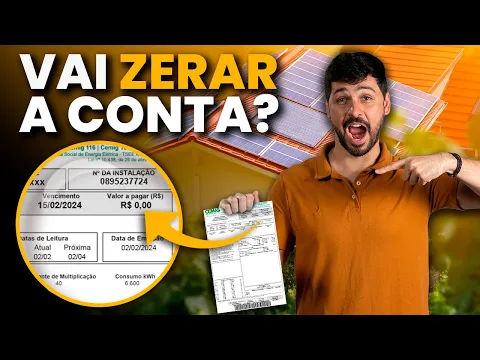
Understand How Free Light for Low Income Benefits Millions, but Can Generate Additional Costs for Solar Panel Owners.
In recent years, solar energy has established itself as a sustainable and cost-effective alternative for millions of Brazilians.
Furthermore, with technological advancements and the reduction in solar panel costs, many families and businesses have started to produce their own energy.
However, recent legislative decisions in Brazil have brought to light a debate that may directly affect those investing in solar energy. The implementation of free light for low income and the risk of increased costs for solar panel owners raise growing concerns in the sector.
-
USP researcher creates thesis to attract international funds for the country’s electric energy sector

-
Trafigura receives authorization from ANEEL to trade electricity in Brazil and expands its operations in the largest energy market in Latin America.
-
Mobile solar panels promised to share space with corn crops, but the 20% to 25% shade reduced production by an average of 7.7% and opened a new dispute between energy and food.
-
More than 80 million kilometers of wires need to be replaced by 2040: the energy transition doesn’t just depend on panels and electric cars, but on a colossal race for copper, aluminum, transformers, and recycling of old cables.


Therefore, experts warn that the accelerated expansion of the sector requires clear regulation to avoid imbalances. Additionally, it ensures legal security for all consumers and investors.
On September 17, 2025, the National Congress approved provisional measure 1,300/2025, ensuring that low-income families have free access to electricity.
Consequently, the measure benefits consumers who receive up to half a minimum wage per person and consume up to 80 kWh per month. About 60 million Brazilians will be reached.
Thus, this historic advancement reinforces the State’s effort to guarantee basic citizenship rights, such as access to electricity.
Despite this, the legislative text did not completely eliminate a regulatory impasse that creates insecurity for solar energy consumers.
The central point of the discussion involved paragraph 10 of article 3 of Law 9,427/1996. It granted the National Electric Energy Agency (Aneel) the power to create mandatory tariff modalities, including fixed tariffs in addition to those proportional to consumption.
Therefore, in a political consensus, this part was removed from MP 1,300. It was transferred to MP 1,304, which Congress will analyze in the future, with a deadline until November 7.
The Historical Importance of Free Light for Low Income
The measure of free light for low income represents a significant social advancement. It reduces inequality in access to electricity, an essential service for homes, schools, and small businesses.
Moreover, historically, energy subsidy policies have ensured that vulnerable populations are not penalized by rising energy costs.
In Brazil, similar programs already existed, such as the social electricity tariff, which provided discounts to low-income families.
However, MP 1,300 goes further, offering free access at a defined consumption level.
Thus, the measure reinforces the idea that access to electricity should be considered a social right.
However, consumers with solar panels express concerns about the maintenance of the attractiveness of their investments.
Absolar, the association of the photovoltaic solar energy sector, warns that the section transferred to MP 1,304 could generate unpredictable binomial tariffs, creating uncertainty about costs and financial returns.
Additionally, Bárbara Rubim, vice president of distributed generation at Absolar, explains that “imposing tariff modalities without consumer consent creates unbalanced and more burdensome structures, directly harming users”.
Consequently, regulatory instability may affect decisions about which supply modality to adopt. It impacts the financial planning of families and businesses investing in clean energy.
Solar Energy in Brazil: Evolution and Incentives
The historical context of solar energy in Brazil shows that the distributed generation policy, approved about three years ago, marked the beginning of the sector’s expansion.
Prior to this, solar energy production was concentrated in large companies and households with greater purchasing power.
Furthermore, incentive policies, such as facilitated financing and access to energy compensation on the grid, have allowed more Brazilians to invest in solar panels.
At the same time, the reduction in equipment costs has opened the door for the creation of a growing market, which generated direct and indirect jobs and boosted the local economy.
With the approval of MP 1,300, the country ensures that vulnerable families have the right to free light for low income.
However, the debate over tariffs for solar energy consumers highlights the need for balance between social policy and incentive for renewable energy.
Furthermore, the lack of clarity regarding tariffs may create insecurity for investors and consumers who have already installed photovoltaic systems. It affects expansion plans and expected financial returns.
Therefore, the lack of regulatory clarity threatens to discourage new installations of solar panels, harming the country’s decarbonization target.
Economic and Environmental Impacts
MP 1,300 divides into two paths: immediate free energy for millions of Brazilians and the future analysis of MP 1,304, which will define tariff rules for those who produce their own energy.
Thus, the separation allowed the rapid approval of the social benefit, but left pending a complex debate about cost balance and incentives.
Furthermore, experts claim that tariff modernization policies must occur transparently and through dialogue, without retroactive effects that harm investors.
Thus, ensuring regulatory security helps solar energy consumers contribute to a clean energy matrix without facing unexpected increases.
On the other hand, the discussion also involves environmental aspects. The expansion of solar energy reduces dependence on fossil fuels.
Moreover, it helps the country meet international goals for reducing greenhouse gas emissions.
If unpredictable tariffs discourage the adoption of solar panels, Brazil may delay the energy transition, hindering the achievement of strategic climate goals.
Furthermore, continuous investment in renewable energy is essential to meet the growing energy demand sustainably, especially with population and economic growth in the coming decades.
Challenges and Perspectives for the Future
The approval of MP 1,300 brought a significant social benefit: the guarantee of free light for low income.
However, it highlighted the need for dialogue and planning for solar energy consumers, avoiding that investments become burdensome or risky.
Therefore, the Brazilian challenge is to find a path that combines social justice and sustainable economic growth. Policies like MP 1,300 represent important advancements, but require clear regulations so as not to compromise the renewable energy sector.
Thus, ensuring free access to electricity for vulnerable families and maintaining the attractiveness of solar energy are essential steps to building a cleaner and safer energy future.
Moreover, the debate over free light and tariffs for solar panels reinforces that energy policies must balance social, economic, and environmental interests.
Free light for low income protects the most vulnerable and strengthens the role of the State in promoting basic rights. At the same time, clear regulation ensures that the transition to clean energy is efficient and attractive for all Brazilians.