






 Portuguese
  Spanish


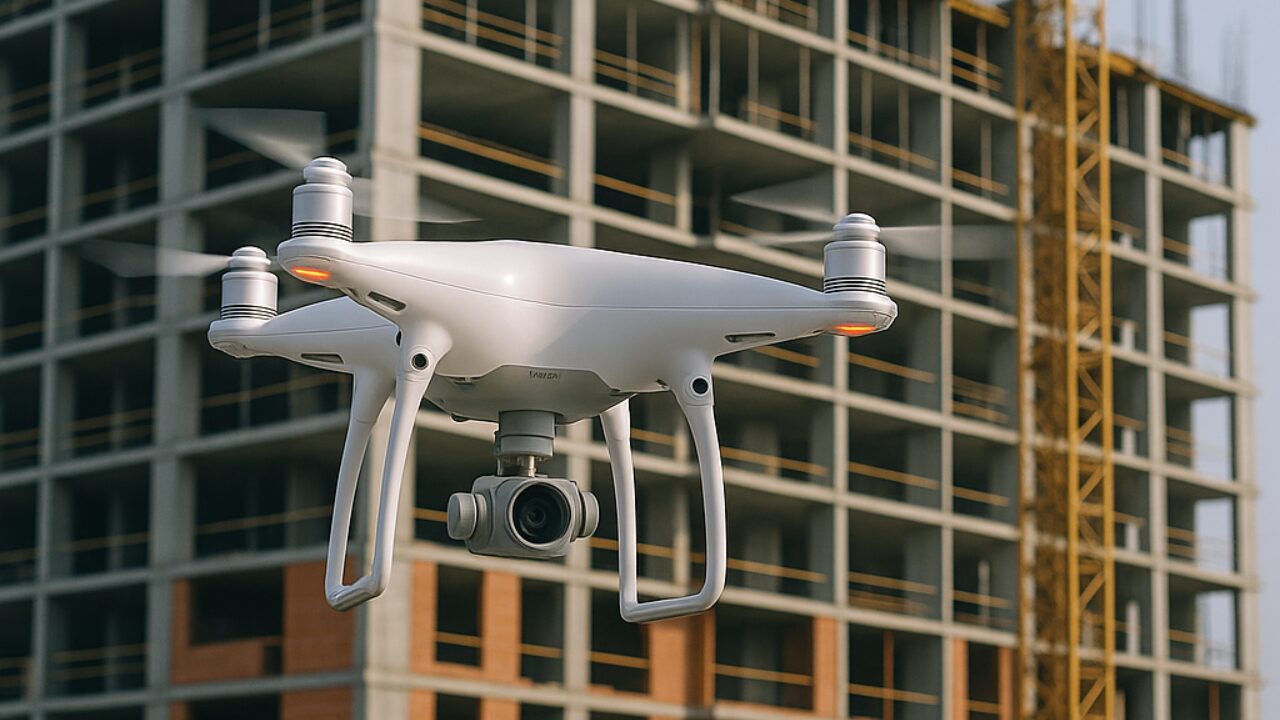

British Researchers Test Technology That Promises to Revolutionize the Construction Industry With the Use of Drones at Great Heights, Enabling Construction in Extreme Places and With Greater Safety.
The construction industry is on the verge of a true transformation with the introduction of drones in large-scale construction. Researchers from Imperial College London and University of Bristol are at the forefront of developing an innovative technology that could allow tall buildings — like the iconic Burj Khalifa in the United Arab Emirates or the Empire State Building in New York — to be erected by “flying robots.” The proposal combines automation and cutting-edge engineering to reach locations that were previously considered inaccessible for traditional methods.
Aerial AM: The Technology Behind the Revolution
The technology being tested is called Aerial Additive Manufacturing (Aerial AM). Through it, drones are capable of positioning construction materials while still in flight, eliminating the need for support structures or fixed construction sites.
This innovation is seen as promising for both high-rise construction and emergency applications, such as quick repairs or building in remote areas.
-
$134.7 Million Project in São Paulo Installs Over 5 Kilometers of Pipes, Creates New Underwater Crossing to Boost Water Supply for Over 450,000 People

-
At 61, Former Homeless Wheelchair User Receives Key to Container Home in Brazil, Declares Independence
-
São Paulo Highway to Receive Over $260 Million in Upgrades, Including 90 Kilometers of Service Roads and New Infrastructure, by 2027
-
Couple Transforms Abandoned Seaside Public Restroom Bought for £33,000 into £295,000 Beach House After a Decade of Renovations





The first practical experiments with the technology are being conducted at DroneHub, a testing center linked to scientific laboratories located in Switzerland.
The focus of the tests is to assess the technology’s performance outside controlled environments, with the aim of validating its use in the real world.
Advantages That Go Beyond Heights
In addition to allowing the construction of structures at high altitudes, the use of drones in the construction industry offers a range of benefits. Among the main ones are:
- Reduction of Risks: Since drones perform critical tasks, there is less need for workers to be exposed to dangers at extreme heights.
- Agility and Precision: Construction with drones can be done on demand, with quick and efficient operations.
- Sustainability: The technology reduces material transportation and waste as it operates in a localized manner.
- Versatility: It is possible to operate in complex terrains, such as slopes, rooftops, and disaster-stricken areas, including flooded regions.
Even more ambitiously, Aerial AM technology is seen as a promising step for construction off the planet, in environments like the Moon or Mars.
Repairs and Challenges for Industrial Adoption
The innovation can also be applied to the maintenance of existing structures, such as repairing building façades or bridges, eliminating the need for scaffolding and minimizing risks for workers.

This application represents a significant advancement for the conservation of urban infrastructure and hard-to-reach areas.
Despite its great potential, the technology still faces considerable obstacles before being widely adopted by the construction industry. Among the main challenges are:
- Durability of the Materials Used;
- Precision in Installing Structural Components;
- Coordination Among Multiple Drones;
- Limitations in Location and Navigation Systems.
Scientist Basaran Bahadir Kocer, involved in the project, warns:
“Understanding these challenges is essential to unlock the full potential of Aerial AM in real-world applications. However, demonstrations point to the capability of performing on-demand repairs, paving the way for greater adoption in industries.”
The Future of Construction Is Already in the Air
The advancement of automation with drones signals a profound change in how buildings and structures will be erected in the coming years. Although the industrial use of the technology still requires maturation, the path is being paved for an era in which construction will be safer.


