Portuguese
  Spanish


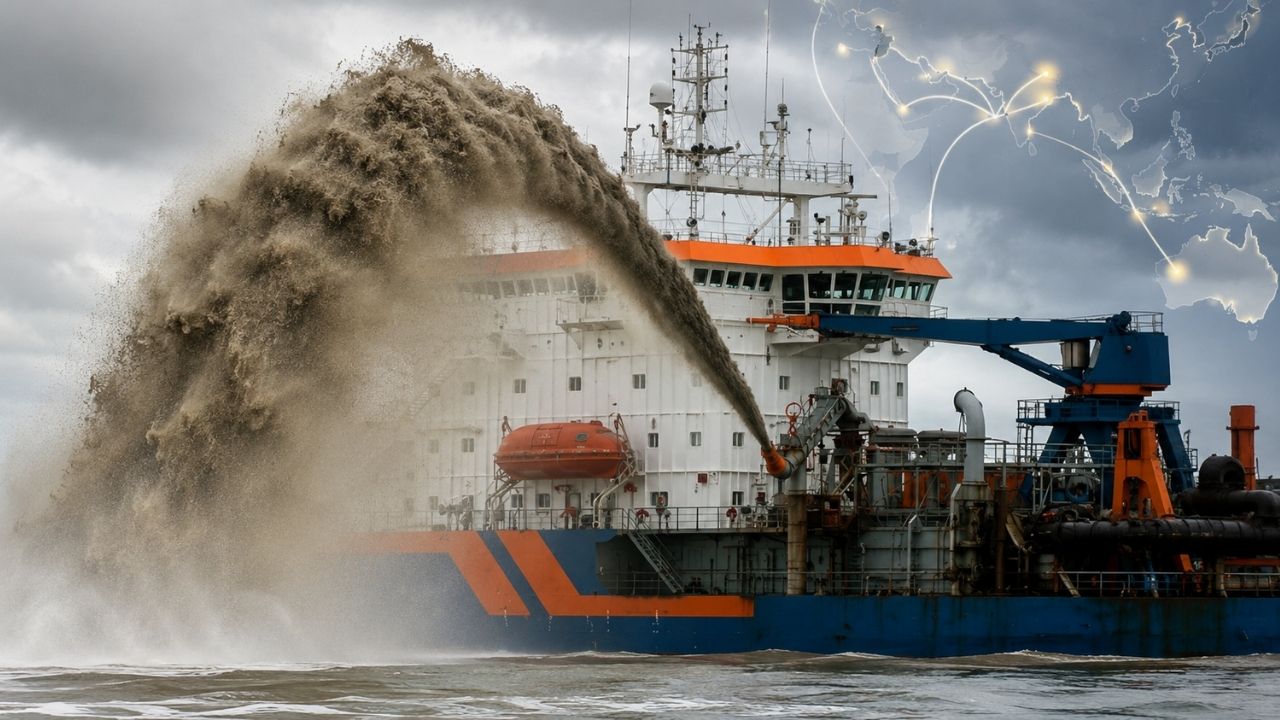

Boskalis Australia project foresees a 100% maritime operation in Cambridge Gulf, in northeastern Western Australia, with a vessel up to 350 meters long to extract sand from the seabed and export the material for construction in Asia.
Seabed sand has become the focus of a billion-dollar infrastructure proposal in Australia. Boskalis Australia Pty Limited appears on the federal public portal EPBC with the project Boskalis Cambridge Gulf Marine Sand Sourcing Project, number 2025/10106, located in marine waters in the center of Cambridge Gulf, in northeastern Western Australia. The process was initiated on January 22, 2025, and is currently under final decision review status.
According to EPBC Act Public Portal, an official Australian government portal, the curious twist lies in the operation’s format: instead of opening a port, building onshore structures, or altering the coastline, the proposal envisions an activity 100% vessel-based, with the extraction of up to 70 million m³ of sand over up to 15 years, for export to Asian markets for construction projects.
Boskalis targets marine sand in Cambridge Gulf to supply construction in Asia
Boskalis’ proposal is to develop a marine sand supply operation in Cambridge Gulf, a region near Wyndham, in northeastern Western Australia.
-
The man who started in construction with his own house founded a company in 1957, went through a banking crisis in 1987, and ended up connected to 16,500 houses in Houston.

-
Builders challenged experts, erected a 16-story building using only reinforced concrete when the known limit was six floors, and proved that skyscrapers would never be the same again.
-
Up to 60 concrete mixer trucks pour 380 m³ of concrete onto the “big slab” of Niemeyer’s first work in Amazonas, in a decisive stage of the construction of the monumental oca that will mark the Parque Encontro das Águas in Manaus.

-
Alert in Santa Catarina: the Anita Garibaldi Bridge on BR-101 is completely closed in both directions due to “structural risk,” and drivers are diverted to a 20 km/h detour that promises kilometer-long queues until July 20.





The material, according to the project description, would originate from natural terrestrial sources that reach the gulf via river inlets. The idea is to remove this sand from the seabed and export it to Asian markets, where it would be used in construction projects.
The project still depends on environmental assessment and decision processes. Therefore, it is not an ongoing operation but a proposal under review by Australian authorities.
Even at this stage, the scale is striking. The maximum projected volume of 70 million m³ places the project on the radar of large maritime operations for material supply for infrastructure.
Operation does not foresee coastal works or onshore facilities
One of the strongest points of the proposal is the absence of coastal infrastructure.
According to the EPBC portal, the operation would not involve the construction or operation of onshore facilities, nor alteration of the coastline. The activity would be carried out entirely in a marine environment, using a specialized vessel.
This detail changes the interpretation of the project. Instead of an undertaking with a port, yards, land routes, and beach support structures, the operation would be concentrated at sea.
The proposal envisions the vessel loading sand in Cambridge Gulf, sailing to a delivery port in Asia, and then returning to the gulf to repeat the cycle.
In practice, the project attempts to transform the seabed into a source of construction sand, without creating an operational base on the Australian coast.
Vessel up to 350 meters would be used to load sand at sea

The operation foresees the use of a Sand Production Vessel, or SPV, based on the concept of a large trailing suction hopper dredge.
Although the project is still in the conceptual phase, the indicative specifications cited on the EPBC portal point to a vessel approximately 350 meters long, with a draft of about 19 meters, capacity for 75,000 to 125,000 m³ of sand, and a crew of about 25 people.
This vessel would be responsible for traveling to the operational area, removing the sand layer from the bottom, and transporting the material out of Australia.
The visual scene is one of a heavy operation, but distant from the coast: a giant vessel working on submarine sandbanks, in an area of deep waters and strong currents.
Proposed area covers approximately 100 km² in the center of the gulf
The proposed operational area is located in the central part of the main body of Cambridge Gulf.
According to the project documentation, the region covers approximately 100 km² and has average depths of around 25 meters relative to mean sea level.
The seabed is described as being formed by highly dynamic sand waves, with a constantly moving substrate, strong tidal currents, and high sediment suspension.
These conditions are part of the justification presented in the company’s studies to state that the area would have little significant benthic community, due to the instability of the seabed and the permanent lack of light on the seafloor. This assessment, however, is still undergoing the regulatory process.
Project foresees up to 70 million m³ of sand, but points to a minimum resource of 300 million m³

The strongest number in the proposal is the extraction volume.
Boskalis reports that exploratory surveys indicate at least 300 million m³ of sand in the proposed operational area, with the possibility of several times larger volumes in Cambridge Gulf as a whole.
Within this scenario, the company proposes to export up to 70 million m³, equivalent to a maximum of 23% of the minimum estimated volume in the operational area.
This comparison is used by the proponent to argue that the extraction would be limited to a fraction of the identified resource.
Even so, the absolute volume is enormous and explains why the project gained prominence: it involves transforming submarine sand into raw material for constructions outside Australia.
Vessel would be non-operational in the gulf for 86% of the time
Another unusual data point is the operating frequency.
According to the proposal, the vessel would load sand in Cambridge Gulf for one to two days every two weeks. Afterwards, it would proceed to the delivery port in Asia and return to the gulf to repeat the cycle.
With this model, the vessel would operate in Cambridge Gulf for approximately 52 days per year, equivalent to 14% of the time. For the other 86%, there would be no operational activity in the gulf.
Boskalis also reports that there would be no refueling or waste disposal in Cambridge Gulf.
This operational design attempts to reduce continuous presence at the site, concentrating sand extraction into short loading windows.
Each cycle would remove a layer of about 40 cm from the seabed


The most visual technical aspect is the extraction method.
During each loading cycle, the SPV would work over an area of approximately 0.5 km², using a dredging head about 6 meters wide.
The proposal foresees the removal of a layer of about 40 cm of sand from the seabed during each cycle.
At the end of up to 15 years, should the 70 million m³ be exported, the operational area would be, on average, less than 1 meter deeper than before the project, according to the technical assessment presented in the process documents.
This is the point that makes the proposal different from traditional terrestrial mining. The operation would not open a pit in dry land, but would remove successive layers of sand from a dynamic submarine environment.
Environmental assessment is still a decisive stage for project advancement
The project appears on the EPBC portal with a final decision pending at the federal level. In the state process, the Environmental Protection Authority of Western Australia published a report recommending that the proposal could be implemented, but subject to conditions.
This point is important because the area is located in an environmentally and culturally sensitive region.
The state report mentions, for example, ecological values and areas associated with flatback turtles, as well as recommended conditions to limit volume, duration, extraction area, monitoring, and environmental objectives.
Boskalis’s own documentation states that studies indicate a low probability of significant environmental impacts, but this is an assessment presented within the process and still subject to regulatory review.
Proposal foresees local jobs, royalties, and support for traditional groups
Boskalis also presents economic and social arguments for the project.
According to the summary on the EPBC portal, the operation would generate state royalty payments, voluntary royalties to traditional groups, service contracts, business opportunities, and up to 40 to 50 local jobs, with a priority focus on Traditional Owners.
The portal also reports that the Balanggarra and Miriuwung-Gajerrong groups issued letters of support for the proposed action, included in the process documents.
This point broadens the debate. The proposal involves not only sand extraction but also local income, contracts, participation of traditional communities, and a discussion about the economic use of marine resources.
Sand becomes a strategic input in an economy that continues to build
The interest in marine sand shows how this seemingly common material has become strategic for civil construction.
Sand is used in concrete, landfills, urban works, infrastructure, and city expansion. In regions of strong growth, demand can pressure new sources of supply.
The Cambridge Gulf case draws attention precisely because it links a remote region of Australia to Asian construction markets.
If approved, the project would transform the seabed of a distant and sparsely populated area into part of an international infrastructure chain.
Cambridge Gulf project shows new frontier of marine mining
Boskalis’s proposal in Cambridge Gulf reveals a larger trend: the search for marine resources to meet construction and infrastructure demands on land.
Without foreseeing coastal works and with an operation based on a single vessel, the project tries to present itself as a more concentrated form of extraction. At the same time, the scale of the numbers keeps the debate open.
It involves up to 70 million m³ of sand, an operation of up to 15 years, an area of about 100 km², a vessel up to 350 meters, and a logistical chain connecting Australia to Asian markets.
The advance still depends on environmental and regulatory decisions. But the case already shows how sand, often seen as a simple resource, is becoming a central part of disputes over construction, environment, maritime logistics, and the future of major works.
If sand is essential for building cities, ports, and infrastructure, to what extent does it make sense to seek this resource from the seabed to supply construction in Asia, and at what point does an operation of this size cease to be a logistical solution and become an environmental risk? Share your opinion.