






 Portuguese
  Spanish
  4 min of reading
  0 comments


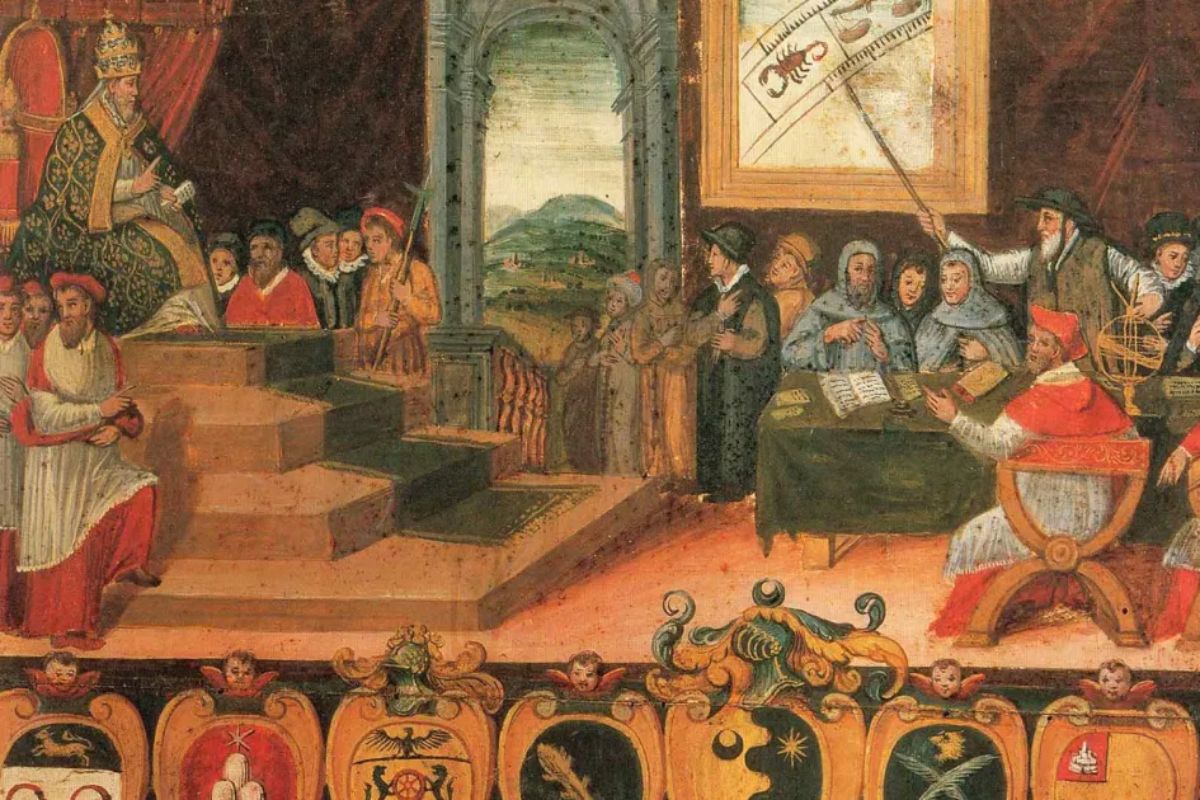
Understand The Controversial Phantom Time Theory Which Claims That 297 Years Of The Middle Ages Never Existed And Why Science And History Prove It Is Wrong.
Have you ever imagined that we are living in the 18th century and not in the 21st? This is the central claim of one of the most fascinating pseudohistories on the internet: the phantom time theory. Proposed in the 1990s, it states that nearly 300 years of our history were simply invented by a conspiracy of powerful leaders. The consequence would be shocking, erasing from existence figures like Emperor Charlemagne.
Although it is an intriguing idea that went viral in online forums, the phantom time theory is completely rejected by historians and scientists. Evidence from astronomy, archaeology, and historical records from civilizations outside Europe categorically refutes the hypothesis. Understand the arguments of this theory and why they do not hold up.
What Is The Phantom Time Theory And Who Created It In 1991?
The phantom time theory was proposed in 1991 by German amateur historian Heribert Illig. His thesis is straightforward: the 297-year period between AD 614 and AD 911 is a hoax. According to him, these years were artificially inserted into our calendar.
-
She panicked when she saw her daughter fall from the crib; years later, she turned the experience into a factory generating R$ 9 million per year.

-
At 75 years old, João José de Carvalho, known as Mr. Janjão, was accepted for the second time by Sisu after overcoming distance, physical limitations, and years away from school, to fulfill his dream of studying Biological Sciences at UFPI.

-
A thrift store that started with children’s clothes and a loan from grandma turned into a network worth R$ 300 million per year: Peça Rara grew to 130 stores, sold 4 million items, and transformed used items into a national circular economy business.

-
The German fund created to compensate victims of Nazi forced labor paid billions, but the responsible parties themselves admit that the money did not come close to compensating 26 million people.




This idea exploits the popular notion that the High Middle Ages were a “Dark Age,” a period of stagnation, which would make the idea of a “gap” in time easier to accept. If the theory were true, monumental historical events and figures that lived during this interval would be, at best, poorly dated or, at worst, pure fabrications.
Why Would Emperor Otto III Have Invented 297 Years Of History?

For a hoax of this magnitude, a conspiracy at the highest level would be necessary. Illig points to the supposed architects: the Holy Roman Emperor Otto III, Pope Sylvester II, and possibly Byzantine Emperor Constantine VII.
The main reason, according to the theory, was Otto III’s desire for his reign to occur in the symbolically powerful year of AD 1000, exactly a millennium after Christ’s birth. Additionally, the conspiracy would have rewritten history to create a false lineage that legitimized Otto III’s power. The most famous victim of this fabrication would be Charlemagne, the “Father of Europe,” whose reign (768-814 AD) and the entire Carolingian Empire would be eliminated from history.
The Error In The Calendar And The Lack Of Archaeology In The “Dark Ages”
Heribert Illig bases his hypothesis on some main arguments to try to validate his theory. The most well-known are the calendar discrepancy and a supposed lack of material evidence.
The more technical argument focuses on the reform of the Gregorian calendar in 1582. The previous calendar, the Julian, accumulated an error of one day every 128 years. Illig calculated that between 45 BC and AD 1582, the error should amount to 13 days. However, Pope Gregory XIII removed only 10 days. For Illig, the three “missing” days would correspond to the three invented centuries. Furthermore, he alleges that there is a scarcity of archaeological finds from the period AD 614 to AD 911.
Science Refutes: How Solar Eclipses And Tree Rings Prove Time Was Not Altered

The phantom time theory collapses when confronted with evidence from independent scientific fields. Astronomy is one of the strongest proofs.
Eclipses and Comets: astronomers can accurately calculate the dates of eclipses and the passage of comets in the past. Historical records from various cultures, such as Chinese and European, documented eclipses during the supposed “phantom time,” and these dates match perfectly with modern calculations. The passage of Halley’s Comet, which has a cycle of 75-76 years, was recorded in 684, 760, and 837 AD, creating an unbroken cosmic timeline.
Tree Rings (Dendrochronology): scientists have created continuous chronologies that date back thousands of years by analyzing the growth rings of trees. For Europe, this chronology is unbroken and shows no gap of 297 years.
The Continuous History Of China And The Islamic Empire That Invalidates The Theory


The most fatal flaw of the theory is its exclusive focus on Europe. While Europe experienced the Middle Ages, other great civilizations flourished and maintained detailed records of their histories.
China and the Tang Dynasty: the period of the supposed “phantom time” almost perfectly coincides with the Tang Dynasty (618-907 AD), one of China’s golden eras. There are continuous records of its emperors, wars, culture, and innovations.
The Islamic Expansion: the life of the Prophet Muhammad (who died in 632 AD) and the rapid expansion of Islam are among the most well-documented events in world history, occurring precisely within the period Illig claims is false.
The Battle of Talas (751 AD): this military clash between the Tang Dynasty and the Abbasid Caliphate was independently recorded by both Arabs and Chinese. The battle is an irrefutable historical contact point that synchronizes the timelines of two great civilizations, proving that the year 751 AD indeed existed.





-

-

-

4 people reacted to this.