





 Portuguese
  English
  Spanish
  3 min of reading
  0 comments


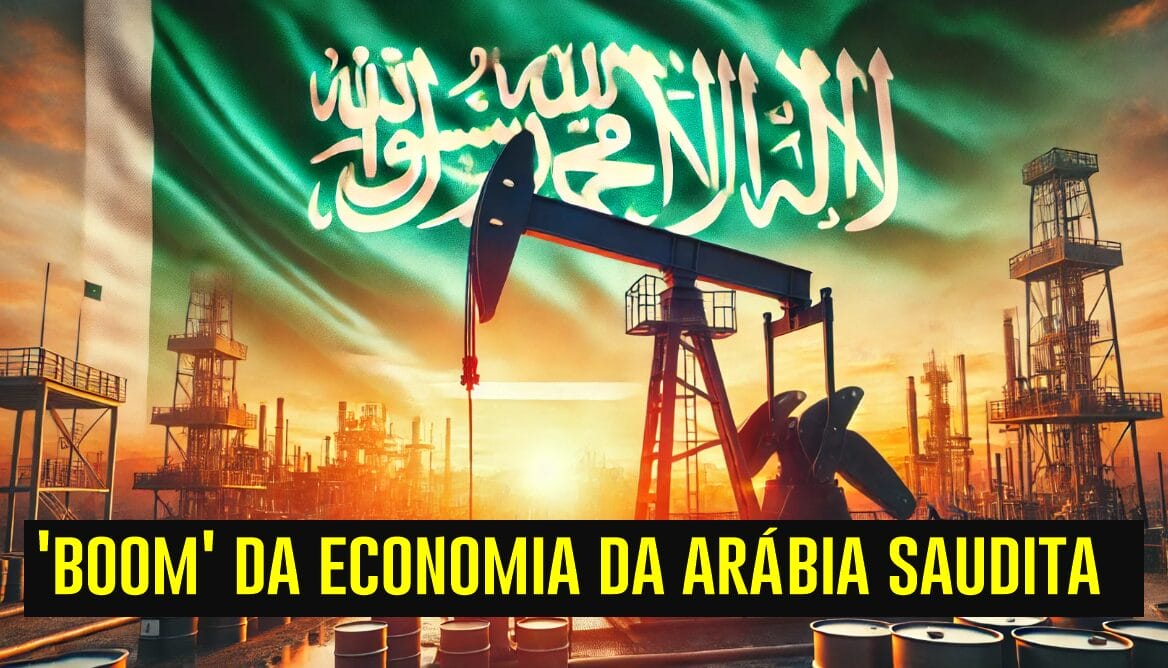
Oil Will Be the Major Driver of Economic Growth in Saudi Arabia in 2025, After Two Years of Modest Performance. Understand How This New Phase of Expansion Promises to Revolutionize the Country’s Economy and Impact the Global Market!
The economy of Saudi Arabia is set to accelerate in 2025, driven by oil production, after two years of modest growth. According to a survey by Reuters with economists, growth is expected to be robust in other member countries of the Gulf Cooperation Council (GCC) as well.
Saudi Arabia: Increase in Oil Production and Economic Impact
The Organization of the Petroleum Exporting Countries and its allies, led by Russia (OPEC+), have been cutting oil production since late 2022, but are expected to increase production in December 2024. This move is expected to raise revenues for the six GCC countries that rely significantly on oil.
Oil prices, which are currently around US$ 74.8 per barrel, are expected to rise to an average of US$ 76.75 in 2025, according to another Reuters survey.
-
Farmer drills well in Ceará in search of water, accidentally finds crude oil and sees million-dollar discovery hindered by a rule that completely changes the future of the site.

-
Family finds oil on a 49-hectare site in Ceará, but exploration has no timeline or guarantee of happening

-
When drilling an artesian well, a farmer wanted water but found oil: ANP confirms that the dark liquid found by a farmer on a site in Ceará is crude oil.

-
European stocks rise with oil drop after Trump’s remarks on Iran as investors monitor global tension




Saudi Arabia, the world’s largest exporter of crude oil, is preparing to abandon its target of reaching US$ 100 per barrel. By increasing its share in the market, the kingdom may reverse previous production cuts, helping to drive its economic growth.
Growth Forecasts for 2025
According to a survey conducted between October 9 and 22, the Saudi economy is expected to expand by 4.4% in 2025, the highest growth in three years, surpassing the expectation of 1.3% for 2024. The average expected growth for GCC economies next year is 4.1%, an increase from the 3.7% forecast made in July.
Economists indicate that the decline in oil prices will be offset by increased production volumes, which will continue to benefit real GDP growth. The head of economy for the MENA region at S&P Global Market Intelligence, Ralf Wiegert, stated: “We expect the effects of lower oil prices and higher production volumes to balance out, benefiting growth.”
Economic Diversification: A Continuing Challenge
Leading GCC countries, such as Saudi Arabia, United Arab Emirates (UAE), and Qatar, are exploring ways to diversify their economies, which traditionally depend on oil. However, even with progress in diversification, economists believe that revenues from oil will continue to play a crucial role.
Wiegert observes: “In the long run, non-oil revenues will not be able to fully replace oil revenues for these economies.”
United Arab Emirates: The Leader in Growth
Among the GCC countries, the United Arab Emirates is projected to be the fastest-growing economy, with an expansion of 4.9% in 2025, compared to 3.7% in 2024. Economist James Swanston from Capital Economics states that the UAE is in a favorable position, as it received increases in its oil production quotas but has yet to fully capitalize on this.
Additionally, the UAE, with its well-developed non-oil economy, is able to support sectors such as tourism and financial services, highlighting Dubai as a success story.
Qatar: An Example of Diversification
Qatar has also made progress in diversifying its economy and is expected to see its economic growth accelerate to 2.7% in 2025, compared to the 2.1% expected in 2024. Like the UAE, Qatar is better positioned to cope with the diminishing global demand for oil, betting on other sectors to keep its economy stable.
In the rest of the GCC, growth expectations are more moderate. For 2025, GDP growth for Bahrain, Kuwait, and Oman is expected to be 2.8%, 2.5%, and 2.8%, respectively. This represents a recovery from growth projections for 2024, which indicated 2.8%, -1.3%, and 1.6% for these countries.
Inflation in the GCC has remained stable and is expected to stay low, with forecasts of 0.8% to 3% for 2024 and 2025. This contributes to a more predictable economic environment, favoring the financial planning of countries in the region.
The economic growth of GCC nations in 2025 will be marked by the resumption of oil production, but also by ongoing diversification efforts. Despite advancements in non-oil sectors, oil will remain an important pillar for these economies in the coming years.








Be the first to react!