






 Portuguese
  Spanish
  5 min of reading
  1 comment


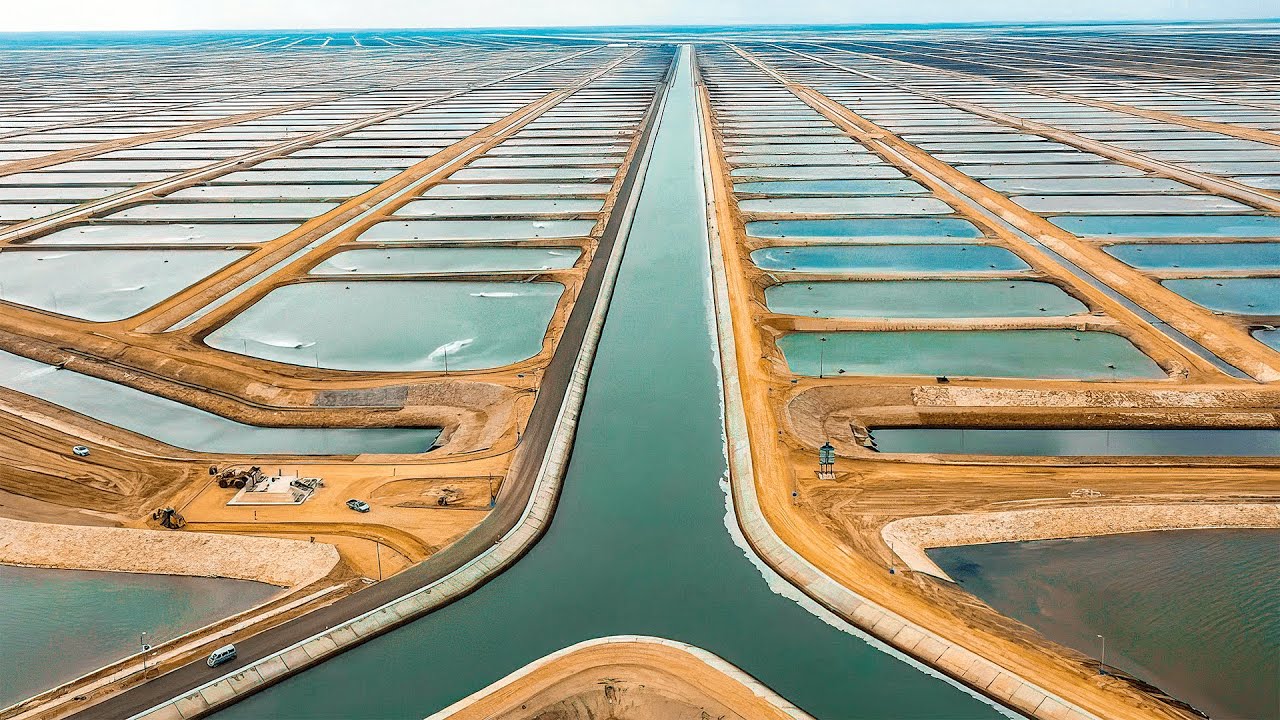


Egypt Transforms Bardawil Lake into State Megaproject for Aquaculture, Bringing Production to the Desert and Creating a New Fish Hub in the Mediterranean.
In the far north of the Sinai Peninsula, between the absolute desert and the Mediterranean Sea, Egypt has launched one of the most strategic aquaculture projects in its recent history. Where previously unproductive areas, natural salt flats, and economically isolated regions prevailed, the Egyptian government is structuring a state megacomplex for fish production at Bardawil Lake, one of the largest and purest coastal lagoons in the Eastern Mediterranean.
The project is part of a national policy for food security, job creation, and reducing dependence on imports. In just a few years, the region has transformed from a marginal productive area to a new frontier of Egyptian aquaculture, with a direct impact on domestic supply and exports to Europe and the Middle East.
Where It All Happens: The Strategic Role of Bardawil Lake in the African Mediterranean
The Bardawil Lake is located on the northern coast of Sinai and covers approximately 650 km², connecting to the Mediterranean through natural channels.
-
Low-Demand Brazilian Beef Offal Gains Popularity Abroad: Indonesia Purchases $19.5 Million, Boosting Revenue and Reducing Waste

-
Soy Expansion in Former Brazilian Savanna Sparks Water and Land Conflicts in Major Agricultural Frontier
-
Mexican Pest Threatens U.S. Cattle Herds at Historic Lows, Potentially Boosting Brazilian Beef Exports as Burger Prices Soar

-
Avocado Boom for European and U.S. Markets Fuels Water Crisis in Drought-Stricken Chilean Region




Unlike many inland lagoons, its waters are known for their exceptional quality, low contamination, and balanced salinity, making it ideal for farming high-value marine species.

Historically, the region was already known for high-value artisanal fishing, particularly for bass, gilt-head bream, wild shrimp, and sole, fish highly valued in the European market. The problem has always been low scale, informality, and instability of production.
The new state project completely changes this logic by introducing excavated tanks, semi-closed systems, controlled renewal channels, and ongoing technical management, transforming an area previously exploited extractively into a modern structured aquaculture complex.
The Economic Turnaround: From Desert Isolation to a National Productive Hub
For decades, northern Sinai was viewed as an area of economic fragility and low attractiveness for structural investments. The establishment of the Bardawil complex radically changes this scenario. The region has begun to receive road infrastructure, logistical support, regular energy supply, and processing centers.
The project is coordinated by agencies linked to the Ministry of Agriculture and the Ministry of Military Production, which gives it a national strategic status. The goal is not only to produce fish but to create a complete economic ecosystem with:
Farming, processing, packaging, refrigeration, export, and domestic distribution.
With this, Bardawil ceases to be just a productive lagoon and starts to function as a core of a new industrial marine animal protein chain in Egypt.
High-Value Species and Focus on Exports to Europe
The project’s differentiator is not only in volume but in the type of fish being produced. The prioritized species are those that command the highest prices per kilogram in the international market, such as:
European bass, gilt-head bream, sole, and marine shrimp.
These species directly meet the demands of the European Union, where traceability, water quality, and sanitary control are absolute requirements. Bardawil enters this market as one of the few regions in North Africa capable of delivering premium products at scale.
According to data from the Egyptian government and reports from the FAO, the aquaculture sector already accounts for over 80% of fish consumed in Egypt, making the country one of the largest fish farming producers in the world. Bardawil emerges as the most sophisticated and exporting arm of this strategy.
Production in Previously Unproductive Areas and Real Gains in Food Sovereignty
The project’s most profound impact is geographical. Egypt is managing to create animal protein in a territory where conventional agriculture is virtually impossible without artificial irrigation. Unlike traditional farms, the Bardawil tanks utilize the lagoon’s natural dynamics, with natural water renewal and advanced environmental control.
This means that the country expands food production without competing for fertile agricultural land in the Nile Valley, which is already intensely occupied by crops like wheat, corn, rice, and cotton.
In practice, Bardawil adds a new productive layer over a territory that previously did not compete with any other large-scale economic activity.
Technology, Sanitary Control, and International Production Standards
One of the project’s central pillars is absolute sanitary control. All production undergoes monitoring of water quality, oxygenation, stock density, balanced feeding, and batch traceability.
This enables Egypt to meet international sanitary standards required by markets such as:
European Union, Turkey, United Arab Emirates, and Saudi Arabia.
Bardawil was not designed as a subsistence project. It was crafted to operate directly in the global competition for premium fish protein.
Jobs, Local Income, and Social Reconfiguration of Northern Sinai
Another direct effect of the project is social. The production chain created around the lagoon generates thousands of direct and indirect jobs, from aquaculture technicians to operators of slaughterhouses, logistics, ice, transportation, and export.
Regions previously marked by chronic unemployment are now integrated into the national productive network. This has a direct impact on regional security, the reduction of informality, and the stabilization of the population in strategic areas of Egyptian territory.
The Geopolitical Ambition Behind the Project
Bardawil also has a geopolitical role. By transforming northern Sinai into a productive zone of high value, Egypt strengthens its economic presence in a historically sensitive area from a security and territorial sovereignty perspective.
Moreover, the country consolidates its position as a powerhouse in Mediterranean aquaculture, competing directly with producers from Spain, Greece, Turkey, and Italy.
Comparison with Global Aquaculture Giants
Today, Egypt ranks among the largest producers of farmed fish on the planet, only behind giants like China, India, Indonesia, and Vietnam. Bardawil’s differentiator is that it does not aim for mass volume, but rather the premium segment, where the added value is significantly higher.
While tilapia dominates the domestic market, Bardawil targets the export of high-value marine species priced in strong currencies.
The Desert That Became a Productive Lake and Changed the Logic of the Aquaculture Map
What the Bardawil Lake project demonstrates, in practice, is that modern aquaculture no longer depends solely on rivers, natural lakes, or humid tropical regions.
With planning, environmental control, and state policy, even a desert territory can be transformed into an exporter of animal protein.
Egypt is reshaping its productive map alongside one of the world’s most contested seas.
When the Desert Starts to Produce Fish for the Whole World
Bardawil is no longer just a lagoon in northern Sinai. It has become a symbol of a strategic economic turnaround, where Egypt ceases to be merely a consumer of external technology and begins to operate aquaculture projects at an international standard.
The message is clear: in the midst of the desert, the country has created a new frontier for high-value protein, directly connected to global Mediterranean trade.





Maravilhoso o projeto,as maneiras de execução,a maneira de distribuição tudo muito bem planejado e executado.
Brasil aprender faz bem.
Bons exemplos devem ser seguidos.