






 Portuguese
  Spanish


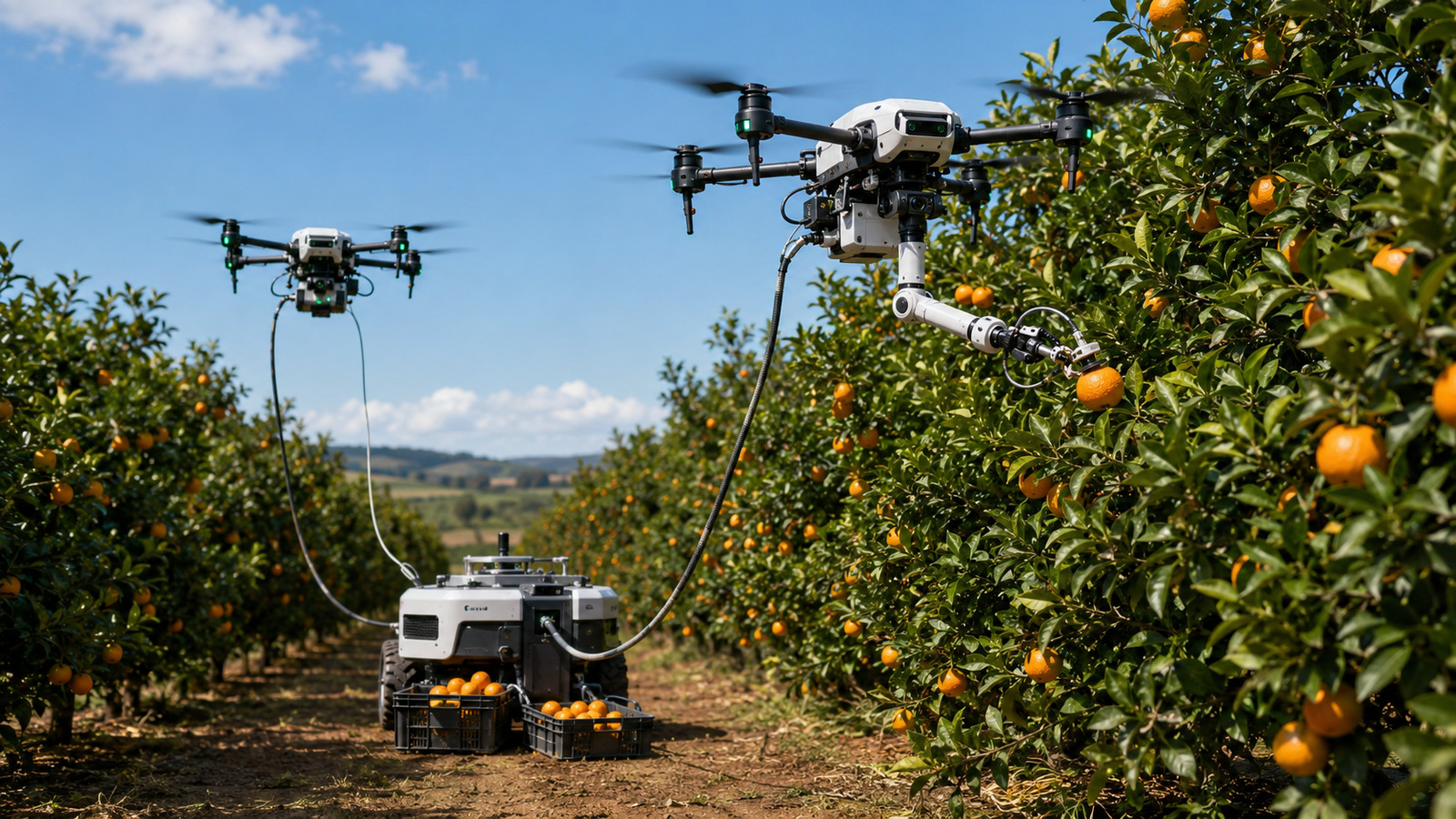
Imported by Dal Tecnologia, orange-picking robot uses drones connected to a mobile base, identifies ripe fruits, and targets large Brazilian farms amid labor shortages in the field
Orange-picking robots imported from the Israeli startup Tevel are already being tested in Brazil after arriving in the country through Dal Tecnologia. Presented at the 51st Expocitros, in Cordeirópolis (SP), the technology flies between orchards, identifies ripe fruits, and can operate autonomously on large farms.


Orange-picking robots operate attached to a mobile base
The so-called aerobotic robots resemble small drones and work connected by cables to a mobile ground base.
This base provides power, transports the harvested fruits in baskets, and processes the data captured by the cameras installed on the equipment.
-
Low-Demand Brazilian Beef Offal Gains Popularity Abroad: Indonesia Purchases $19.5 Million, Boosting Revenue and Reducing Waste

-
Soy Expansion in Former Brazilian Savanna Sparks Water and Land Conflicts in Major Agricultural Frontier
-
Mexican Pest Threatens U.S. Cattle Herds at Historic Lows, Potentially Boosting Brazilian Beef Exports as Burger Prices Soar

-
Avocado Boom for European and U.S. Markets Fuels Water Crisis in Drought-Stricken Chilean Region





With sensors, cameras, and attached software, the system locates the oranges, evaluates size, color, and ripeness, and harvests them one by one.
The removal can occur by suction, with a structure similar to an arm and a rubber tip.
There is also the option of using a cutter, called a “trimmer,” to cut the fruit’s stem. In this format, the orange falls to the ground and, due to the fall, is destined for juice production. Meanwhile, the fruits harvested by suction can go to the table.
Technology targets tree tops and productivity
According to Alexandre Luque, operations director at Dal Tecnologia, the robots are not here to replace pickers but to act in a complementary manner. The focus is on the upper part of the trees, where manual harvesting is more difficult and can increase risks.
Luque states that many producers prune trees between 3.5 and 4 meters to facilitate manual work and reduce accidents.
The consequence is that shorter trees may limit production, as a taller plant would have greater productive potential.
The technology aims to address precisely this point: harvesting where human labor has more difficulty reaching.
For the company, the lack of workers in the field tends to increase the adoption of this type of equipment in Brazil.

System with six drones can harvest one fruit every two seconds
Productivity is another point highlighted by Dal Tecnologia. A drone harvests one fruit every 12 seconds.
A complete set marketed by the company has six drones, allowing one fruit to be harvested every two seconds when all are in operation.
Roberto Carlos de Sousa, the company’s business director, highlights this performance within the complete set. Luque adds that the structure can operate 24 hours a day, seven days a week.
Sousa also reveals that there are paid pilot projects underway with one of the leading juice manufacturers with a strong presence in Brazil, responsible for the investments in the tests.
Initial focus is on oranges and apples
Dal Tecnologia imported the robots about two years ago. Since then, they have been in the promotion and testing phase on large orange farms in Brazil.
In Europe, the technology has existed for about eight years and is already used commercially, especially in apple harvesting.
In Brazil, the main focus will be on oranges, but the company also offers the system to apple producers.
Guava, pear, and peach producers have already shown interest. Despite this, Luque states that the algorithm still needs to be improved for effective harvesting of these fruits. For now, the company keeps development concentrated on oranges and apples.
This article was prepared based on information from Dal Tecnologia and statements by Alexandre Luque and Roberto Carlos de Sousa, with data, numbers, and statements preserved as per the material consulted.





Be the first to react!