






 Portuguese
  Spanish


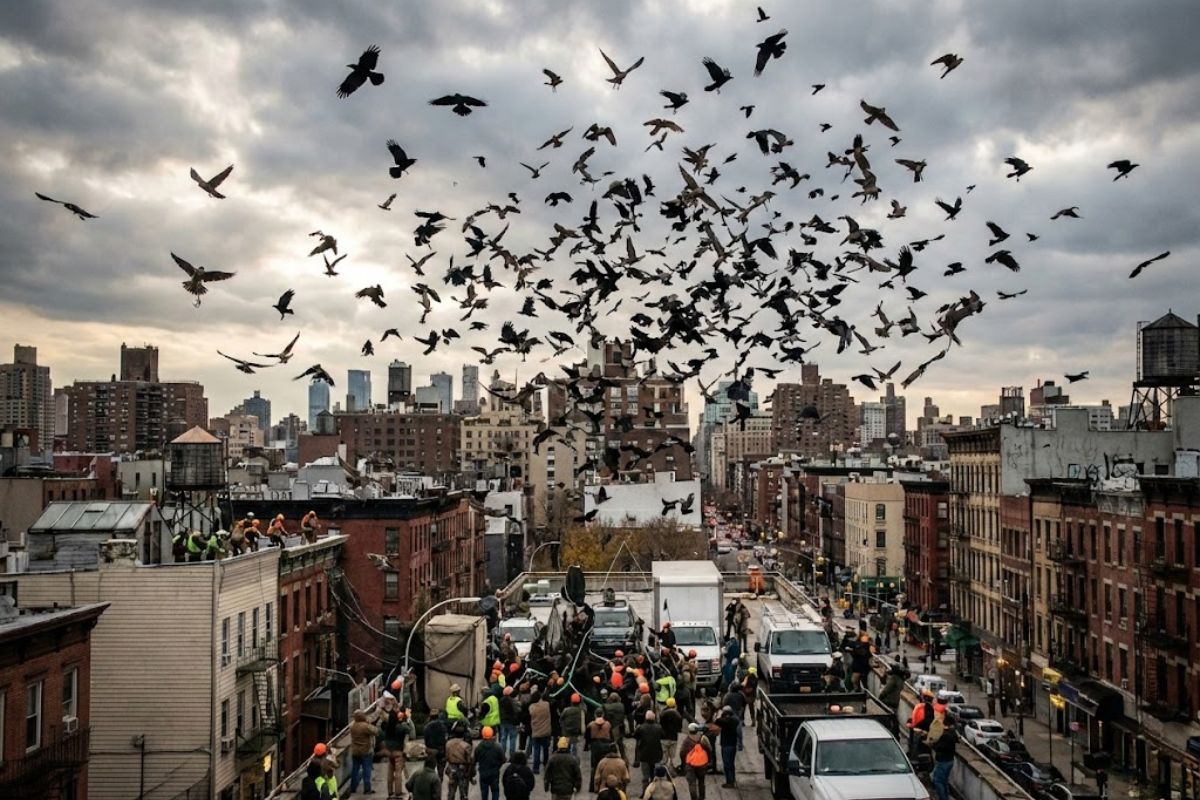


In Kenya, authorities tried to contain crows by releasing natural predators in urban areas, but the strategy failed, generated attacks, collective fear, and environmental damages, exposing the cognitive ability of these birds and showing how poorly calculated environmental decisions can quickly escalate into social crises.
The crows have become a growing urban problem in Kenya, especially in coastal cities like Watamu and Malindi.
Flocks have taken over residential areas, rooftops, streets, and even electrical networks at points along the coast.
The most cited species in the country is the Indian house crow, considered invasive and highly adaptable to the urban environment.
-
World’s Largest Particle Accelerator Begins Four-Year Hiatus for Magnet Overhaul, Aiming to Hunt Dark Matter by 2030

-
“Sahara Dust Turns Rain Red, Startling Residents Across Europe”
-
Stanford Scientists Develop 20-Cent Paper Centrifuge Inspired by Ancient Toy, Spins at 125,000 RPM Without Electricity, Separates Plasma in 1.5 Minutes, Aiding Diagnostics in Remote Areas

-
World’s Largest Vaccine Manufacturer, Immunizing Two-Thirds of Global Infants, Originated in a Pune Horse Farm





In light of the advancement, control has become a public operation, fueled by pressure from residents, tourism, and agriculture.
Here it is worth noting an important factual correction.
Instead of mass predator release, the widely documented measures along the coast involve chemical control campaigns and coordinated eradication actions, precisely because the species has few natural local enemies capable of restraining population growth.
Why Crows Have Become an Urban Problem in Kenya
In Kenya, crows have found an urban environment with a constant food supply.
Exposed landfills, food scraps, markets, and tourist areas reduce the pressure for migration.
In recent local counts, Watamu was estimated to have over 12,000 birds.
Malindi recorded over 31,000 in surveys from the same monitoring cycle.
With easy food and urban shelter, the flock grows and becomes established.
And the problem goes beyond “noise and mess.”
It turns into daily pressure on public health, native fauna, and the local economy.
Extreme Intelligence and Social Behavior That Complicates Control
The crows are social birds.
They learn quickly.
They observe human routines.
They adapt to risk.
This changes the game for any strategy based solely on scaring, capturing, or displacing the flock.
The more the city reacts in an improvised manner, the more the group’s behavior adjusts.
And the effect is usually a displacement of the problem, not a solution.
Direct Impact on Health and the Urban Economy
The accumulation of droppings, feathers, and contaminated food scraps increases the maintenance cost of outdoor areas.
Restaurants, hotels, and tourist spots end up spending more to keep usable spaces.
The pressure also falls on lines and structures, as flocks concentrate in high places and repeat routes.
In regions where tourism is central, the perception of a “city taken over” turns into image damage.
And damage to revenue.
Severe Damages to Local Agriculture
The crows are not restricted to urban areas.
They circulate between city and countryside.
They attack smaller livestock, mainly domestic birds, and increase rural damages.
Once the flock learns there is easy food, it returns.
Even after repeated attempts to scare it away.
The Public Response and the Debate on Control Limits
With the problem advancing, control gained a sense of urgency.
Authorities and local groups began to use methods aimed at population reduction.
Part of the strategies includes substances directed at controlling the Indian house crow, used with protocols to minimize risks to other species.
The debate intensifies because the line between control and extermination is sensitive.
The population demands a quick response.
The environment calls for caution.
And any operational error can affect other birds, animals, and even urban areas.
The Lesson Behind the Crisis
The case of crows in Kenya exposes a classic pattern of urban environmental management.
If food remains available in exposed garbage and irregular disposal, the flock continues to be rewarded.
And any point measure turns into futile effort.
In intelligent and adaptable species, the city needs to address the structural cause.
Waste management.
Closure of landfills.
Monitoring.
And coordinated actions.
In your opinion, what should have been prioritized in Kenya to contain the crows, Intensive population control, Radical change in waste management, or both at the same time?


