






 Portuguese
  Spanish


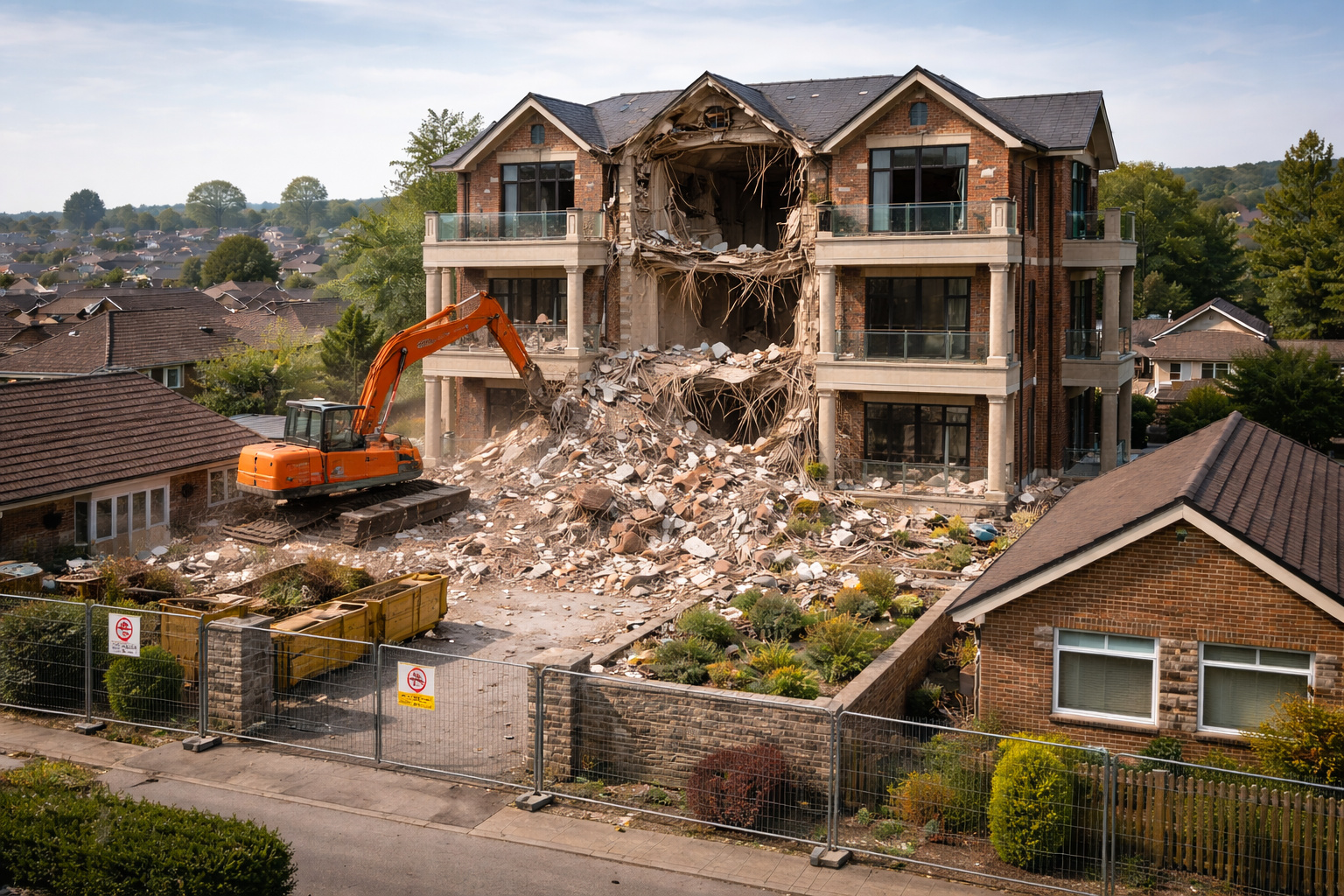


Three-Year Litigation Involving Construction Outside Urban Regulations, With Direct Impact on Local Landscape and Residents’ Lives Ends in Dewsbury
An emblematic case of disregard for urban planning gained prominence in the United Kingdom and began to mobilize authorities and residents. The episode involves real estate businessman Amir Azam, who decided to transform a property acquired in 2021 in the town of Dewsbury, near Leeds, in northern England.
That year, Azam bought a modest house for about € 275,000, equivalent to R$ 1.72 million, in a neighborhood made up of single-story homes and family bungalows. Initially, the businessman requested permission to extend the existing construction. However, he later decided to demolish the original house and build a new property on the site.
A Construction That Disrupted the Neighborhood’s Standard
Instead of preserving the region’s discreet profile, the new project progressed rapidly. On the lot, Azam built a three-story mansion, with brick walls exceeding 16 meters in length, as well as two additional buildings in the garden. Thus, the construction clearly stood out from the other houses in the vicinity.
-
Architect Transforms Tiny 4m² Home in São Paulo Favela into 11m² Living Space with Modern Amenities

-
Single mother of four swaps £3,000 London rent for life on a 60-foot solar-powered boat with Starlink and a washing machine, reducing monthly costs by 75%

-
22-Year-Old Transforms Old Farm Trailer into Two-Story Tiny Home Using Recycled Materials

-
Doctor Revives Ancient Crescent-Shaped Dams in Drought-Stricken Indian Region, Restoring Water to Over 1,000 Villages and Reviving Rivers Dormant for 60 Years



Since then, the residents filed frequent complaints. According to reports sent to local authorities, the mansion generated an oppressive visual impact, reduced the privacy of neighboring houses, and blocked windows with an extensive side wall. Over three years, the complaints escalated the conflict between the businessman and the community.
Attempt at Regularization and Rejection by the City Hall
Amid growing pressure, in 2023, Amir Azam attempted to regularize the construction by requesting a retrospective planning permit, when the construction was already completed. However, after technical analysis, the City Council denied the request. Urban planning officials stated that the mansion posed an oppressive, dominant, and incompatible impact with the architectural standard of the cul-de-sac.
According to the official report, although the new house maintained a similar width to the previous one, the total volume increased significantly. Moreover, the greater depth of the building created a long side wall, which exacerbated the sense of disharmony compared to the neighboring residences.
Court Ruling Determines Total Demolition
After years of appeals and administrative disputes, urban planning enforcement concluded that there was no viable alternative. The planning inspector confirmed the decision and ordered the complete demolition of the property, including foundation and footings, considering the work incompatible with the local urban environment.
The businessman was given a deadline of six months to comply with the order. According to estimates from the case, the costs of demolition and restoration of the land could exceed € 100,000, an amount that Azam will have to pay in full. Contacted by the British press, such as the newspaper DailyMail, the businessman stated that he was unaware of the formal decision and avoided public statements.
Similar Cases Reinforce Urban Rigour
Although extreme, the episode does not represent an isolated case. According to records from the DailyMail, similar situations have occurred in the United Kingdom. One example involves a couple from Cambridgeshire, in north London, who claimed to be building a horse breeding clinic but ended up erecting a mansion valued at over £ 1 million. After judicial review, the court also ordered the demolition of the structure.
In another scenario, in the United States, real estate developer Mohamed Hadid, father of models Bella and Gigi Hadid, began constructing a 2,800 square meter mansion in Bel Air, without obtaining the necessary permits. After years of litigation, the courts determined the demolition of the structure, which began in 2022, ending a process of significant public impact.
In light of these episodes, authorities emphasize the need to strictly adhere to urban regulations, especially in established residential areas.
To what extent can large private investments override collective rules without compromising the urban and social balance of communities?


Achou que estava no Brasil kklllll
Nem sempre um estrangeiro, mas sempre é um deles.