






 Portuguese
  Spanish


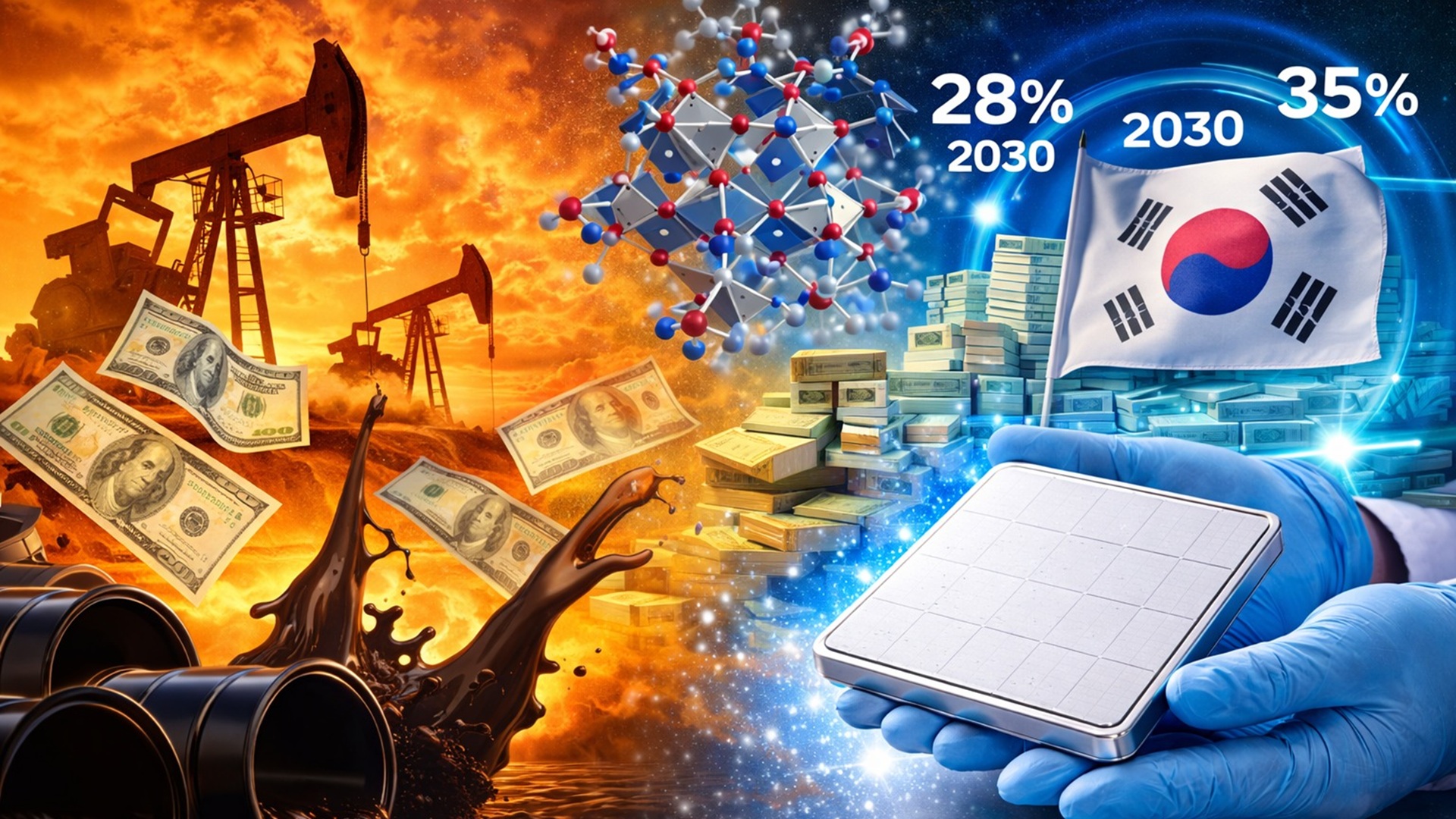


With An Investment Of Almost US$ 22.9 Million, South Korea Accelerates Research On Perovskite To Develop Perovskite-Silicon Tandem Panels With 28% Efficiency By 2030 And A Goal Of 35% In Five Years, Targeting Unique Commercialization In The World
The “Great White Whale” of solar energy mobilizes almost US$ 22.9 million from South Korea to develop tandem perovskite-silicon panels with 28% efficiency by 2030 and 35% in five years, amidst ongoing global dependence on oil.
The “Great White Whale” Of Solar Energy And The Long Dependence On Oil
The “Great White Whale” of solar energy emerges in a scenario marked by the persistence of fossil fuels. Oil is described as a white elephant in the room, even in the face of the ongoing energy transition and the growing awareness of climate change.
For almost 4,000 years, oil has been used for waterproofing and lighting. The demand for refined oil intensified with the world’s first two wells, drilled in Baku in 1847 and Pennsylvania in 1859.
-
China Develops Custom 140-Ton Electric Mining Truck with 770 kWh Swappable Battery, Deploys 290 Units in Xinjiang’s Largest Zinc Mine

-
Meta to Launch Arena, a New Prediction App Targeting 3.56 Billion Users, Competing with Polymarket and Kalshi

-
Scientist Challenges Famous Human Evolution Theory, Argues Homo Sapiens Evolved Gradually Over Thousands of Years
-
15-Year-Old American Builds Ocean Generator with PVC Pipe and 3D-Printed Propeller for $12, Wins National Prize, Presents at White House, and Makes Forbes 30 Under 30 List




By around 1900, the Oil Age was established. The increase in demand occurred particularly in transportation, with automobiles, military and industrial power, the production of petrochemicals for modern manufacturing, and in dominating the global energy matrix.
Despite the climate crisis being considered global, the search for oil has not ceased. Recent trends indicate that global consumption is still growing, albeit more slowly than at its peak, while the energy transition continues.
Perovskite As The New Focus Of The “Great White Whale” Of Solar Energy
The “Great White Whale” of solar energy takes shape with the advancement of a new solar material. Silicon cells still dominate the photovoltaic market, but experts are seeking alternatives that overcome limitations associated with this technology.
The material on which the world, and especially South Korea, is focusing efforts is perovskite. The country will invest almost US$ 22.9 million in this material, which has become an increasing obsession in solar development.
Progress has already been made with tandem perovskite-silicon panels, which achieve 25% efficiency. This result positions the technology as a candidate to redefine performance standards in solar generation.
Goals Of 28% By 2030 And 35% In Five Years
No official confirmation has been given on which project will be prioritized, but it has been announced that government funding will be directed towards research and development. The main goal is to achieve tandem perovskite-silicon panels with 28% efficiency by 2030.
The South Korean Minister of Economy and Finance, Koo Yun-cheol, argues that the commercial advancement of these panels is key to strengthening the country’s solar industry. He emphasized the importance of cutting-edge technologies in high-efficiency tandem cells.
According to the minister, the goal is to achieve unique commercialization in the world and global leading efficiency levels of 35% for tandem cells and 28% for modules in the next five years. The timeline reinforces the ambition of the program.
This investment integrates other significant projects in development, especially following the opening of contests in 2025 to expand clean energy generation capacity.
Efficiency As A Decisive Boundary In The Energy Transition
The “Great White Whale” of solar energy symbolizes the pursuit of higher efficiency levels. If new thresholds are reached, solar energy could replace oil in the energy industry, according to expectations associated with advancements in perovskite.
Still, the search is described as time-consuming. High-efficiency solar cells have become the new major challenge, while the world continues to pursue better technological results.
Meanwhile, oil refineries continue to expand. The impact of fossil fuels remains undeniable, even with the growth of green energy and the advancement of innovative materials.
There is also a reference to a solar cell with 50% efficiency in sight, indicating that the technological horizon may go beyond current goals. However, no additional details about this development are available.
Between the historical weight of oil and the bet on perovskite, the “Great White Whale” of solar energy synthesizes a central dispute in the global energy matrix. The transition continues, with investments directed towards research, defined numerical goals, and established deadlines.
If the targets of 28% by 2030 and 35% in five years are achieved, unique commercialization could alter the technological balance of the sector. Until then, the race for efficiency continues to shape the future of solar energy and global dependence on oil.







South Korea Must doing an association With Iceland. Iceland produce silicium. South Korea has Technology and Iceland has Energy free Carbone and Metal Industry. Uma Associação Coréia do Sul e Islândia seria bom para a produção de painéis solares (????). Um entraria com a matéria prima industrial (raw material intermediate) e Outro com Capital, Tecnologia e Mercado (Coréia do Sul e os 50 milhões de habitantes) além da posição Geo (locus) estratégica (Ásia).