






 Portuguese
  Spanish


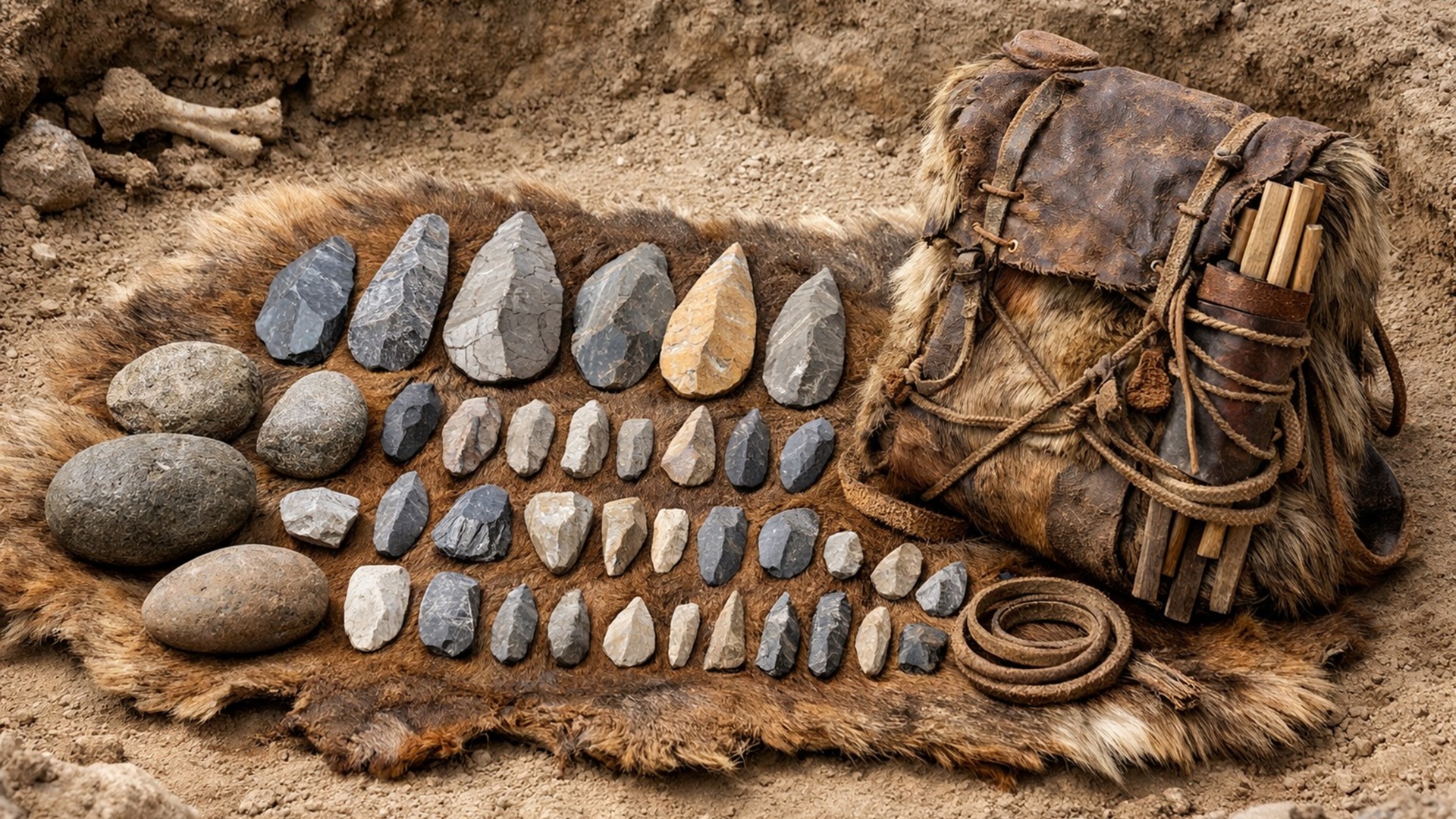

Discovery Made in 2021 at the Archaeological Site of Milovice IV in Southern Moravia Brings Together 29 Blades Dating Between 30,250 and 29,550 Years Before Present and Indicates Possible Complete Personal Equipment of an Individual of the Gravettian Culture, Preserved in the Archaeological Horizon II
Buried for 30,000 years, the tool kit found in 2021 at the Milovice IV site in Southern Moravia includes 29 stones dated between 30,250 and 29,550 years before present and may represent the complete personal equipment of a single individual from the Gravettian culture.
The discovery took place in the hills of Southern Moravia, a region that has revealed thousands of Stone Age artifacts over decades. Unlike most previous finds, which consisted of scattered fragments, the set of 29 stones presented an unusual configuration.
The pieces were compacted and preserved the arrangement they would have had if they were wrapped in a container made of leather or tree bark, perishable materials that decayed over millennia. Radiocarbon dating of the charcoal from the same layer placed the deposit between 30,250 and 29,550 years before present.
-
China Develops Custom 140-Ton Electric Mining Truck with 770 kWh Swappable Battery, Deploys 290 Units in Xinjiang’s Largest Zinc Mine

-
Meta to Launch Arena, a New Prediction App Targeting 3.56 Billion Users, Competing with Polymarket and Kalshi

-
Scientist Challenges Famous Human Evolution Theory, Argues Homo Sapiens Evolved Gradually Over Thousands of Years
-
15-Year-Old American Builds Ocean Generator with PVC Pipe and 3D-Printed Propeller for $12, Wins National Prize, Presents at White House, and Makes Forbes 30 Under 30 List




According to a study published in the Journal of Paleolithic Archaeology, the context indicates that this is not waste accumulated over generations, but possibly the complete personal equipment of a single individual. This distinction allows us to observe how an Ice Age hunter moved and which tools they considered essential.
Tool Kit Preserved in the Archaeological Horizon II
The excavation carried out in 2021 revealed a complex stratigraphy with multiple occupations from the Upper Paleolithic. The set emerged from the Archaeological Horizon II, a layer that also contained a hearth and animal bones, mainly horse and reindeer.
The researchers documented the position of the tool kit using a total station and conducted the excavation in three phases. Detailed photographic documentation preserved the spatial relationships between the 29 blades and flakes.
The study claims that the specific context suggests original grouping in a container made of perishable material. The absence of this material is currently considered expected, as organic preservation is rare in open-air sites from this period.
The formation of the horizon appears to have occurred relatively quickly. The authors note that the main body of the Archaeological Horizon II was deposited shortly after or during the human occupation of the site, which may explain the maintenance of the set intact.
Technical Analyses Reveal Diverse Functions and Origins of the Tool Kit
Technological and use-wear analyses conducted at Sapienza University of Rome and the University of Hradec Králové identified multiple functions in the pieces. A substantial part exhibited fractures associated with projectiles.
Other tools showed evidence of cutting, scraping, and drilling. The analyses indicated intensive use and repurposing of broken fragments, which were sharpened and modified for new functions.
The raw materials were traced by inductively coupled plasma mass spectrometry with laser ablation. Some stones came from sources located over 100 kilometers away.
According to the study, the variety of raw materials reflects the individual’s range of mobility or network of contacts. The reuse of small fragments also suggests economical treatment of personal equipment, possibly due to scarcity during travels.
The use of chips and broken pieces reinforces the hypothesis of resource limitation during hunting movements or migration. The tool kit highlights individual decisions related to maximizing the material available.
Gravettian Culture and Regional Context of the Find
The dating between 30,250 and 29,550 years before present situates the set in the period when the Gravettian culture spread across central Europe, approximately between 33,000 and 24,000 years ago.
Sites like Dolní Věstonice and Pavlov, near Milovice IV, record occupations in a cold steppe environment. The groups hunted herd animals, including horses, reindeer, and mammoths.
According to Dominik Chlachula from the Archaeology Institute of the Czech Academy of Sciences and the study’s lead author, the artifacts likely highlight an episode in the life of a person, something described as very rare for the Paleolithic.
He stated that such discoveries can shed light on the behavior of prehistoric peoples during migrations or hunting expeditions, which typically left few traces in the landscape.
Spatial Context and Importance of the Intact Set
The set was found in a residential camp, among hearths and the bones of hunted animals. This context associates the individual with a broader social environment, even though the tools may have been used in more isolated expeditions.
The study emphasizes that if the artifacts had been discovered separately, they would not have stood out from other discarded materials at the site. It is the preserved spatial context that gives relevance to the set.
The compacted arrangement of the 29 blades and flakes suggests organized storage. The configuration reinforces the interpretation that the tool kit represented personal equipment rather than a simple collective accumulation.
The pieces are stored in a laboratory at the Czech Academy of Sciences, where they remain available for further studies. Researchers continue to work to enhance the understanding of the formation processes of the Milovice IV site.
The detailed documentation of the excavation and the preservation of spatial relationships allowed for precise analysis of the set. The tool kit, having remained grouped for about 30,000 years, offers a rare record of a specific moment in the life of an individual from the Ice Age.
By gathering dating data, functional analyses, and raw material tracking, the study presents an integrated picture of the find. The combination of stratigraphic context, spatial organization, and material diversity supports the interpretation of personal equipment.
Thus, the tool kit found at Milovice IV adds an individual dimension to the archaeological record of the Gravettian culture. The discovery enhances understanding of mobility, resource use, and technological organization in the Upper Paleolithic, remaining anchored solely in the evidence documented at the site.






