Portuguese
  Spanish


Researchers propose, in a new study, to use the Moon as a quarantine center for samples collected on Mars and other worlds. The idea is that the naturally isolated and sterile lunar environment would act as a barrier against any extraterrestrial life before contact with Earth.
What if the Moon became a kind of space quarantine station? This is what a study published in the scientific journal Ambio argues, proposing to use the natural satellite as a biosafety filter for samples collected on Mars and other worlds that might harbor extraterrestrial life.
The proposal is based on a simple logic: the Moon is naturally isolated and sterile, which would make it an ideal barrier between Earth and possible unknown organisms. Before any extraterrestrial material reaches our planet, it would first undergo a quarantine and rigorous analyses on the lunar surface.
Why the Moon would be a good quarantine center
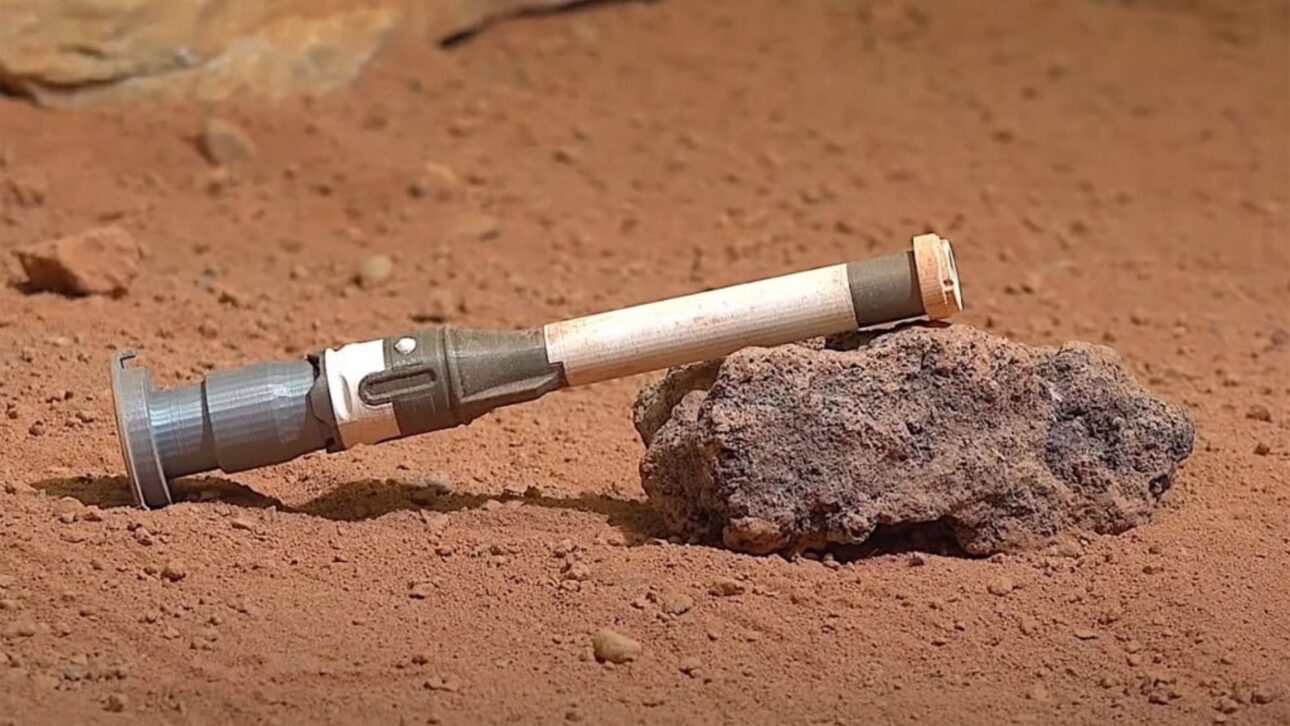
The central idea of the study is to create a biocontainment facility on the surface of the Moon, where all samples collected in space would be sent before reaching Earth.
-
16-Year-Old from Brazil’s Sertão Wins Young Scientist Award for AI Predicting Rainfall with 94.5% Accuracy to Aid Farmers

-
Netherlands Reports First Child Euthanasia Case Since Rule Expansion for Minors

-
Brazilian Innovator Survives Homemade Submarine Dive in Paraty Despite Hatch Leak and False Oxygen Alarm
-
China Develops Custom 140-Ton Electric Mining Truck with 770 kWh Swappable Battery, Deploys 290 Units in Xinjiang’s Largest Zinc Mine



Only after undergoing this quarantine and detailed analyses would the material be released. The researchers also recommend that everything be handled exclusively by robotic systems, reducing human exposure and the risk of failures during containment.
The argument behind this is straightforward: no facility on Earth, not even those with maximum security, could guarantee total containment in the event of an accidental leak. The natural isolation of the Moon would act as a true shield.
The proposal is signed by Frederick Moxley, director of the Strategic Threat Analysis and Research Laboratories (STAR) in the United States, and by Anthony Ricciardi, from McGill University in Canada, a specialist in invasive species.
The fear: extraterrestrial life and back contamination
The authors’ concern is what would happen if an unknown form of extraterrestrial life reached Earth’s biosphere. For them, the impacts would be unpredictable and possibly irreversible.
The comparison they make is with invasive species: on Earth, an organism introduced in the wrong place can spread uncontrollably and cause enormous ecological and economic damage, something that decades of research have already proven.
There is also a more curious scenario, called “back contamination.” In it, a terrestrial microbe mistakenly taken to Mars or another celestial body would undergo mutations, evolve, and return to Earth as a new organism, with characteristics different from the original ones.
It is worth remembering that there is no evidence of extraterrestrial life to date, and Ricciardi himself admits that it is impossible to quantify this risk, as there is no data. Even so, the authors argue that it is more prudent to prepare for the hypothesis of extraterrestrial life than to simply ignore it.
The race for the Moon between the United States and China
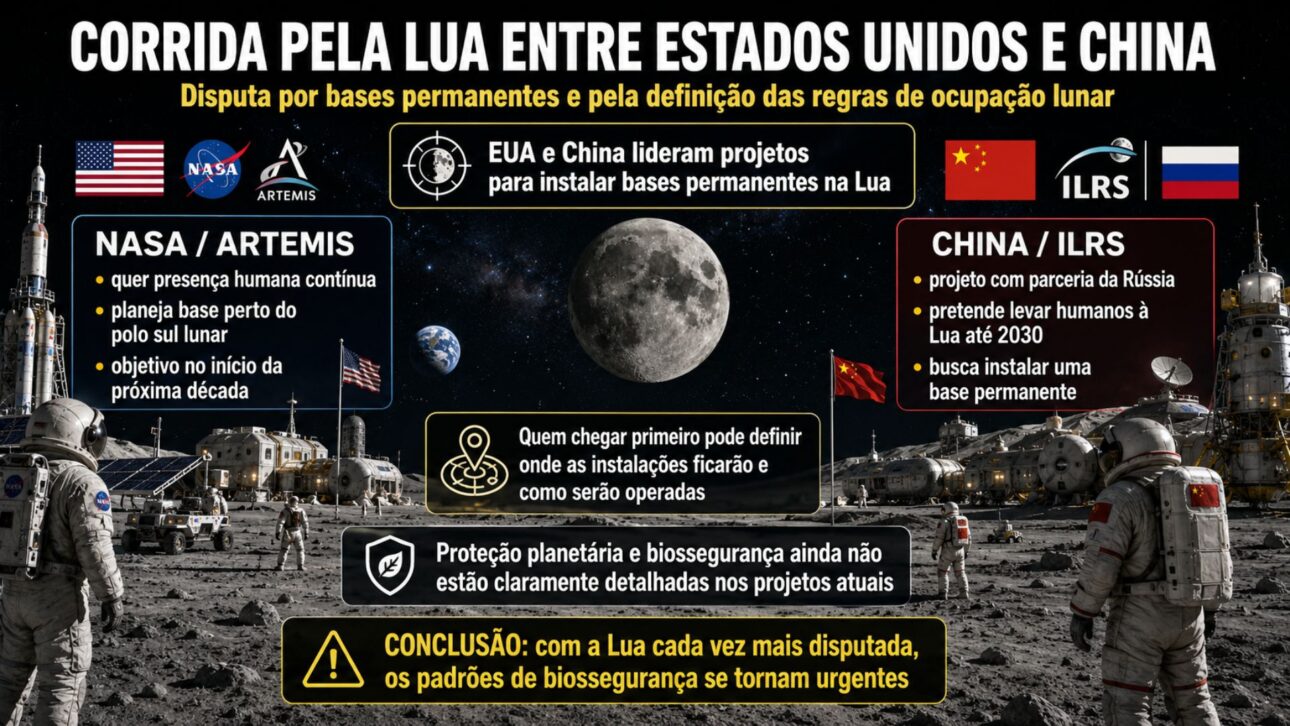
The study comes at a time of intense competition for the Moon. The United States and China lead projects to establish permanent bases on the satellite, which is expected to play a central role in future space missions.
According to Moxley, whoever arrives first will likely determine where the installations will be and how they will be operated, and none of the current projects have detailed how they intend to handle planetary protection.
On one side, China is developing the International Lunar Research Station (ILRS) in partnership with Russia and plans to send humans to the Moon by 2030.
On the other side, NASA is advancing with the Artemis program, which envisions continuous human presence and a base near the lunar south pole at the beginning of the next decade. For the authors, this increasingly busy and competitive environment makes biosafety standards even more urgent.
A proposal, not an official plan
It is important to clarify the status of the idea: it is a proposal by two researchers, not an official policy of space agencies. So far, biosafety infrastructure does not appear in the plans for future bases, and issues such as cost, feasibility, and responsibility for building the lunar quarantine remain open.
The history itself shows the extent of the debate: NASA even placed the astronauts of the Apollo 11 and 12 missions in quarantine upon returning from the Moon in 1969, but abandoned the protocol upon finding that the lunar samples did not bring life.
Today, the topic resurfaces strongly because sample return missions are advancing. NASA’s Perseverance rover has already collected material on Mars that awaits to be brought back, and international treaties require special care with bodies that may have harbored life.
Bringing the samples from Mars to the Moon first would be, in the authors’ view, an extra layer of security, even though many scientists consider the risk low given the absence of any proof of extraterrestrial life.
Turning the Moon into a quarantine for samples from Mars seems like a science fiction plot, but it raises a real question about how far we should go to protect Earth.
Tell us in the comments if you think the idea is exaggerated or a necessary precaution given the possibility, however remote, of extraterrestrial life.