Portuguese
  Spanish


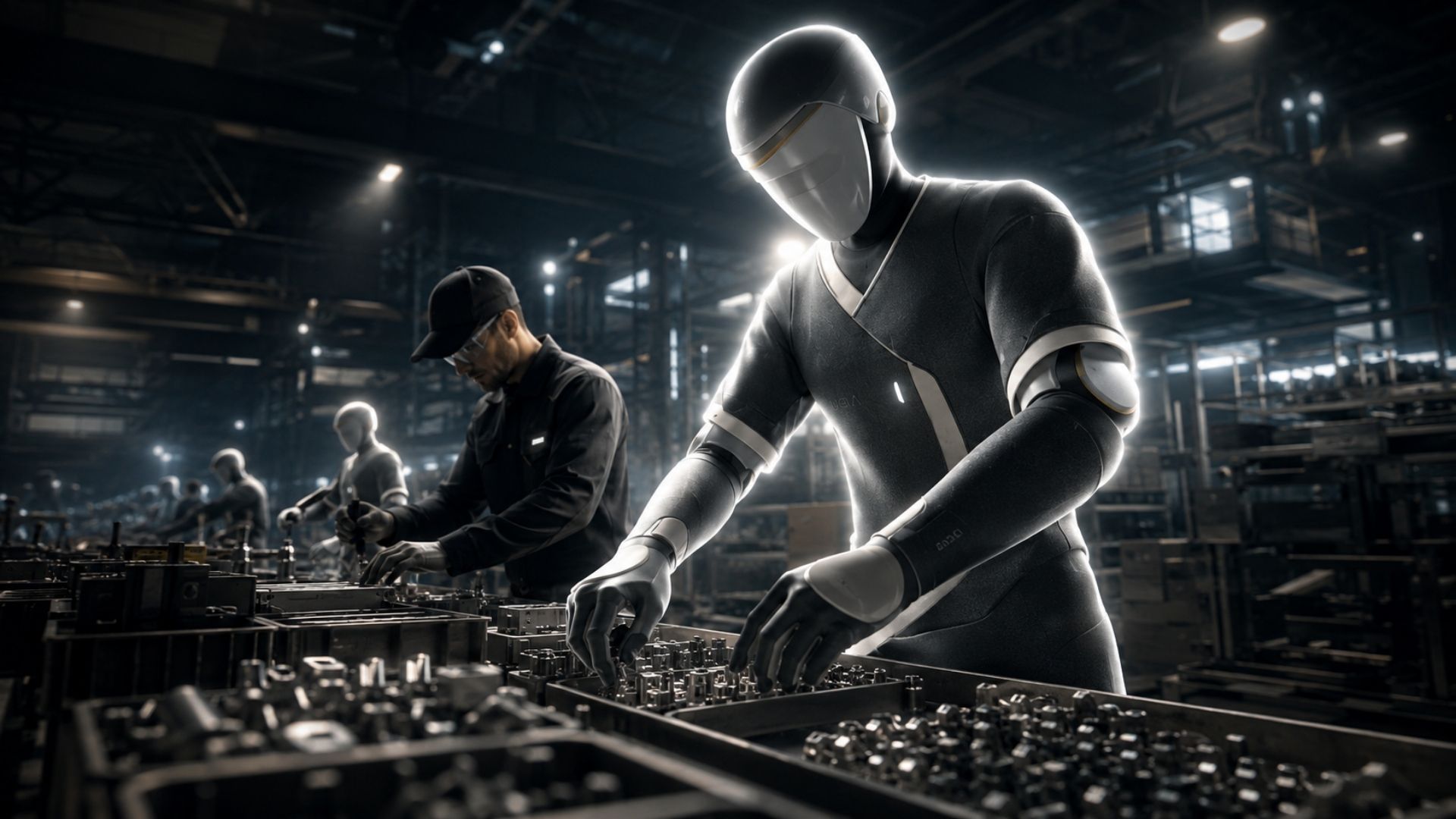

Named Northstar, the humanoid robot from the Parisian startup UMA learns by imitation: instead of code, it watches a person perform the task and repeats the gesture. The company wants to bring this method to warehouses and factories, starting in Europe and not in the United States.
In early July 2026, a small French company turned into a product an idea that sounded like fiction: a machine that learns to work just by watching a human perform the task. It was when UMA, a Parisian “physical AI” startup, revealed to the public the design of its first humanoid robot, the Northstar, an android guided by artificial intelligence and designed for factories, warehouses, and logistics centers. Instead of the usual pages of code, the robot watches an operator perform the movement and starts to repeat it on its own, refining the details with practice.
The heart of the project has a name: Real-Time Learning, a real-time learning architecture that allows the android to acquire skills by demonstration, without manual programming. It is no accident that such a young company already appears with weight in the debate. Leading it is Rémi Cadène, former engineer of Optimus, Tesla’s humanoid, and his bet breaks with the logic that has governed industrial robotics for decades: instead of rewriting the system for each new function, just show the machine how the work is done.
Who is behind the project and where the bet came from
The revelation took place during the Machina Summit, at Station F, in Paris, and was reported on July 8, 2026. Cadène comes to the subject with experience: before founding UMA, he spent years at Tesla, in the Autopilot team, and worked between 2021 and 2024 on the neural networks of Optimus, the android that Elon Musk presents as part of the future of the automaker. In 2024, he left Tesla for Hugging Face, a global reference in artificial intelligence, where he led the LeRobot, an open robotics library now used as a basis in laboratories around the world.
-
A young Kenyan engineer collects plastic waste from the streets and transforms it into robots that translate physics lessons into sign language in real-time, a machine made with old bottles that teaches what was missing to deaf children left out of science.

-
What is the dark substance found in the sand of Ipanema Beach? Civil Police conduct an examination, collect samples of the material, and initiate an investigation to identify the composition, clarify the origin, and verify if there was an environmental crime.
-
The beer that was hidden for 3,000 years has returned to the world: scientists find yeast preserved in Ancient Egyptian vessels and recreate a pharaoh’s drink to discover the lost taste of an ancient civilization.
-
NASA spotted a giant “surfboard” crossing the Moon’s orbit at 11,500 km/h, and the truth behind the mysterious object required a 0.338 millisecond photo to be revealed.




The company came out of stealth mode in December 2025, when it raised about $40 million in a seed round, and it brings together a team that helps explain so much attention. Alongside Cadène, CEO and co-founder, are Simon Alibert, technology director and co-creator of LeRobot; Pierre Sermanet, scientific director with experience at Google DeepMind and New York University; and Robert Knight, responsible for open-source robotic hands and arms, such as the SO-100 model.
Among advisors and supporters are top-tier names, such as Yann LeCun, chief AI scientist at Meta and Turing Award winner, and Thomas Wolf, co-founder of Hugging Face, as well as funds like Greycroft. The acronym itself sums up the target: UMA stands for “Universal Mechanical Assistant”.
How the robot learns without anyone writing code
The method relies on three ingredients that work together. First comes the demonstration of the task by a person; then, the definition of a reward, what the machine should understand as “successful”; and finally, live repetition under the supervision of an operator. A predictive model of the world plays a key role, allowing the robot to rehearse and correct movements even when stationary, without starting from scratch with each attempt.

To explain the logic, Cadène refers to a simple scene: learning to tie a shoe. The person makes mistakes, tries again, adjusts the gesture, and at some point, it becomes reflexive. It is this cycle of trial and correction that the company wants to install in the machine. In practice, a production line could teach a new function in minutes, without calling programmers every time the product changes, and this is where UMA’s boldest promise lies: breaking the engineering bottleneck that today makes robots expensive and delays their arrival in factories.
What is a humanoid robot used for inside warehouses and factories
The product’s target is clear: repetitive, tiring, or dangerous tasks — carrying, stacking, sorting, and moving loads for hours on end. These are precisely the functions where there is a lack of people willing to work and where the human body wears out. The project’s advantage is fitting into spaces already built for people, without forcing the factory to be remodeled to accommodate the machine.
The conquest of these environments is planned in stages. Warehouses and logistics centers come first, as they have flat floors and predictable routines, which provide fewer variables for the android to manage. Only later does manufacturing, which demands more dexterity, come into play, and further down the line, scenarios like hospitals and laboratories. However, one should not confuse the showcase with reality: what UMA showed was the product design and usage vision, with pilot programs scheduled for as early as 2026. A stage demonstration is one thing; facing the pace of a real warehouse, eight hours a day, is quite another.
A “European” android designed to inspire confidence
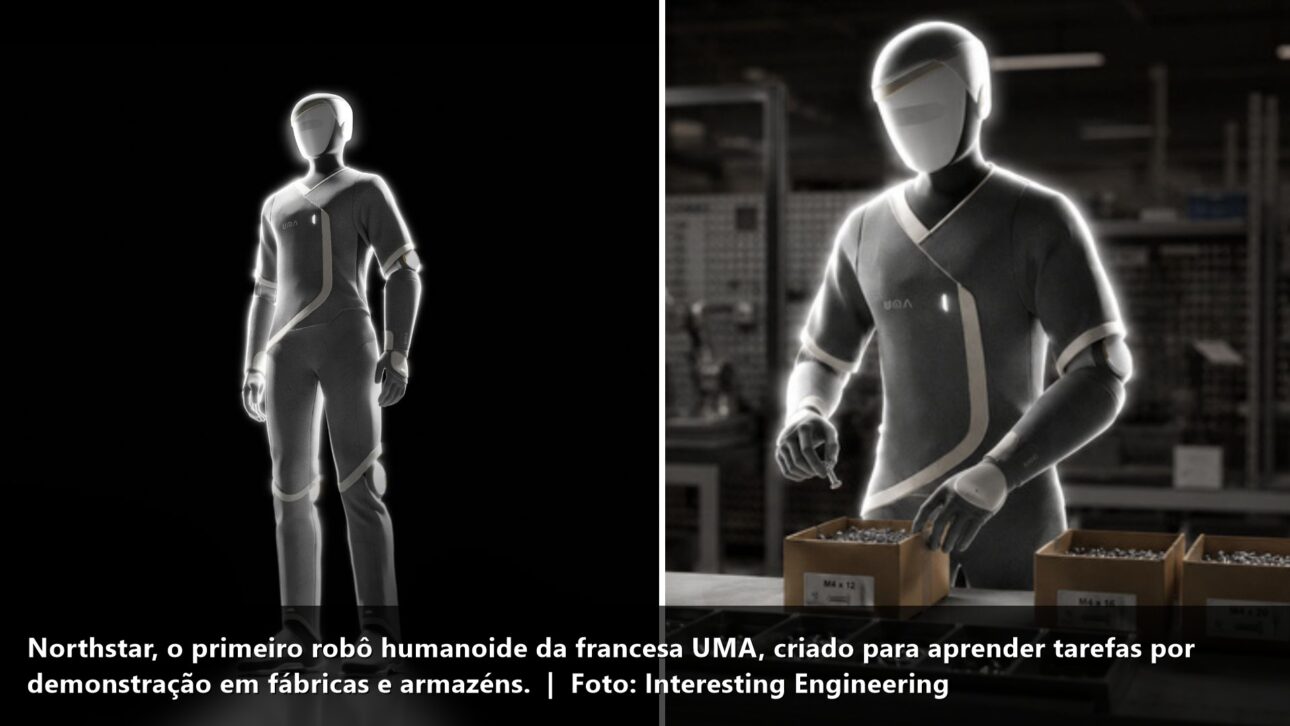
The appearance of the Northstar carries intention. It has a human-scale silhouette, without a face — just a neutral visor in place of the head — and wears a technical fabric with replaceable sensors, leaving the mechanical joints exposed in a lightweight and easy-to-repair structure. According to Cadène, the look was calculated to be comfortable to look at, conveying calm and competence instead of the threatening machine of popular imagination.
This aesthetic concern goes hand in hand with the decision to conquer Europe first. The argument is that the continent combines strict safety rules with human-centered workflows, a terrain where a transparent and friendly robot has a better chance of acceptance. Those who want to know the official discourse can access the company’s institutional website. The watchword is discretion: no promising a machine that does everything on the first day, but rather equipment that integrates seamlessly into existing operations, bypassing the discomfort of the “uncanny valley” that often repels those who encounter overly realistic androids.
The Northstar enters an already crowded global race
The French android does not land on free ground. The race for commercial humanoids has become one of the hottest in technology: Tesla is developing the Optimus, the American Figure is raising billions, Boston Dynamics is repositioning the electric Atlas within the Hyundai group, and Chinese companies like Unitree are launching models at aggressive prices. Each project follows its own path, and care must be taken not to mix the achievements of one with those of another.
In this scenario, UMA considers itself an underdog. Its bet is not to have the strongest or fastest robot, but one that learns with less data and less programming — a thesis about software, not metal muscles. If correct, it believes it can compensate for the rivals’ lead in capital and time. The obstacle, however, is real: taking an elegant design off the drawing board and turning it into a machine that works safely and at a viable cost is exactly the point where several competitors have already stalled — and the company itself acknowledges that the journey is long.
The first robot UMA will sell does not have two legs
There is a detail that undoes the fantasy of the android walking through the corridors. Before the complete biped humanoid, the first commercial product should be an industrial robot on wheels, with two arms and a prototype expected by the end of 2026. The reason is down-to-earth: wheels are cheaper and more stable than legs, and almost all warehouse services take place on flat floors.
The business model follows the same pragmatic line. Instead of selling the machine at once, UMA talks about offering it as a service, by subscription, diluting the cost and lowering the entry barrier. There are about 30 employees divided between AI and hardware, with laboratories in Paris, Geneva (dedicated to hands), and London (focused on the market). Cadène, by the way, insists on keeping the euphoria in check: for him, this technology will take years to be adopted on a large scale, at the same slow pace with which the internet and smartphones transformed entire sectors. The revolution is real in the company’s view, but it’s not for tomorrow.
What UMA’s technology signals for the industry, including in Brazil
Whoever wins, the method at center stage interests the entire industry. If teaching a machine becomes as simple as demonstrating the task once, automation ceases to be a privilege of large factories with engineering teams and becomes suitable for smaller operations. Programming by gesture, rather than by code, is fundamentally a way to democratize machines on production lines.
For Brazil, the subject is far from abstract. The country is accelerating e-commerce logistics and warehouse automation at a time when the workforce for heavy functions is becoming increasingly scarce. Equipment that learns by demonstration, without requiring programmers for every adjustment, is precisely the type of technology that attracts distribution centers and factories focused on productivity — even with UMA currently focused on the European market. The direction of the sector became clear in Paris: less hand-written code, more machines that learn by watching.
UMA promises an android that dispenses with programming and learns by copying people, made for factories and warehouses and betting on Europe as a showcase. It is a bold vision, still surrounded by prototypes and promises.
Do you believe that demonstration as a way of teaching will really unlock these machines on production lines, or is it just another beautiful design that will stall when it comes to real work? Tell us here in the comments.