






 Portuguese
  Spanish
  5 min of reading
  0 comments


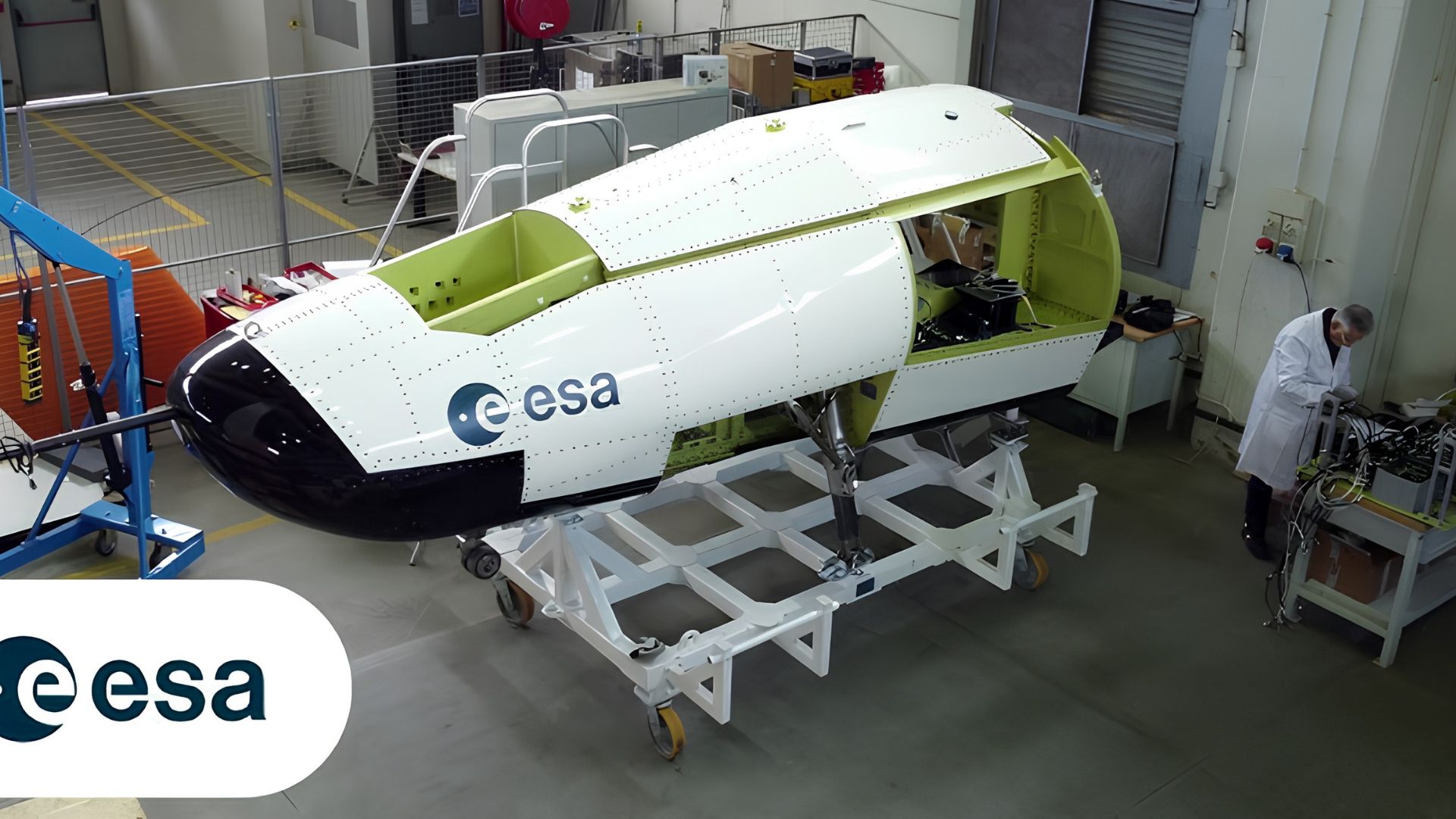
ESA develops the Space Rider, a reusable spacecraft capable of operating for two months in space and returning to Earth with up to 800 kg of scientific cargo.
While the United States and China accelerate the race for giant rockets, lunar bases, and constellations of thousands of satellites, Europe is trying to enter an even more strategic competition: that of reusable orbital operations. The project chosen for this is the Space Rider, an unmanned spacecraft created by the European Space Agency to remain in orbit for up to two months, return to Earth, and go back to space repeatedly without a complete reconstruction of the vehicle.
The ESA describes the Space Rider as the first European reusable space transportation system. The vehicle will be launched by the Vega-C rocket from French Guiana, carrying scientific experiments, technological demonstrations, and small commercial payloads in low orbit and then landing in a controlled manner on a runway for reuse. The first operational flight is currently scheduled for 2028.
European Space Rider is born to transform disposable rockets into reusable orbital operations
The Space Rider was conceived as a kind of reusable automatic orbital laboratory. According to the ESA, the vehicle is approximately the size of two minivans, can operate in low orbit for about 60 days and return bringing entire scientific payloads back to Earth.
-
At 22 years old, a young person from Recife creates an artificial intelligence startup with a team barely over 25, serves giants like Bayer and Ipiranga, earns millions without taking a cent from investors, and transforms a young company into a national AI phenomenon.

-
The invisible danger inside the house: plugging too many devices into the same outlet and spreading extensions throughout the rooms can overload the electrical network, silently heat wires, and turn a common habit into one of the leading causes of house fires.

-
Goodbye traditional laundry: Roborock launches washer and dryer with super hydrolysis, microbubbles, 99.99% sterilization, low-temperature drying, automatic detergent, app control, and cycles to remove stains, odors, mites, and bacteria from clothes.

-
It is now possible to generate energy without batteries: new flexible material transforms body heat into electricity and paves the way for more efficient, autonomous, and comfortable wearable devices, with the potential to revolutionize personal electronics in the coming years.




The system’s architecture directly derives from the IXV, the European experimental reentry vehicle launched in 2015 to validate thermal, aerodynamic, and navigation technologies during atmospheric return.


The Space Rider builds on this foundation and adds complete reusable systems, extended operational capability, and a functional cargo bay aimed at commercial and scientific missions.
The program is part of the PRIDE initiative, created specifically to develop a European reusable orbital platform with low operational costs.
ESA states that the central goal is to ensure “independent and routine access to space”, reducing dependence on foreign launchers and platforms for research missions, technology validation, and future industrial applications in orbit.
Spacecraft will have 1,200 liters of usable volume and capacity for up to 800 kg in orbit
The structure of the Space Rider was designed to function as a flexible orbital environment for different sectors. According to Avio, an Italian company directly involved in the project, the vehicle will have a cargo bay with approximately 1,200 liters of usable volume and the capacity to transport up to 800 kg of orbital cargo.
ESA states that the system will be able to conduct experiments in microgravity, pharmaceutical research, biomedicine, biology, materials science, and space technology demonstration.
The goal is to allow companies and scientific institutes to test real equipment in the space environment before using them in operational satellites or future lunar missions.

Besides scientific research, the Space Rider was also designed for Earth observation missions, satellite inspection, telecommunications, robotic systems validation, and testing of space instruments in real orbit. ESA states that the vehicle will be able to operate in different orbital inclinations, from equatorial orbits to high latitude trajectories.
Europe attempts to reduce dependence on SpaceX and regain lost space autonomy
The advancement of the Space Rider comes at a delicate time for the European space industry. In recent years, the continent has faced delays with Ariane 6, temporary halts of Vega-C, and increasing reliance on American launchers to place satellites in orbit.
While SpaceX performs dozens of reusable landings per year with the Falcon 9 and accelerates the development of the Starship, Europe still operates mainly with disposable systems.
The Space Rider emerges precisely as an attempt to enter the orbital reuse market without relying exclusively on giant rockets or military programs.

The strategic differential of the project lies in the controlled return of cargo. Today, few platforms in the world can launch, operate, and bring back complete experiments from space in a reusable manner. This places the European program in a technological category comparable to systems like the American X-37B and the Dream Chaser developed in the United States.
Space Rider will land using steerable parachutes and can fly multiple times
Unlike traditional capsules that fall into the ocean, the Space Rider was designed to land on a runway using an advanced controlled descent system.
Technical documents of the program show that the vehicle will use braking parachutes and then a steerable parafoil to perform a controlled horizontal approach.

According to the preliminary data of the program, the spacecraft was designed to execute at least six reusable missions over its operational life. The ESA is also working to reduce the preparation time between flights to less than six months, something considered essential to make the platform commercially competitive.
The inaugural mission is expected to transport institutional and commercial cargo. A report from European Spaceflight states that at least 18 clients have already signed memorandums of understanding to embark experiments on the first flight of the European reusable vehicle.
Europe bets on Space Rider to enter the future industrial orbital economy
The development of the Space Rider occurs at a time when the space economy is beginning to shift from simple satellite launches to permanent industrial operations in low orbit. Companies in the pharmaceutical, telecommunications, materials science, and earth observation sectors are already studying commercial applications in microgravity.
The ESA believes that the Space Rider can open a European market for short-duration reusable orbital missions, functioning as an intermediate platform between small satellites and future commercial space stations.
The system was designed precisely to conduct frequent missions with lower costs than traditional disposable capsule models.
If the program achieves the promised operational model, Europe could join an extremely exclusive group of powers capable of launching, operating, recovering, and reusing their own orbital vehicles — a capability currently concentrated in a few companies and governments on the planet.
While the United States and China compete over colossal rockets and permanent lunar presence, the ESA is trying to demonstrate with the Space Rider that the next space revolution might not just be about reaching space, but about learning to return from it continuously.




Be the first to react!