Portuguese
  Spanish


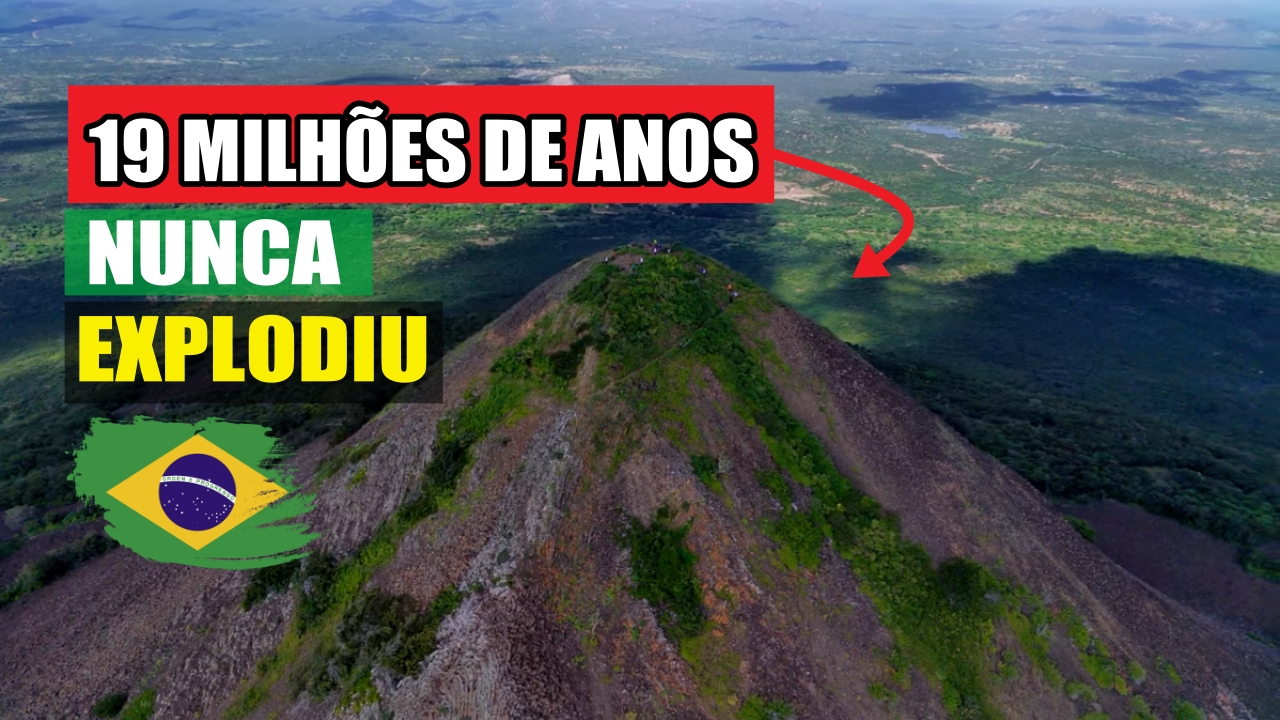


Revealed The Mystery Of Cabugi Peak: Brazilian Volcano In The Heart Of Rio Grande Do Norte That Did Not Have The Force To Explode And Preserves Its Original Shape For 19 Million Years
In the interior of Rio Grande do Norte, a solitary mountain dominates the horizon and holds a geological secret that few Brazilians know. The Cabugi Peak, located in the town of Angicos, is the only volcano in Brazil that still preserves its original shape.
At 590 meters high, the sleeping giant attracts adventurers, scientists, and curious people who wish to touch the geological history of a country that, officially, has no active volcanoes.


A Brazilian Volcano That Withstood The Test Of Time
The Cabugi Peak is, in fact, a volcanic neck, the solidified conduit of an ancient volcano that never fully erupted.
-
The forgotten Atari stock that seemed like something out of a movie: millions of sealed cartridges were buried underground and were sold for very low prices.

-
Collector adapts forklift electric motor in a Kombi Corujinha pickup, hides 16 batteries under the bed, and makes the Brazilian classic run silently with up to 90 km of range.

-
Goodbye traditional vacuum: Samsung surprises and launches 2-in-1 robot with steam, AI that recognizes floors and stains, self-cleaning station, hot air drying, automatic emptying, water refill, and app control.
-
Brazil is transforming acerola waste discarded by the pulp industry into an ambitious and surprising project that could forever change the way the country utilizes one of the most invisible by-products of the fruit sector.


Formed about 19.7 million years ago, during the Miocene, it is composed of mafic alkaline rocks such as basalt and olivine-basalt, as well as ultramafic fragments brought from the Earth’s mantle.
This structure has been studied by Brazilian geologists and detailed by the Geological Service of Brazil (SIGEP), which classifies it as the youngest record of volcanic activity on Brazilian continental soil.
Although it looks like an intact volcano, Cabugi is what remains of an ancient magmatic system eroded over time. Thus, researchers explain that it “never actually exploded,” but rather solidified from the inside out, forming the perfect cone that is seen today in the potiguar hinterlands.
Trail Among Stones, Sun, And History
Climbing Cabugi Peak is an experience that combines physical effort, contemplation, and learning. The round trip trail is about 4.8 kilometers, with an elevation gain of 392 meters. The journey takes, on average, two to two and a half hours to complete, depending on the pace and photo breaks.
The first half is made on a firm dirt path, surrounded by typical Caatinga vegetation. The final stretch, however, requires caution: there are loose volcanic rock blocks, exposed to the sun and lacking shade. Therefore, those who venture to the top should bring water, sunscreen, a hat, and appropriate footwear.
The view from the top compensates for the effort; it is possible to see the city of Lajes and part of BR-304 winding through the hinterland.
How To Reach This Giant Of Rio Grande Do Norte Located At 590 Meters High
The Cabugi Peak is approximately 170 kilometers from Natal, the state capital. Access is via BR-304, the road that connects the potiguar capital to the interior. Leaving Natal, the trip takes just over two hours to Angicos.
The trailhead is located near the highway, in a rural area of easy access, although the signage is still modest.
The peak is part of the Cabugi State Ecological Park, created by State Law No. 5,823/1988 and regulated by Decree No. 14,813/2000.
The park spans over 2 thousand hectares and is managed by IDEMA-RN, focusing on the preservation of geodiversity and native Caatinga vegetation.
However, the tourist infrastructure is still limited, and visitation occurs spontaneously.
Best Time And Tips For Tourists In Brazil
The best time to visit the Peak is between June and December, the dry season in potiguar semi-arid. According to the website AventureBox, the intense heat is a challenge, and it is recommended to start the climb early in the morning. In the afternoon, the sunset casts a golden hue on the slopes and creates a scene worthy of photography.
As local guide Francisco de Assis explains, who has accompanied visitors to the region for years, “Cabugi is a gift from nature, but also a testament to the force of time. Here, we walk where the Earth boiled millions of years ago.”
The site is also used as an astronomical observation point and an educational space for schools in the state’s interior. In some times of the year, universities from the Northeast conduct geological excursions and field activities, reinforcing the scientific value of the peak.
The Giant That Represents An Entire State
More than a natural attraction, the Cabugi Peak is a cultural symbol of Rio Grande do Norte. Its triangular silhouette appears in municipal coats of arms, commemorative stamps, and tourism campaigns from the state government. Many call it the “Sacred Mountain of the Potiguares,” and some argue that the name “Cabugi” comes from the Tupi language, meaning “pointed hill.”
The RN Tourism Portal highlights the site as one of the main tourist spots in the state, alongside Lajedo de Soledade in Apodi and the Dunas Park in Natal. By uniting geology, history, and landscape, Cabugi is gaining recognition as one of the favorite destinations for trekkers and nature photographers.
The Legacy Of A Brazilian Volcano That Never Exploded
The Cabugi Peak continues to be one of the most intriguing formations in Brazilian geology. For many scientists, it represents the most accessible window to observe the planet’s interior without having to drill into the soil.
Its intact structure is a true open-air lesson about the volcanic past of the Brazilian city and the entire Northeast.
In a country known for its beaches and forests, it is surprising to discover an ancient volcano in the heart of the hinterland. And perhaps it is precisely this uniqueness that makes Cabugi so fascinating: it is a reminder that Brazil still holds mysteries beneath its most arid landscapes.
If you have already visited the Cabugi Peak, or if you dream of experiencing this piece of potiguar sertão, tell us in the comments how your experience was or share this article with someone who would love to climb a volcano in the middle of Brazil.