






 Portuguese
  Spanish
  2 min of reading


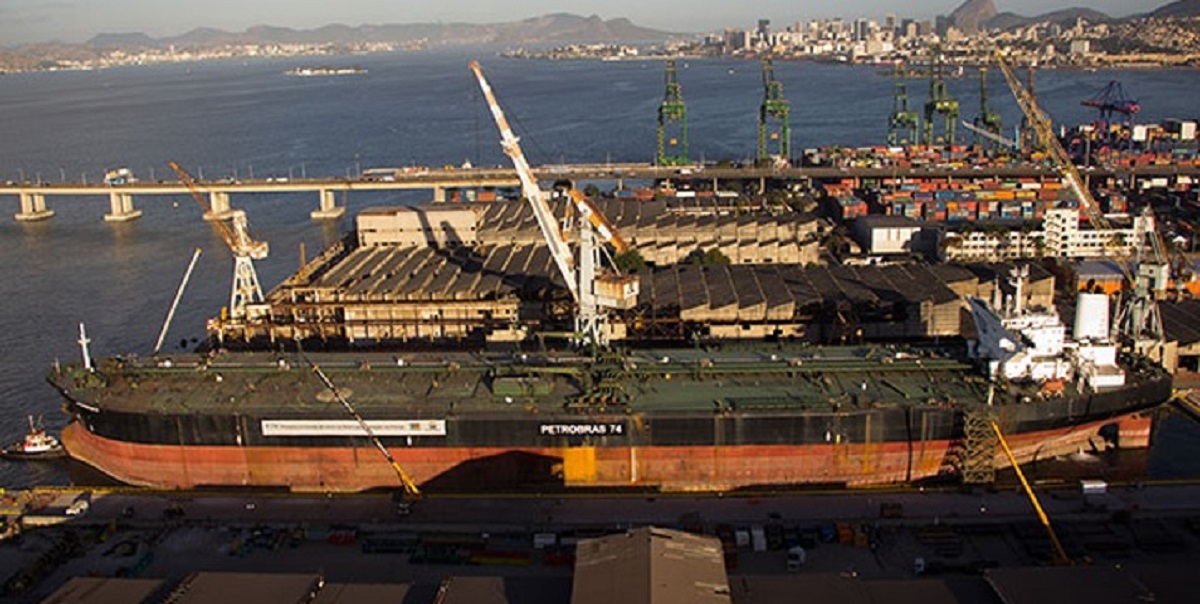
Shipyard (ex-Ishibras) That Once Experienced Glory During the Japanese Era Is Operated by Petrobras in the Caju Neighborhood, Port Region of Rio de Janeiro
From the golden days of shipbuilding and of Japanese origin, the Inhaúma Shipyard, operated by Petrobras in the Caju neighborhood, Port Region of Rio de Janeiro, had its power cut off last Wednesday (04/10) due to non-payment to the utility company.
The workers present had to move to other buildings to continue their work, and even the clocking out process could not be recorded.
The Inhaúma shipyard (ex-Ishibras) is of Japanese origin and had its moments of glory during the prosperous times of our shipbuilding industry.
After being closed for years, it was leased by Petrobras in 2013 and its facilities were revitalized by Enseada (EEP), which would convert four oil tankers into the hulls of the future P-74, P-75, P-76, and P-77 platforms that would be destined for the Cessão Onerosa areas in the pre-salt of the Santos Basin.
-
A Brazilian city decided to purchase a piece of the Atlantic Forest with more than 153,000 square meters, and owners of preserved areas will be able to submit proposals to transform the forest into a conservation unit.

-
Brazilian siblings aged 11 and 7 read 240 books in just one year and caught attention on social media: while many children spend hours on screens, they turned their family’s routine into an example of reading, discipline, and curiosity.
-
The legendary oak that, according to the story, hid Robin Hood from the Sheriff of Nottingham, died at the impressive age of 1,200 years in England, and the first chilling sign of its end was that no leaves sprouted on the tree this spring.

-
While the world looks at forests, the UN warns that the Earth is also threatened by the silent degradation of natural grasslands and savannas, ecosystems that cover half of the planet, support billions of people, and can exacerbate water, food, and climate crises.


Only the hulls of P-74 and P-76 were converted at the shipyard; the hulls of P-75 and P-77 were sent by Petrobras to China.
At the peak of the conversion works for the hulls of P-74 and P-76, over 5,000 direct jobs were created at the shipyard, boosting shipbuilding in Rio de Janeiro.
It is sad to see one of the giants of Brazilian shipbuilding, besides being completely covered in rust in its empty workshops, reach this point.
It is not just the state of Rio de Janeiro that suffers from the crisis in the shipbuilding industry; the recent defeat of the Vard Promar Shipyard in Pernambuco (which was the builder for the “FLV” consortium formed by the Italians Fincantieri and Leonardo shipyard) worsened the situation of the shipbuilding industry in the state.
The lack of orders from the Atlântico Sul Shipyard (EAS) further contributes to the chaos in the sector, and there are even risks of shipyard closures, causing serious concerns for the Metalworkers Union of Pernambuco (Sindmetal-PE). Click here and keep reading this article!






Be the first to react!