






 Portuguese
  Spanish
  3 min of reading
  1 comment


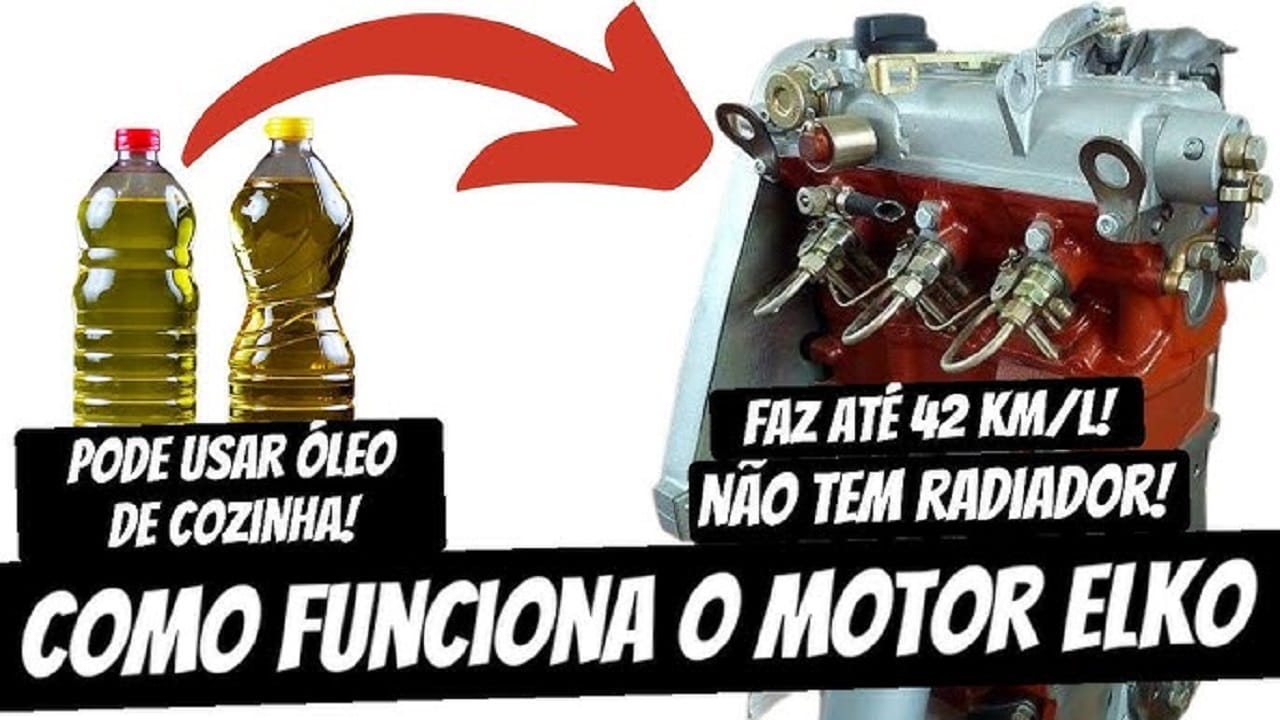

German Inventor Creates The Revolutionary ELKO Engine, An Innovative Propulsor Cooled With Cooking Oil, But That Did Not Advance In Development.
The ELKO Engine, an invention of engineer German Ludwig Elsbett, represents an innovative milestone, although often forgotten, in the field of mechanical engineering. This distinct diesel engine is capable of operating with vegetable or animal oil and stands out for not requiring a radiator or specific cooling system, relying solely on lubricating oil for its cooling.
In the 1950s, Elsbett caused quite a stir in the engineering community by publishing a scientific paper on his experiences with engines. He introduced the surprising idea that the ELKO Engine could operate efficiently without a radiator and cylinder sleeves, using only its unique construction technique.
ELKO Engine Emerged After World War II

At that time, Elsbett had even made the experimental engine with one cylinder and 8 kW of power or almost 11 horsepower with consumption of up to 42 km/l.
-
Uber Faces Shareholder Scrutiny as Board Accused of Ignoring Safety, Compliance, and Harassment Warnings Amid Over 3,500 U.S. Lawsuits

-
Ferrari’s First Electric Car Divides Fans, Priced at $630,000, Amid Concerns Over Limited Editions; Brand Clarifies It’s Not Just for Future Perks
-
BYD Dolphin Mini: The Electric Car That Defies Depreciation, Losing Only 3.58% in a Year and Becoming the Best-Selling Retail Model Under $22,000

-
Electric Car JAC E-JS4 Loses $19,000 in Value in One Year, Leading Record Depreciation of Used Cars in Brazil Due to Expensive Battery and New Models


The inventor created this peculiar mechanics that would be capable of using any fuel, even being able to use cooking oil without problems, something very innovative for the European people, who relied on motorized vehicles, as after World War II fuel became scarce and the price of gasoline per liter was very high.
Multifuel engines like the one created by Elsbett were not new, as another oil engine had gained popularity in the post-war period. The system created by Ludwig operated like a conventional diesel engine, using even the same starting system, but nevertheless, the creator of the new ELKO engine faced financial problems, as no investor was interested in his invention and his car did not attract much attention.
The inventor spent some time unemployed and then, when the famous German truck and engine manufacturer offered him a job opportunity, he did not think twice before accepting the job.
Difficulties Faced By Elsbett
From 1959 onwards, Elsbett began working in the diesel engine division at the Nuremberg factory. During his work, the company showed some interest in his invention, demonstrating interest only in the diesel injection system that makes the mixture enter in a vortex shape in the combustion chamber.
At the company, the inventor of the ELKO engine also implemented a suspended assembly line system, which expedited the construction of engines and vehicles, reducing production costs. However, something was unsatisfactory, and he wanted to return to being an entrepreneur and create his own new engine.
Thus, he gathered his savings and left the company in 1965 to open a new company called Elsbett Konstruktion. The engine, which would become revolutionary, was presented to the world in 1973 and would be known as the ELKO engine, which was completely different from anything that had been created about diesel or gasoline engines until then.
From the outside, it looked like a regular engine like any other but had 3 cylinders and a direct injection system, which was considered something surprising, as until then, physicists and engineers claimed that direct injection in low-displacement engines was impossible.
Other Advantages Of The ELKO Engine
Another attractive feature of the ELKO Engine’s mechanics is that it could burn both diesel oil and oil of vegetable or animal origin, such as liquid lard, as long as they are clean and filtered.
Everything in this engine was meticulously planned, and its air intake system was designed for the air to spiral into the cylinder, forming a cyclone or whirlwind, with the oil injected into the center of the vortex.
The piston of the ELKO engine has a hole in the center, shaped like a small bowl. Because of this cavity in the piston, it is referred to as a semi-adiabatic engine. Due to the heat only concentrating in the center, it does not require a radiator nor cooling ducts.





CORREÇÃO: O motor elsbett usava sim um sistema de arrefecimento com radiador e ventilador mas usava o óleo lubrificante ao invés da água.