Portuguese
  Spanish


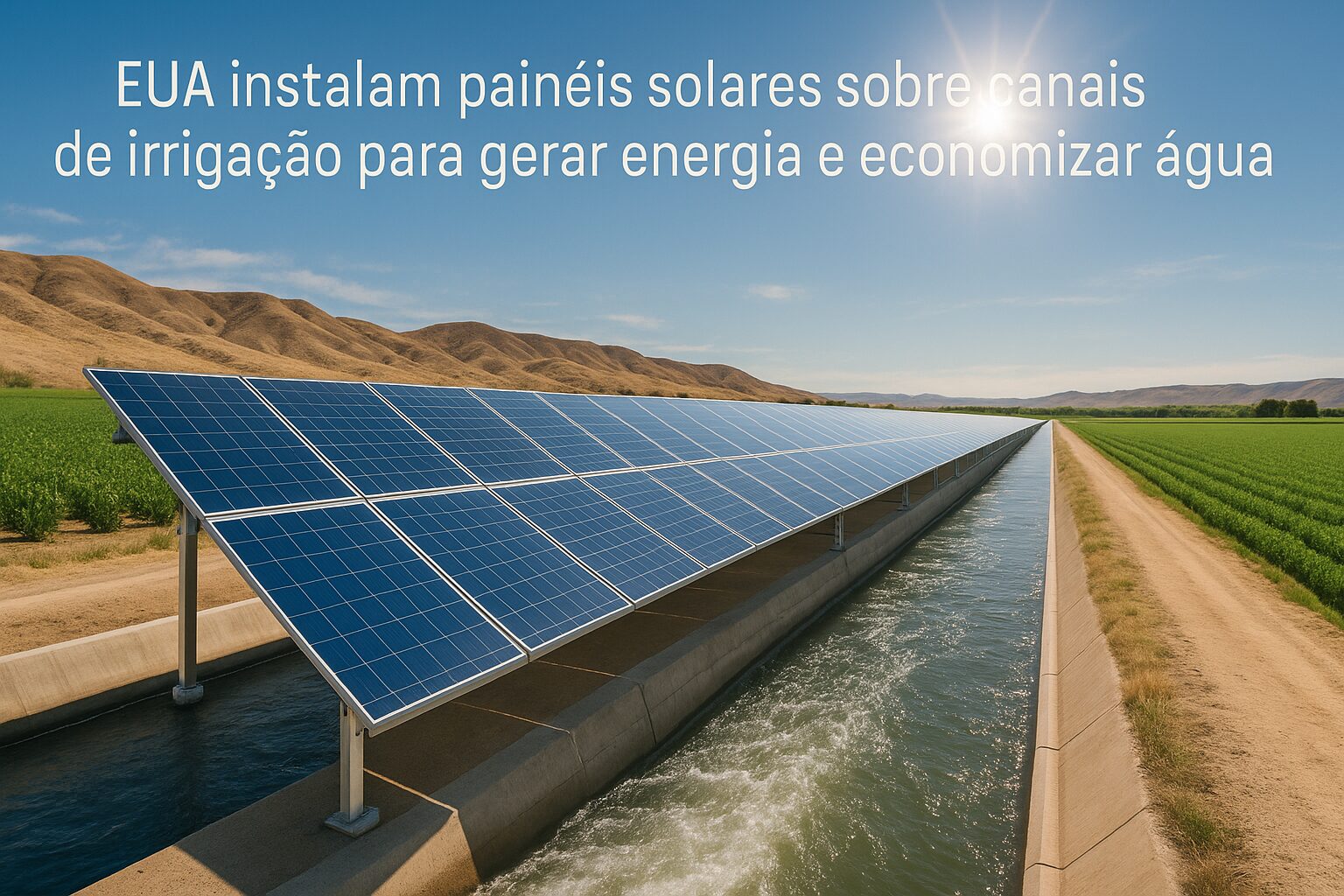

Project Implemented in U.S. States Combats Climate Crisis by Uniting Clean Energy Generation with Water Savings in Regions Affected by Extreme Droughts.
In the search for creative solutions to tackle the climate crisis, the U.S. is betting on the installation of solar panels over irrigation channels as a way to generate renewable energy while preserving water resources. The initiative is underway in states such as California, Oregon, Utah, and Arizona, regions frequently affected by severe droughts.
With investments exceeding US$ 25 million (about R$ 140 million), the proposal combines two important fronts of the environmental agenda: renewable energy generation and the reduction of water evaporation in irrigation systems. This practice, although innovative in the United States, has already been successfully applied in countries like India and Spain.
Nexus Project Leads Initiative in California
The most advanced example in the U.S. is the Nexus Project, installed along irrigation systems in the San Joaquín Valley, California. The first phase of the project received US$ 15 million in funding, much of which came from the Inflation Reduction Act, approved by the federal government to boost the energy transition.
-
Brazil’s Offshore Wind Energy Potential Worth $1 Trillion Stalled by Long-Delayed Agreement

-
World’s Largest Engie Solar Plant in Brazil Highlights Billion-Dollar Energy Waste Issue: Company Considers Batteries and Bitcoin Mining to Avoid Wasting Production

-
Air Products Cancels $2.9 Billion Clean Hydrogen Megaproject in Louisiana, Shuts Down Arizona Unit, Highlighting High Costs of U.S. Energy Transition
-
Over 60 Tractors Take to the Streets in Lopera as Solar Parks Compete with Olive Groves, Affecting 13,000 to 100,000 Trees According to Conflicting Reports


The initial installation took place in the Turlock Irrigation District, which serves about 4,700 farmers. The solar panels were positioned in two different orientations – south and west – with the goal of testing which position offers greater efficiency in electricity generation. The expectation is to produce up to 1.3 gigawatt-hours (GWh) per year.
In addition to generating enough energy to supply homes and small properties, the project contributes to California’s climate goal: to reduce greenhouse gas emissions by 40% by 2030. The shade created by the solar panels over the water reduces evaporation, which represents a significant saving in regions facing water scarcity.
Solar Panels Over Channels: Dual Function and Intelligent Use of Space
The proposal to use solar panels over irrigation channels combines energy efficiency and environmental conservation. Instead of occupying agricultural areas with conventional solar farms, the U.S. is taking advantage of existing spaces. This avoids deforestation of new areas and preserves arable land for food production.
According to the website Ecoticias, this strategy helps to reduce the impact of renewable energy generation on land use, making projects more sustainable and socially acceptable. In Utah, for example, the Layton project anticipates a savings of 3.7 million liters of water per year by using raised structures over the channels.
Other proposals are being evaluated in the country, such as the installation of floating solar panels in the Delta-Mendota Canal, also in California, one of the main water distribution structures in the state. The expectation is to increase energy production without compromising water supply.
International Models Inspire Projects in the U.S.
The installation of solar panels in irrigation channels is not an American exclusivity. India was one of the first countries to test this approach on a large scale. The state of Gujarat, in 2020, began the application of solar modules along more than 80,000 channels in the region.
In addition to generating renewable energy, Indian projects contributed to water conservation and avoided the use of productive land for the construction of conventional solar power plants. Spain has also experimented with similar initiatives, mainly in agricultural areas with arid climates.
These models served as a basis for the U.S. to adapt their solutions to the local context, respecting the climatic, regulatory, and environmental conditions of each region.
Experts Warn of Possible Environmental Impacts
Despite the apparent advantages, experts urge caution. A study from Cornell University in the United States showed that excessive coverage of water bodies with solar panels can generate adverse effects. According to the study, ponds with up to 70% coverage showed a 27% increase in greenhouse gas emissions.
The research suggests that blocking sunlight could affect the balance of aquatic ecosystems, altering the activity of microorganisms responsible for natural processes such as organic decomposition. The researchers recommend that similar projects be evaluated on a case-by-case basis, with constant environmental monitoring.
Renewable Energy Advances in the United States
The advancement of renewables in the U.S. is part of a broader energy transition plan. According to the U.S. Department of Energy, the installed capacity for solar and wind energy has grown significantly in recent years. The expectation is that these sources will represent the majority of the energy matrix by 2040.
Projects like Nexus and other initiatives over irrigation channels complement investments in smart grids, energy storage, and energy efficiency. The U.S. government’s goal is to reduce dependence on fossil fuels and make the energy matrix more resilient to climate change.
Source: Olhar Digital