





 Portuguese
  English
  Spanish
  5 min of reading
  0 comments


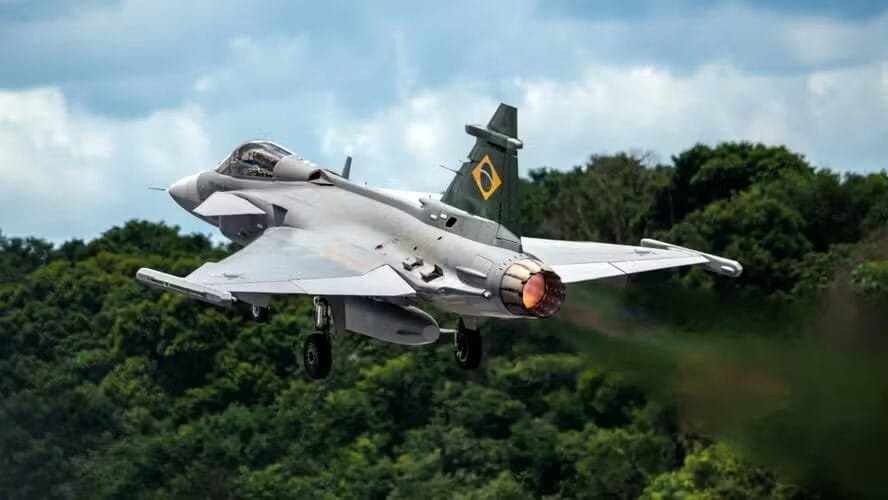
Brazil Faces U.S. Manipulation After Success of Gripen Fighters and KC-390 Transport Aircraft. Country Advances in Technology Transfer and Challenges Global Rivals.
The Brazilian defense industry faces yet another international onslaught.
Behind the scenes, a real geopolitical battle is underway, and Brazil, which has recently established itself as a key player in the military aviation market, now finds itself in the spotlight.
The U.S. Department of Justice is targeting Saab, the manufacturer of the Gripen fighters, and the focus of the dispute is the contract signed by Brazil.
-
More than 100 Chinese ships are surrounding Taiwan, warns the head of the country’s National Security Council.

-
Trump’s announcement about sending 5,000 American soldiers to Poland was received with relief by European allies, but it also raised doubts within NATO about the United States’ strategy, the permanence of the troops, and the division of defense costs on the continent.

-
Yesterday, on the 21st, President Lula stated that he fears an incursion by Donald Trump into the Amazon: while the Brazilian Army advances in a transformation policy that includes troop reorganization, use of technology, and 20% of the forces in a high state of readiness.
-
The war that doesn’t appear on the front: the silent bomb of demographic collapse threatens Russia as Putin loses young people in Ukraine, babies in statistics, and talents in exile.




This movement triggers a series of questions about American interests in undermining Brazilian competitiveness.
Last Thursday (10), a subpoena was issued by the Justice Department of the U.S. requiring Saab to provide detailed information regarding the sale of 36 Gripen fighters to Brazil, finalized in 2014.
According to the newspaper Carta Capital, according to official sources, this investigation is linked to accusations from Operation Zelotes, involving alleged influence trafficking by President Luiz Inácio Lula da Silva.
However, the inquiry was dismissed by Minister Ricardo Lewandowski in 2022, pointing to a lack of evidence and indications of political manipulation by prosecutors.
The U.S. attempt to interfere in the agreement sounds like a geopolitical maneuver to maintain its dominance in the defense sector.
Pressures from Washington and the Global Context
According to the Attorney General of the Union, Jorge Messias, the U.S. government is clearly uncomfortable with Boeing’s defeat in the bidding process for the Gripen fighters, which motivated this new action.
The Super Hornet, offered by the U.S., was discarded in favor of the Swedish Gripen, primarily due to technology transfer issues, a crucial point for Brazil.
The lawyer argues that this interference is similar to what occurred during Operation Lava Jato, when Brazilian companies were targeted by international attacks.
Boeing’s defeat in 2014 was not the only affront to U.S. interests. The competition also included the French Dassault, with its Rafale aircraft.
However, both projects were rejected by Brazil, as they did not offer the technology transfer the government was seeking.
The commitment from Saab, on the other hand, included sharing knowledge and collaborating to ensure Brazil achieves operational autonomy.
Brazilian Advances and U.S. Discomfort
According to former Justice Minister Eugênio Aragão, the success of Embraer’s KC-390 transport aircraft also bothers the U.S. as the aircraft is replacing the Lockheed C-130 Hercules in various markets.
This dispute reflects the United States’ strategy to try to stifle the rise of competitors that threaten its companies.
The KC-390 is already winning international bids, including at NATO, with countries like Turkey and India interested in large batches.
Saab, pressured by the U.S., is also keeping an eye on this dispute, especially now that Sweden has joined NATO.
For Saab, the success of the Gripen and Brazil’s entry into the international military aviation scene represent a significant advance, but also bring new political challenges.
Lawyer Rafael Valim states that this situation is yet another example of the use of “geopolitical lawfare” by the United States, which employs the Foreign Corrupt Practices Act (FCPA) to attack global competitors.
Technology Transfer and Brazil’s Gains
The Gripen fighter program not only brought Brazil technological autonomy but also a robust industrial base.
Since the beginning of the contract, half of the Gripen components have been produced in Brazilian territory, with the final assembly of most aircraft taking place at Embraer’s facilities in Gavião Peixoto, São Paulo.
Brazilian companies like Akaer and AEL Sistemas have been involved in the development of the fighters, collaborating directly with Saab.
Economist Marcos José Barbieri Ferreira from Unicamp explains that by choosing the Gripen, Brazil secured more than just a simple purchase contract.
The country ensured direct participation in the engineering and integration process of the aircraft, a feat that would not have been possible with the fighters offered by Boeing or Dassault.
Gripen Fighters: The International Reaction and a New Era for Brazil
As Brazil’s prominence in the defense sector grows, Washington intensifies its actions to undermine the advancement of Brazilian companies.
According to Professor Arthur Pinheiro de Azevedo Banzatto from the Federal University of Grande Dourados (UFGD), Brazil is the second most targeted country by the FCPA, trailing only China.
This external pressure is a direct reflection of Brazil’s rise as an emerging power, especially in the context of BRICS.
Moreover, the global market is increasingly attentive to Brazil’s movements, with countries like China forming strategic partnerships.
Next month, the visit of Chinese President Xi Jinping is expected to intensify this cooperation, bringing new opportunities for Brazilian infrastructure and logistics, areas that have historically attracted U.S. attention.
With the success of the Gripen and KC-390, Brazil consolidates itself as an important player in the global defense industry, directly challenging companies like Boeing and Lockheed Martin.
This commercial dispute is more than just a simple market rivalry; it reflects the struggle for geopolitical power in an increasingly polarized global scenario.
The Future of the Brazilian Defense Industry
The choice of the Gripen represented a historic turning point for Brazil in the defense sector. Not only because of the quality of the aircraft but also due to the technological and industrial impact that the agreement brought to the country.
Amid international pressures, Brazil remains steadfast in its development trajectory, confronting head-on attempts at geopolitical interference.
Will the United States continue to use its influence to try to halt Brazilian progress, or are we witnessing a new era of autonomy and prominence on the global stage?









-

1 person reacted to this.