Portuguese
  Spanish


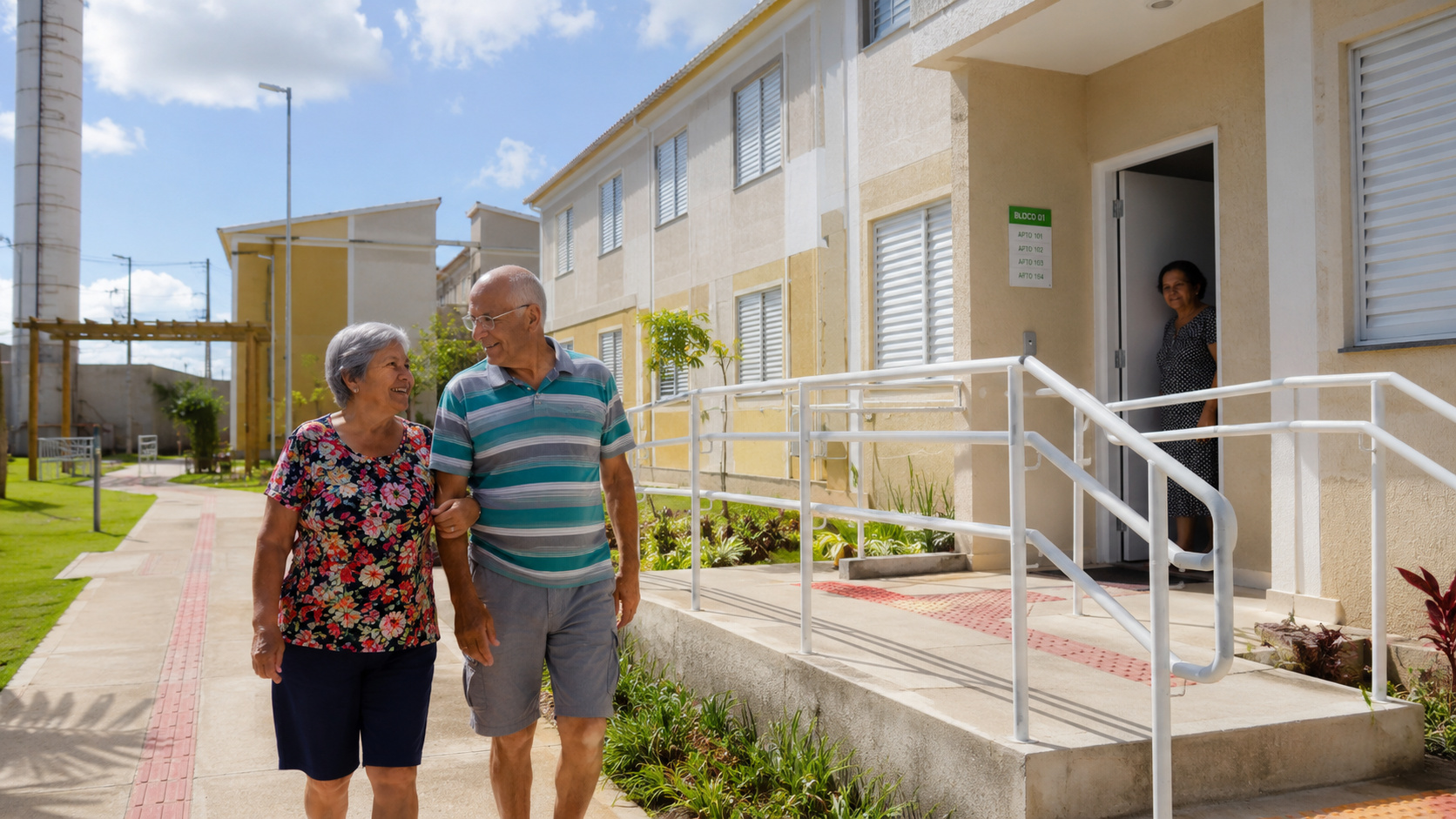

Federal government housing program guarantees priority for seniors over 60, reservation of ground floor properties, and specific financing rules that directly impact installment amounts and payment terms
The accelerated aging of the Brazilian population has turned affordable housing into one of the country’s main social concerns. In this scenario, the Minha Casa Minha Vida program has adopted specific measures to serve seniors over 60, ensuring priority access to public housing and specific rules for real estate financing.
According to information released on May 19, 2026, the federal program offers exclusive benefits for the elderly, including mandatory reservation of properties, preference for ground floor units, and accessibility adaptations. However, a rule from the Central Bank of Brazil also imposes a limit that may hinder financing for retirees and pensioners.
The measure has drawn attention because, in practice, many seniors end up facing higher installments precisely due to the so-called “80-year rule,” used by banks in calculating the maximum payment term.
-
Adventurer Camps in Giant Fig Tree in the Brazilian Amazon After Spotting It with Drone

-
Nokia 3210 Revived with Modern Features by Enthusiast, Retains Classic Design After 25 Years
-
Off-Grid Family in Brazil Solves Water Supply with 5,000-Gallon Tank and Automated Pump System

-
U.S. Rotates 11,000-Ton Building 90 Degrees Over 31 Days While Keeping 600 Employees Inside With Uninterrupted Utilities





Seniors have legal priority and the right to ground floor properties

For families classified in Band 1 of the program — intended for those with a monthly income of up to R$ 2,640 — the legislation establishes special protection for elderly residents.
Under the current rule, at least 3% of housing units must be mandatorily reserved for people over 60. Additionally, there is priority for apartments located on the ground floor, reducing risks related to mobility and the use of stairs.
This model seeks to ensure more safety and autonomy for the elderly within public housing developments.
In addition to the privileged location, the properties must also meet minimum accessibility criteria. Among the planned adaptations are:
- Adequate spaces for circulation;
- Possibility of installing support bars;
- Adaptable environments for wheelchairs;
- Structure prepared for access ramps;
- Bathrooms with better mobility.
As published by the federal housing program, the goal is to encourage active aging and allow the elderly to remain integrated into communities with more comfort and independence.
80-Year Rule Reduces Term and Increases Installment Amounts
If seniors receive priority in Range 1, in Ranges 2 and 3, age can become a significant financial obstacle.
This happens due to the rule established by the Brazilian banking system, which determines that the sum of the buyer’s age and the financing term cannot exceed 80 years and six months.
In practice, this limitation drastically reduces the time available to pay for the property.
A retiree aged 65, for example, cannot take out a traditional 35-year financing. In this case, the maximum term allowed is around 15 years.
Although the rule seems merely technical, the financial impact is usually significant.
With less time to pay off the property:
- The installments become higher;
- The down payment tends to increase;
- Bank approval becomes more stringent;
- Many buyers need to include children or grandchildren in the income composition.
Real estate sector specialists point out that this condition can practically double the monthly installment value compared to longer contracts.
Even so, pensions and retirement benefits are normally accepted as proof of income by the financial institutions participating in the program.
How Seniors Can Participate in Minha Casa Minha Vida
The path to joining the program depends directly on the family’s income bracket.
In the case of Range 1, intended for low-income families, the process must be done directly at the city hall or the local social housing sector.
At this stage, it is mandatory to have an updated registration in the Cadastro Único, known as CadÚnico.
For families classified in Ranges 2 and 3, the procedure takes place through the Caixa Econômica Federal or partner construction companies accredited to the program.
Among the documents normally required are:
- Official document with photo;
- CPF;
- Proof of residence;
- Proof of income;
- Retirement or pension statement;
- Income Tax Declaration, when applicable.
After the submission of the documentation, the bank conducts a credit analysis to determine:
- Maximum property value;
- Allowed term;
- Interest rate;
- Installment amount;
- Need for additional down payment.
Meanwhile, the federal government maintains the policy of expanding affordable housing for the elderly as part of housing inclusion strategies in response to the growing population over 60 years old in Brazil.
According to the report published on 05/19/2026 and updated on 05/20/2026, the program continues to prioritize safe, affordable, and adapted housing for families with elderly members, especially in regions with higher social demand.