






 Portuguese
  Spanish


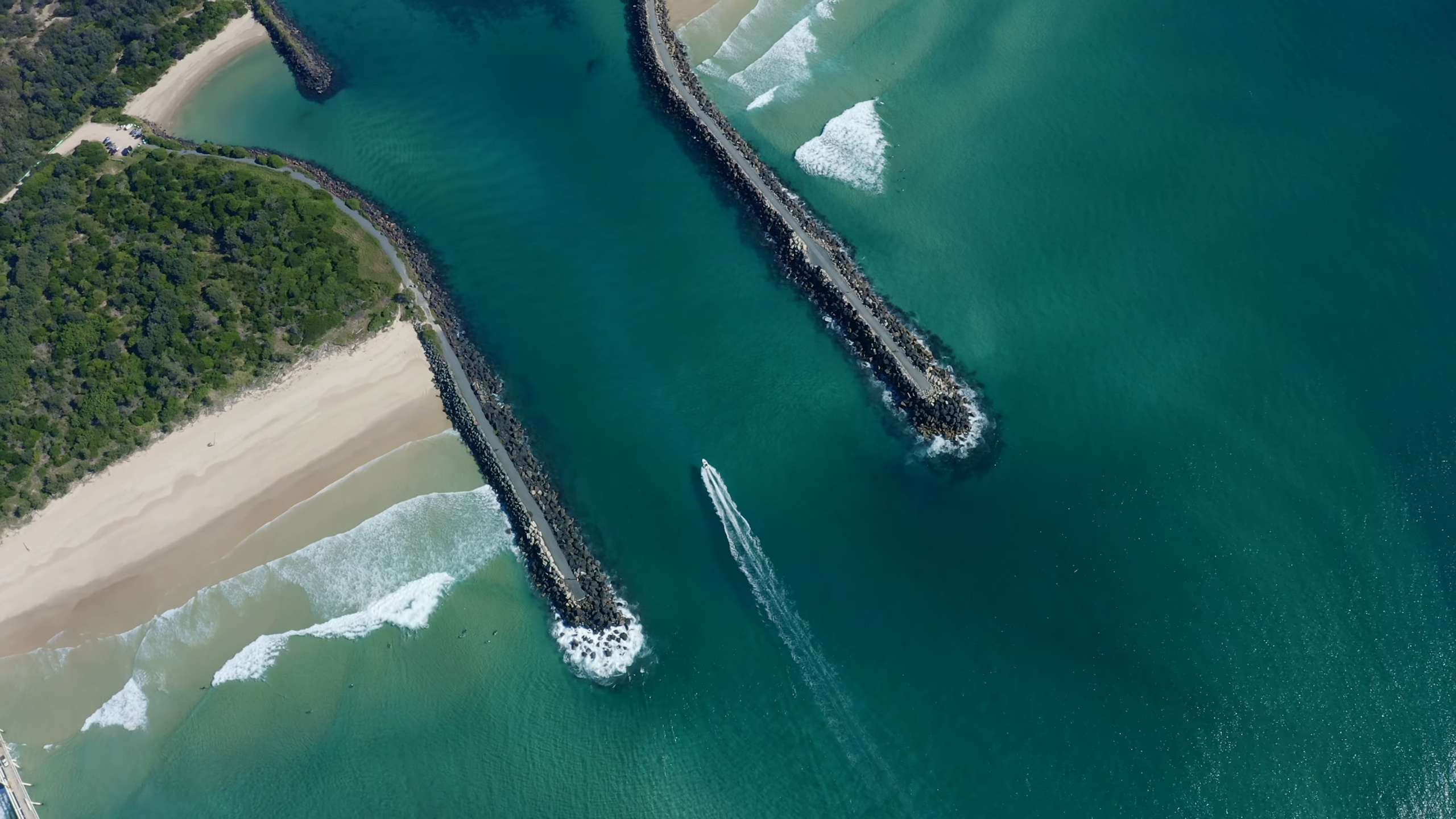


Gold Coast Sand Bypass System pumps 500,000 m³ of sand per year, keeps the channel navigable and protects beaches from coastal erosion in Australia.
According to the Gold Coast Waterways Authority, the Gold Coast Sand Bypass System is the world’s first permanent sand bypass system. The infrastructure was designed to solve a problem that most coastal cities still try to tackle with expensive and inefficient periodic dredging. The system was built in 1986 as an integral part of the Gold Coast Seaway, the artificial entrance created to stabilize the mouth of the Nerang River into the Pacific Ocean, in Queensland, southeastern Australia. Before 1986, the bar of the Nerang River was described as “incredibly dangerous.”
The river mouth migrated up to 60 meters north per year, driven by southeast winds, littoral drift, and currents that move 500,000 cubic meters of sand along the southeastern coast of Queensland every year.
Gold Coast Seaway stabilized the Nerang River, but could destroy beaches to the north
The conventional solution to stabilize a coastal entrance like this is two parallel breakwaters, capable of holding the river mouth in a fixed position. But breakwaters create a new and immediate problem: they interrupt the natural flow of sand along the coast.
-
Pennsylvania Mine Creates Ice in Summer Heat and Melts in Winter, Turning a Mountain Crevice into a Reverse Natural Refrigerator

-
China Accelerates Global Expansion of Robotics: From Smart Vacuums to Industrial and Humanoid Machines, Millions Exported to Over 150 Markets
-
Polar Air Mass to Hit Brazil: Temperatures to Plummet in Nine States, Near Freezing in the South with Frost Risk Until Monday
-
Chinese “dark factories” produce electric cars 24/7 with minimal human intervention, as Zeekr assembles 800 units daily, raising concerns in Brazil.







The sand that would normally migrate north begins to accumulate behind the southern breakwater. Meanwhile, the beaches north of the channel — Surfers Paradise, Main Beach, and The Spit — are deprived of the natural supply and start to erode.
The Gold Coast Seaway project recognized this risk before construction. Therefore, it included the Sand Bypass System from the start as an inseparable component of the work, not as an improvised fix years later.
Sand bypass system cost A$ 50 million and used 1 million tons of rock
The Seaway project cost A$ 50 million and used 1 million tons of imported rock. The construction also employed 4,500 concrete cubes of 20 and 25 tons to form the breakwaters.
The difference with many coastal works lies in the planning. Instead of stabilizing the channel and leaving erosion for later, Gold Coast created a permanent infrastructure to move sand from one side to the other.
Since March 2026, when Cyclone Alfred hit Queensland, more than 160,000 cubic meters of sand have been pumped through the system in intensified operation.
Littoral drift explains why artificial channels cause coastal erosion
To understand why the Gold Coast Sand Bypass System exists, it is necessary to understand littoral drift. This is the process by which sand continuously moves along the coast, creating winners and losers when an artificial work blocks this flow.

Along any coast where waves arrive at an oblique angle to the beach, there is a littoral drift current running parallel to the shoreline. This current transports sand in a preferential direction, continuously and silently.
In southeast Queensland, southeast winds and ocean currents move sand from south to north along the entire coastline. Every grain of sand on the beaches of Surfers Paradise arrived from areas further south and will move north when conditions allow.
Breakwaters block the natural transport of sand on beaches
When an artificial channel cuts this drift, the breakwaters create a barrier that sand cannot cross. Sediment accumulates on the south side until it reaches the top of the structure.
From this point, sand begins to bypass the end of the breakwater and enter the channel. This accumulation forms sandbanks that threaten navigation and require constant removal.
Meanwhile, the beaches to the north, deprived of continuous supply, begin to recede. The phenomenon has a technical name: down-drift sediment starvation, a problem documented in channels and ports around the world.
Sediment starvation would put Surfers Paradise and Main Beach at risk
At the Gold Coast Seaway, engineers calculated before construction that, without some bypass mechanism, the beaches north of the channel would progressively and potentially irreversibly lose sand.
This risk would affect important coastal areas of Queensland, including Surfers Paradise, Main Beach, and The Spit. Erosion would not be a distant side effect but a direct consequence of blocking the littoral drift.

Therefore, the Australian system was designed as a structural part of the work. It not only keeps the channel navigable; it also artificially replaces the natural sand transport that the breakwaters interrupted. The engineering solution developed for Gold Coast is physically simple in description but had no precedent in scale and permanence when it was built in 1986.
A 494-meter jetty extends from the south side of the channel into the ocean, crossing the zone where sand accumulates behind the breakwater. It is in this strip that the system intercepts the sediment transported by the littoral drift.
Along the jetty, 10 vertical jet pumps are installed buried in the sand, 11 meters below the reference level. They are positioned exactly where sand accumulation occurs before threatening the channel.
Buried jet pumps transform sand into slurry to cross the Seaway
The jet pumps operate with high-pressure water. The water pumped by the jetty creates pressure that forces the surrounding sand and water into the equipment.
This mixture of sand and water forms a pumpable sludge called slurry. It is this material that allows the accumulated sediment to be transported through troughs and underwater pipelines.

The sludge is gravity-fed through an inclined trough to a control station at the base of the jetty. Then, a variable-speed centrifugal pump injects the material into a submarine pipeline that passes under the channel.
6.4 km submarine pipeline returns sand to South Stradbroke Island
The 6.4 km pipeline transports the sand sludge under the channel bed and discharges the sediment on the southern ocean beach of South Stradbroke Island, north of the Seaway.
This is exactly the point where the sand would naturally arrive through the coastal drift if the artificial channel did not exist. The system does not invent a new flow: it artificially recreates the path that the coast already made on its own. When operating at full capacity, the process happens continuously at 500 cubic meters per hour. The system can operate autonomously at night, without operators present, monitored by computers.
The Gold Coast Sand Bypass System is monitored by computers that control which of the 10 pumps should remain active. The goal is to maximize the efficiency of sand capture and transport.
This control allows adjusting the operation according to sediment accumulation, sea conditions, and the need to keep the channel navigable. The infrastructure works continuously, not just when an emergency is already in place.
This is the main difference compared to periodic dredging. Instead of waiting for the sand to form dangerous banks, the system captures the sediment before it blocks navigation or accelerates beach erosion.
500 thousand cubic meters of sand per year show the scale of the system
Five hundred thousand cubic meters is the annual volume of sand that the system moves from one side of the channel to the other. This number needs context to be visualized correctly.
A cubic meter of wet sand weighs approximately 1.6 tons. Therefore, 500 thousand cubic meters equate to about 800 thousand tons of sand per year.
This volume corresponds to the weight of almost 6 thousand loaded train wagons. It is a gigantic scale of coastal sediment management, operating every year under the Gold Coast channel.
Pumped sand could form an entire beach if dumped all at once
If the 500 thousand cubic meters were distributed along a 1 km beach with 50 meters width, they would form a layer of 10 meters deep.
It is an amount that, if dumped all at once, could create an entirely new beach. But the system does not work for visual impact, but for continuous replenishment.
The Sand Bypass System moves the sand gradually throughout the year to reconstitute the natural flow that existed before the channel’s construction. This constancy is what maintains the balance between navigation and coastal protection.
Gold Coast and Tweed River form a mega infrastructure of coastal sediments
For comparison, the largest beach replenishment operation in southern Queensland was the Tweed River Sand Bypassing System. It was built with a similar design to solve the same problem created by the Tweed River channel, on the border between Queensland and New South Wales.
When both systems operate at full capacity, the sand bypass infrastructure of southeastern Queensland moves approximately 900 thousand tons of sediment per year.

This sediment passes through pipelines buried under riverbeds and coastal channels. The set forms one of the largest continuous coastal sediment management operations in the world.
In March 2026, Cyclone Alfred hit southeastern Queensland. It was the first cyclone to approach Gold Coast in decades. The storm moved abnormal amounts of sand in a few hours, creating exceptional buildup behind the southern breakwater. This buildup directly threatened the navigability of the channel.
Since Cyclone Alfred, more than 160 thousand cubic meters of sand have been pumped through the system. The volume is equivalent to about one-third of the normal annual average in just a few weeks.





