Portuguese
  Spanish


During the Cold War, a Former AVON Executive Built a Luxury Underground Mansion to Withstand Nuclear Attacks. Valued at US$ 18 Million, It Was Forgotten for Decades.
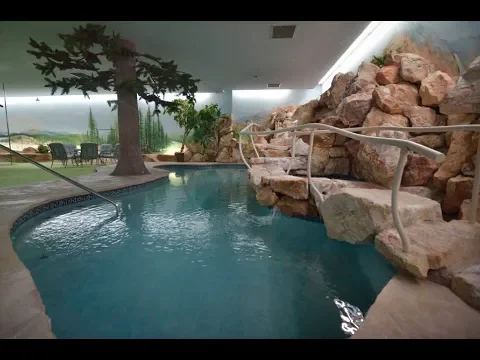
At the height of the Cold War, the fear of a nuclear war was real. Governments, millionaires, and visionaries began investing in structures that would ensure their survival in the face of global catastrophe. It was in this context that Girard B. Henderson, former AVON executive and American entrepreneur, decided to build one of the most extravagant underground residences ever recorded in the United States. Located in Las Vegas, Nevada, the bunker-mansion was designed to withstand atomic blasts while providing the comfort of a luxury mansion — complete with an artificial backyard, indoor pool, scenic gardens, and even a painted false sky on the ceiling. You might also be interested in: Over 100 Countries Send Seeds to a “Doomsday Vault” in the Arctic — and the Reason Has Everything to Do with the Future of Life on Earth. Learn About the Svalbard Vault
Who Was Girard Henderson?
Girard “Jerry” Henderson was a business magnate, known for being an executive and director at AVON Products, as well as the founder of companies such as Gulfstream American and the Foundation for the Advancement of Science and Education. During the 1970s, Henderson became an enthusiast of survival technologies and began investing in underground housing.
A visionary, eccentric, and fearful of the geopolitical direction of the time, he believed that a nuclear war was inevitable — and that only the prepared would survive.
-
Two Newborns Named Cecília Share Same Birth Minute at Brazilian Hospital, Creating Rare Coincidence

-
Brazilian Couple Turns Property into Culinary Hub, Investing $400,000 to Build a Business Earning $800,000 Annually
-
Couple Quits Jobs, Converts 1981 VW Van into Home, Travels 80,000 Kilometers Across the Americas, and Wins Surprise Tickets to See Messi Make History at the World Cup

-
Rio de Janeiro School’s Listening Program Reduces Dropout Rates and Boosts Literacy, Set to Expand to 350 Municipal Schools


The Construction of the Underground Bunker-Mansion
In 1978, Henderson decided to build in Las Vegas a 1,400-square-meter underground house, located about 8 meters below the surface. He purchased a lot in a residential neighborhood and built a fake residence above ground, used as a façade. The true dwelling, however, was completely hidden beneath the earth.
The Interior of the Bunker-Mansion Includes:
- 5 Bedrooms and 6 Bathrooms
- Dining Room, Living Rooms, and a Spacious Kitchen
- Indoor Pool and Spa
- Garden with Fake Trees, Artificial Lawn, and Simulated Night Lighting
- Hand-Painted Murals on the Walls to Simulate Natural Landscapes
- Ceiling with Lighting System to Imitate the Day Cycle
The design was signed by Jay Swayze, a Texan architect known for his high-end underground house designs.
During the 1970s, the fear of mutually assured destruction (MAD) between the U.S. and the USSR led to the popularity of private bunkers. However, most of them were spartan, made only for minimal survival. Henderson’s project was different: it was a luxury bunker-mansion, with everything a traditional mansion would have — except the real sky.

The intention was clear: if the outside world was in ruins, his life would continue normally underground.
The Abandonment After the Death of the Bunker-Mansion Founder
Girard Henderson passed away in 1983, just five years after the construction of the underground mansion. Since then, the property has undergone a long period of abandonment.
With the devaluation of nuclear shelters after the end of the Cold War and the difficulty of maintaining complex underground structures, the property has been closed for decades. During that time, it became a subject of local fascination and speculation.
The Attempt to Sell for US$ 18 Million
In 2014, the bunker was purchased by the Stasis Foundation, an organization linked to research in cryogenics and human longevity, for about US$ 1.15 million. Aiming to preserve the space and convert it into an educational or tourist center, the foundation partially restored the site.

However, in 2020, the property was listed again on the real estate market for US$ 18 million. Despite all the historical and visual appeal, there were no interested parties willing to pay such an amount.
Today, the bunker continues to be advertised for sale or rental for events and recordings, being one of the most curious and unusual properties in the U.S.
The Bomb-Proof House That Became a Movie Set
Over the years, the mansion began attracting attention from the entertainment industry. Various productions, music videos, and documentaries have used the location as a set, highlighting its vintage style, air of mystery, and connection to the years of tension during the Cold War.
Popular videos on YouTube have garnered millions of views, showcasing the preserved interior of the house — with its intact retro aesthetic, including tube televisions, original furniture, and even functioning appliances from the time.
Is the Mansion Really Bomb-Proof?
The answer is: in theory, yes. The house was built with cutting-edge technology for its time, including:
- Reinforced Concrete Walls
- Ventilation Systems with Filtration for Radioactive Particles
- Self-Contained Water and Food Reservoirs
- Independent Power Generators
- Thermal and Acoustic Shielding
Despite this, it has never been tested in practice — and today it does not meet modern nuclear safety standards. Nonetheless, it is considered one of the most complete underground residential structures ever built in the U.S.
Why Didn’t Anyone Else Want to Live There?
Despite all the innovation and protection, the truth is:
- Maintaining the property is expensive: ventilation, lighting, and humidity require constant technical care.
- It’s an Uncommon Space: the absence of sunlight and the closed design make daily life difficult.
- Cultural Shift: the fear of nuclear war has lessened, and properties like this have lost attractiveness in the traditional market.
The result was an eccentric, expensive, and difficult-to-sell property, even with all its historical appeal.
A Time Capsule from the 70s
Today, Girard Henderson’s mansion is considered a time capsule. Everything about it harks back to the 1970s: the psychedelic wallpaper, vintage appliances, kitsch aesthetics, hand-painted murals. The feeling for those who enter is that time has stopped.
For researchers, journalists, and curious individuals, the site represents the apex of nuclear paranoia among the wealthy — and the attempt to maintain luxury even in the face of global destruction threats.
The story of the bunker-mansion built by a former AVON executive is, above all, a story about fear, power, and excess. Amidst the tension of the Cold War, Girard Henderson decided that the solution was to dig — and create an underground refuge where life would continue normally even after the end of the world.
But what was meant to be a sanctuary against the apocalypse became, over time, an abandoned monument of paranoia and extreme luxury. Valued at up to US$ 18 million, the mansion still stands, empty — waiting for someone willing to live beneath the ground in the city that never sleeps.
Sources:
- Business Insider – The Doomsday Bunker in Las Vegas
- BBC – Bunkers of the Cold War Era
- The Guardian – Life Underground
- NPR – Bunkers and Billionaires