






 Portuguese
  Spanish
  5 min of reading
  0 comments


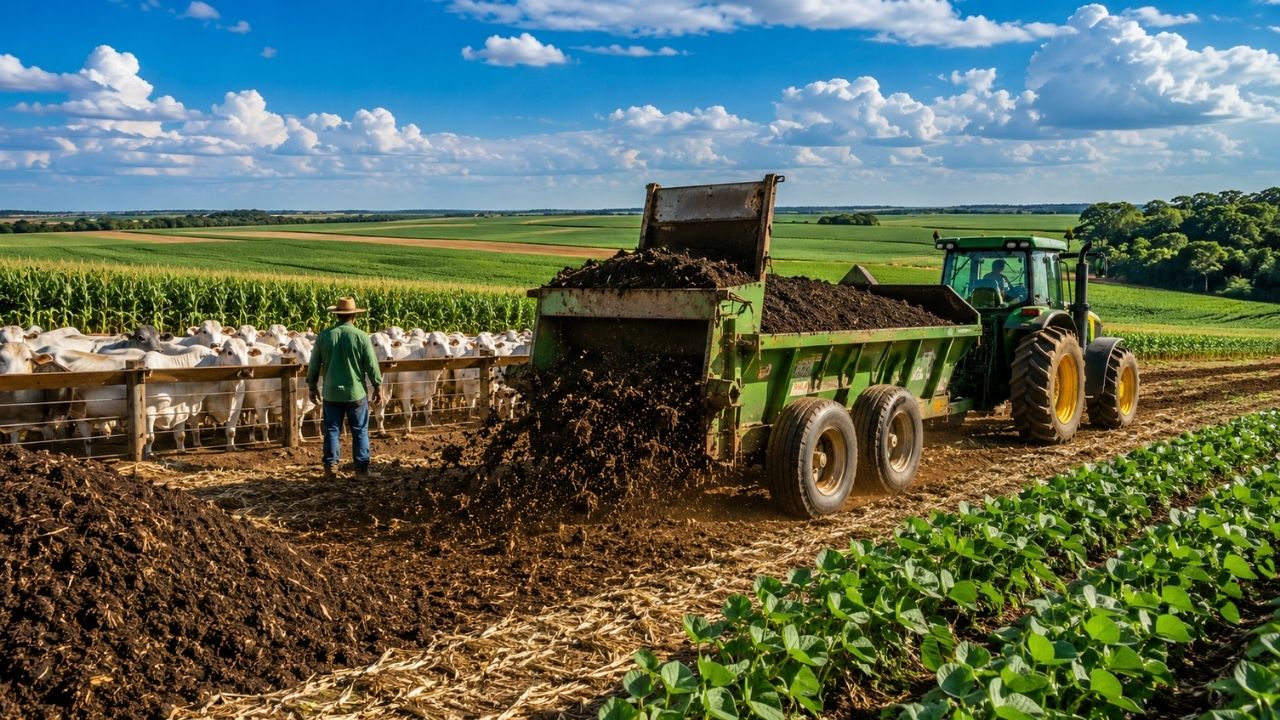
The farm in Silvanópolis transforms cattle manure into natural fertilizer, integrates crop and livestock farming, reduces costs, and shows an alternative to imported fertilizers amidst Brazil’s dependence on external inputs, expensive freight, and pressure on rural farming costs in current Brazil, impacting agricultural production.
A farm in Matopiba has been drawing attention for transforming a common livestock residue into an agricultural input. Cattle manure, which could be treated merely as an environmental liability, undergoes composting with microorganisms and becomes a natural fertilizer used in its own production.
According to the globonews channel, the case shows how the integration between crop and livestock farming can create a more efficient cycle within the farm gate. Instead of relying solely on purchasing chemical fertilizer, the property reuses organic material, reduces expenses, and gains more control over some of the nutrients used in the soil.
Cattle manure ceases to be residue and becomes an agricultural input

In the farm’s routine, the manure generated in confinement is taken to a composting area. There, the material receives microorganisms prepared on the property itself, which aid in the process of transforming the residue into natural fertilizer.
-
Brazilian Joins Homeownership Consortium, Faces Decade of Dual Payments Totaling $141,000, Surpassing Traditional Mortgage

-
Low-Demand Brazilian Beef Offal Gains Popularity Abroad: Indonesia Purchases $19.5 Million, Boosting Revenue and Reducing Waste
-
Soy Expansion in Former Brazilian Savanna Sparks Water and Land Conflicts in Major Agricultural Frontier
-
Land Rover to Halt Production in July, Putting 371 Jobs at Risk, as Chinese Automaker Negotiates to Convert Factory to 100,000 Vehicles Annually by 2027



According to those responsible for the production, phosphorus is solubilized over a period of about 15 days. After this process, the fertilizer is ready to replace chemical fertilizer in the part related to phosphorus, one of the essential nutrients for crop development.
The logic is simple, yet powerful: what could once represent waste now gains productive value. Manure ceases to be an operational problem for livestock farming and begins to function as a tool within agriculture.
This model also reduces the need to purchase some inputs from outside the property. In a country that still depends on imported fertilizers, any alternative capable of reducing costs and utilizing internal resources gains relevance for the rural producer.
Farm becomes self-sufficient in phosphorus
The farm achieved self-sufficiency in phosphorus, one of the three main agricultural nutrients alongside nitrogen and potassium. These elements form the basis of what is called NPK, an essential set for soil fertility and crop productivity.
In the case of the property, internal phosphorus production allows for the replacement of chemical fertilizer at this specific stage. This does not mean total independence from fertilizers, as the farm still needs to buy nitrogen and potassium, but it represents an important advance in reducing external dependence.
The central point is that the property has gained control over a strategic part of its own fertilization. Instead of being fully exposed to price fluctuations, freight costs, and fertilizer availability, it can internally produce a significant fraction of what it needs.
Furthermore, production exceeds internal consumption. According to the producers’ report, the surplus amounts to about 4,000 to 5,000 tons sold externally, which also transforms the natural fertilizer into a potential source of revenue.
Integration between crop and livestock farming closes the productive cycle
The experience only works because the farm integrates livestock and agriculture. The cattle provide the manure, the manure undergoes composting, the fertilizer returns to the crops, and agricultural production continues to feed the rural system.
In practice, this integration creates a more efficient relationship between activities that are often treated separately. Livestock farming generates organic raw material, while crop farming benefits from the fertilizer produced within the farm itself.
This cycle reduces waste and increases the utilization of available resources. Instead of buying everything from outside and discarding animal waste, the property reorganizes its internal flows to transform surplus into input.
Integration also addresses a growing concern in the countryside: producing more without uncontrollably increasing costs. When the producer can better utilize what already exists within the farm, they reduce financial pressure and improve system efficiency.
Natural fertilizer can cost less than chemical fertilizer
One of the model’s strongest points is its cost. According to producers, phosphorus extracted on the farm is about 58% cheaper than the equivalent chemical product, especially in a scenario of expensive freight, scarcity, and instability in the fertilizer market.
This difference is significant because fertilization is one of the most sensitive parts of the agricultural budget. When fertilizer prices rise, the impact quickly reaches crop planning, the producer’s margin, and the final production cost.
Another factor cited is the residual effect of natural fertilizer in the soil. According to the experience reported on the property, areas that have received the product for years may show less need for new phosphorus applications in certain cycles.
This point does not eliminate the need for technical monitoring, soil analysis, and proper management. However, it shows that the use of organic material can go beyond the immediate replacement of chemical fertilizer, also influencing soil quality and fertility over time.
Dependence on imported fertilizers increases the weight of the solution


Brazil has large-scale agriculture and, at the same time, depends on fertilizers from other countries. This combination makes the sector vulnerable to international conflicts, exchange rate fluctuations, logistical problems, and increased freight costs.
In this context, a farm that can produce part of its own fertilizer gains a strategic advantage. The property is not immune to market pressures, but it reduces its exposure at an important point in production.
The Matopiba experience alone does not solve Brazil’s dependence on imported fertilizers. However, it points to a possible path for properties with integrated livestock farming, a volume of organic matter, and the structure to perform composting with technical control.
Nor is it an automatic solution for every producer. The result depends on management, scale, knowledge, structure, agronomic monitoring, and the ability to apply the fertilizer correctly to the crop.
What this experience reveals for Brazilian agriculture
The farm in Matopiba shows that sustainability and economy can go hand in hand when rural production is conceived as a system. Cattle manure ceases to be just waste, becomes natural fertilizer, reduces costs, and helps close the cycle between livestock and crops.
At the same time, the case raises a broader discussion about the future of Brazilian agriculture. In a country dependent on imported fertilizers, producing part of the nutrients on the property can be an increasingly relevant strategy.
The challenge lies in knowing how far this model can be replicated. It requires structure, planning, and integration between activities, but it can open space for more efficient properties, less exposed to the external market, and more careful with soil use.
Do you think more producers should invest in natural fertilizers made on their own farm, or does this model still depend on a difficult scale for most? Leave your opinion in the comments.





Be the first to react!