






 Portuguese
  Spanish
  6 min of reading
  0 comments


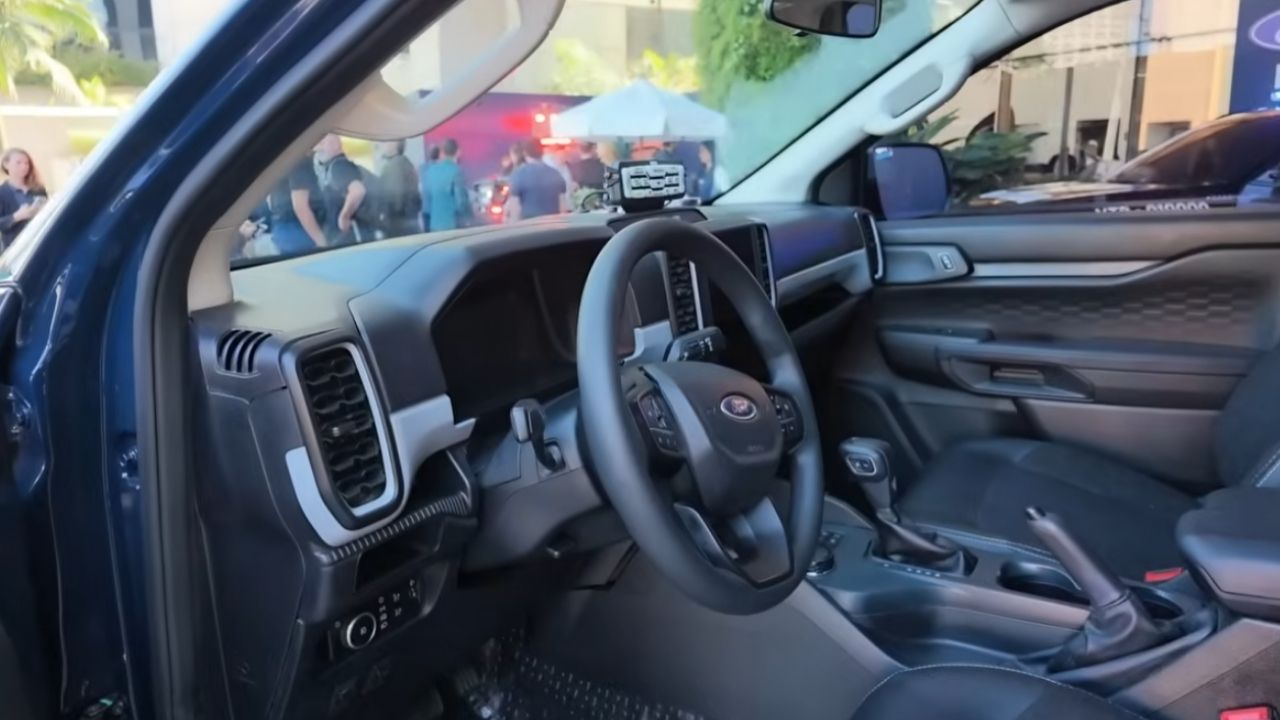
The PRF’s Ford Ranger shows how a 4×4 patrol car for Brazilian highways receives a radio communicator, light bar, diesel traction, auxiliary lights, and internal controls for patrolling. The preparation reveals functional adaptations that help agents in approaches, operational support, and signaling during daily police work on Brazil’s federal highways.
The PRF’s Ford Ranger appeared in a configuration prepared for highway operations and drew attention by revealing details that normally go unnoticed by the public. On the outside, the pickup maintains the Ranger’s robust base but gains institutional paint, a light bar, auxiliary lights, and accessories aimed at police work.
According to the Falando de Carro channel, the proposal becomes even clearer. The cabin shows a radio communicator, lighting controls, siren activation, traction controls, and features designed for those who need to operate in rapid displacements, approaches, support in occurrences, and daily patrolling on Brazilian roads.
Pickup maintains diesel base and gains preparation for police use

The PRF’s Ford Ranger is based on a 2.0 diesel configuration, with a reported power of 170 horsepower and torque close to 40 kgfm. The setup works with a six-speed automatic transmission and a 4×4 traction system, an important combination for a patrol car that needs to circulate on highways, shoulders, support areas, and more difficult access sections.
-
Uber Faces Shareholder Scrutiny as Board Accused of Ignoring Safety, Compliance, and Harassment Warnings Amid Over 3,500 U.S. Lawsuits

-
Ferrari’s First Electric Car Divides Fans, Priced at $630,000, Amid Concerns Over Limited Editions; Brand Clarifies It’s Not Just for Future Perks
-
BYD Dolphin Mini: The Electric Car That Defies Depreciation, Losing Only 3.58% in a Year and Becoming the Best-Selling Retail Model Under $22,000

-
Electric Car JAC E-JS4 Loses $19,000 in Value in One Year, Leading Record Depreciation of Used Cars in Brazil Due to Expensive Battery and New Models


The big difference is not just in the engine, but in the set of adaptations. The pickup receives external signaling elements, visual identification of the Federal Highway Police, and equipment that transforms a common-use model into an operational tool. The proposal is to maintain the original robustness of the truck, adding specific resources for public service.
At the front, the model appears with a frontal protection structure and lights positioned to reinforce visibility during operation. The PRF’s visual identity stands out on the bodywork, with the characteristic blue, institutional stripes, and the corporation’s emblem on the sides.
Even with these changes, the mechanical base remains close to the Ranger’s original configuration. This indicates a common strategy for operational vehicles: using a vehicle already known in the market and adapting essential points for police routine, without completely transforming its structure.
Side and bed show focus on resistance and practicality

On the side, the PRF’s Ford Ranger maintains lines similar to the conventional versions of the pickup, but receives important details for daily use. The alloy wheels, apparently 17 inches, appear with a darkened finish, while the wheel arches and fenders maintain the robust appearance of the assembly.
The side step has a practical function. It facilitates access to the cabin and also offers more safety on rainy, muddy, or dusty days, as the surface helps reduce the risk of slips. In a work vehicle, this type of detail can make a difference in the constant entry and exit routine of agents.
At the rear, the bed features a protector and a damped tailgate, a feature that facilitates handling in daily use. The roll bar also appears adapted to the vehicle’s purpose, serving as a structural and visual support point for the police configuration.
The bed is a relevant point because vehicles of this type do not only transport people. They can be used to support seizures, transport equipment, cones, signaling materials, and items necessary for inspection operations on highways.
Cabin reveals radio, simple finish, and cleaning solutions

Inside, the PRF’s Ford Ranger follows a more functional than luxurious logic. The finish uses a lot of hard plastic, a common solution in vehicles designed for heavy work, as it facilitates cleaning, maintenance, and resistance to continuous use.
The seats feature mixed upholstery, combining fabric and synthetic material. There’s mechanical height adjustment and a rubberized floor, designed to simplify cleaning after operations in dusty, muddy, or rainy locations. It’s not a cabin made to flaunt comfort, but to withstand an intense routine.
The radio communicator is installed in an easily accessible position, near the center console. This equipment is essential for communication between teams, operational bases, and other patrol cars during approaches, displacements, and incidents on highways.
The multimedia center retains features like Apple CarPlay and Android Auto, while the air conditioning has physical controls. The pickup also includes USB sockets, a 12V outlet, cup holders, a central compartment, and an induction charger, making for a simple but functional interior.
Controls on the dashboard manage lights, siren, and emergency signaling

One of the most interesting aspects of the PRF’s Ford Ranger is the set of controls installed on the upper part of the dashboard. There you’ll find the buttons responsible for activating auxiliary lights, side lighting, patrol signaling, siren, horn, and emergency mode.
This solution allows agents to quickly control the vehicle’s signaling without diverting too much attention from the operation. In a roadside incident, every second counts, especially when it’s necessary to alert other drivers, organize vehicle flow, or signal a stop.
The beacon and side lights are not just visual elements. They help make the patrol car more visible in low-light situations, on shoulders, at roadblocks, accidents, and inspections. Correct lighting reduces risks for both police officers and drivers passing by the location.
Furthermore, the cabin centralizes the Ranger’s traction controls, allowing switching between 4×2, 4×4, and low-range 4×4. The model also features a rear differential lock, hill descent control, and driving modes, useful features on uneven terrain or off-road situations.
A common pickup truck becomes a patrol tool


The PRF’s Ford Ranger shows how a standard pickup truck can be converted into a police support vehicle without losing its original base. The transformation involves paint, signaling, radio, lighting, external accessories, internal adjustments, and operational features.
This type of preparation highlights an important difference between a regular car and a patrol vehicle. While a private vehicle is designed for comfort, travel, and family use, a patrol vehicle needs to meet demands for safety, visibility, resistance, communication, and rapid response.
In the Ranger’s case, the pickup body helps in missions that require more versatility. The bed increases transport capacity, 4×4 traction allows for greater operational reach, and the diesel engine favors use on long highway journeys.
Even so, the preparation does not transform the vehicle into something far removed from the reality of the streets. On the contrary: the PRF’s Ford Ranger draws attention precisely because it starts as a well-known pickup truck and reveals what changes when it becomes a daily patrolling tool.
Why this patrol vehicle attracts attention on highways
The Ford Ranger from the PRF shows that a highway patrol vehicle goes far beyond the official paint job and the flashing light on the roof. Behind the institutional appearance, there’s a radio communicator, internal controls, 4×4 traction, side signaling, a finish geared towards cleaning, and solutions designed for the operational routine on the roads.
The result is a pickup truck that combines a known mechanical base with police work equipment. And you, do you think this type of vehicle is suitable for Brazilian highways or should the PRF invest in another model? Leave your opinion in the comments.







Be the first to react!