






 Portuguese
  Spanish


In Brumadinho, farmer Djalma Cordeiro used a lettuce plantation to form the Brazilian flag during the World Cup and honor his newborn grandson. Published on June 18, 2026, by Só Notícia Boa, the case went viral after almost 9 days of work with his son in the Minas Gerais field.
A farmer from Brumadinho, in Minas Gerais, transformed his own lettuce plantation into a giant Brazilian flag during the World Cup. The author of the tribute is Djalma Cordeiro, a resident of the Pastorinha settlement in the Metropolitan Region of Belo Horizonte, who decided to unite support for the Brazilian National Team and family celebration in the same garden bed.
The idea gained traction after the video of the plantation went viral on social media. Besides the flag, Djalma wrote on the ground the name of his grandson, José Augusto Cardoso Cordeiro Silva, born on June 6. The report by Só Notícia Boa was published on June 18, 2026, and showed how a rural area turned into an image of affection, creativity, and pride.
An old idea came to life in the World Cup year
Djalma said he had been thinking about doing something similar for 28 years, but had not yet managed to put the plan into practice. The chosen moment ended up bringing together two strong reasons: the birth of his grandson and the spirit of supporting the Brazilian National Team during the World Cup.
-
China returned almost 20 Brazilian ships with soybeans and is now back to buying from the USA, but stocks above 9 million tons raise suspicions of a political move, not a commercial necessity.

-
Japan will have a bullet train that levitates at 500 km/h and will cross 90% of the route through tunnels; the project promises trips in just 67 minutes but faces billion-dollar challenges and unprecedented environmental obstacles.
-
Few people know, but the smallest city in Rio holds a tunnel that was once the largest in the world, covering only 95.35 km², housing a railway work of 2,233 meters, and is also known for the historic title of the 4th best climate in the world.
-
A ‘hanging’ road in SP with viaducts over 80 meters, 11 tunnels, 20 suspension bridges, and pillars fixed at a depth of 40 meters has been challenging the Serra do Mar for almost 50 years and still impresses engineers.


The lettuce plantation became the base of a dual tribute. On one side, the Brazilian flag represented the passion for the country and football. On the other, the baby’s name turned the design into an intimate gesture, connected to the family’s history. What could have been just a productive garden bed turned into a message drawn on the ground.
Pastorinha settlement became the scene of the giant flag
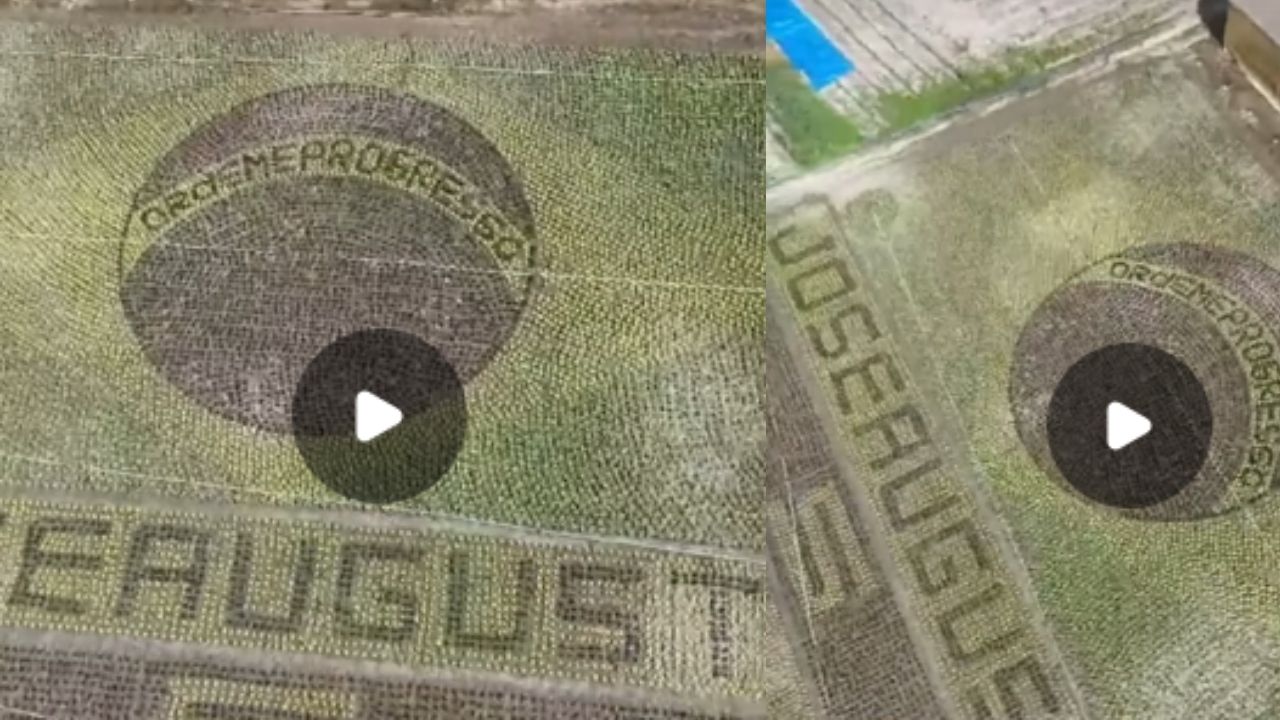
The scene was captured at the Pastorinha settlement in Brumadinho, a municipality in the Metropolitan Region of Belo Horizonte. The location is part of the family’s history, who have lived there for more than 26 years, according to the report.
This context helps to understand why the image attracted so much attention. It is not just a flag made with plants, but a work created within a space connected to rural life, family production, and the memory of the settlement. The strength of the scene comes precisely from the simplicity of the material used: soil, lettuce, marking, and patience.
WATCH THE VIDEO BY CLICKING HERE.
Father and son took almost 9 days to design the garden bed
To create the design, Djalma enlisted the help of his son, Djordyan Cardoso. Father and son spent almost 9 days organizing the land, marking the spaces, and carefully planting the seedlings to form the Brazilian flag and write the baby’s name.
The work required visual planning and manual execution. Each garden bed needed to be in the right place for the design to be recognized from above or by wide images. In practice, the lettuce plantation became a kind of living canvas, constructed seedling by seedling.
Tribute also cites the history of the settlement
In addition to the Brazilian flag and the grandson’s name, the plantation also pays tribute to the Landless Workers’ Movement. The mention is linked to the history of the settlement where the family has lived for more than two decades.
This detail broadens the meaning of the tribute. The design speaks not only of the World Cup or birth but also of belonging. The lettuce plantation began to carry elements of the family, the country, and the history of the rural community where it was created.
Lettuces were still growing when the video went viral
Djalma explained to Rádio Itatiaia that the lettuces were still in the growth phase. Therefore, the visual of the project could still become more defined in the following days, as the plants reached the ideal point before harvest.
He estimated that the shape would remain for another 15 to 20 days, depending on the cold and the cutting point. The expectation was that, in about two weeks, the image would reach its visual peak. In other words, the flag went viral even before reaching its final appearance.
Social media reacted to the farmer’s creativity
The video drew attention because many people took a while to believe that the flag had been made with lettuce. On social media, users praised Djalma’s creativity and highlighted the beauty of transforming the land into a symbol of love, hope, and family unity.
The repercussion also shows how simple stories can gain strength when they unite a strong image and real feeling. The scene of the lettuce plantation works because it is easy to understand: a farmer used what he had in front of him to honor his grandson, celebrate Brazil, and move those who saw the result.
World Cup gave visual meaning to the tribute
The World Cup atmosphere was an essential part of Djalma’s choice. The support for Brazil’s sixth World Cup victory coincided with the birth of José Augusto, which led the farmer to combine the two emotions in the same design.
This union between sport and family explains why the image gained popular appeal. The Brazilian flag is already a recognized symbol, but when it appears formed by lettuces in a Brumadinho garden, it gains another meaning. It ceases to be just a national representation and becomes a reminder of a birth.
Simple garden turned into a visual spectacle in the field
Djalma’s story shows that creativity does not necessarily depend on great resources. With seedlings, soil, marking, and help from his son, the farmer created an image capable of circulating on social media and sparking curiosity in people who might never have heard of the Pastorinha settlement.
The result also values the view of the countryside. Often, rural production appears only associated with numbers, harvests, and supply. In this case, the lettuce plantation gained an artistic and emotional layer, while still being part of the family’s agricultural routine.
When the field becomes a tribute and surprises the country
The giant flag made by Djalma Cordeiro in Brumadinho became news because it mixes manual work, family memory, World Cup, and life in the countryside. The farmer transformed a common plantation into a tribute to his newborn grandson, the Brazilian National Team, and the very history of his community.
The scene also leaves a simple question: do you think this type of rural tribute is more moving precisely because it arises from something common, like a lettuce plantation, or because of the family significance behind the design? Leave your opinion in the comments.


