






 Portuguese
  Spanish


The participation of Gabriel Ferrari and his son Lucca in Ironman Brazil brings together adapted sports, physical endurance, and continuous care during one of the longest triathlon events, held in Florianópolis.
The amateur athlete Gabriel Ferrari completed the 226 km of Ironman Brazil alongside his son, Lucca Ferrari, 6 years old, who has cerebral palsy.
The duo participated in the event in Florianópolis, last Sunday (31), covering 3.8 km of swimming, 180 km of cycling, and 42.2 km of running with adapted equipment to allow the child’s presence throughout the course.
During the competition, Gabriel pulled a boat in the swimming stage, rode an adapted tricycle in the cycling course, and pushed a chair during the run.
-
Workers renovating a playground in northern England uncover 176 World War II bombs buried underground; training artifacts still contained explosives.

-
Brazilian Architect Transforms Waste into Sustainable Homes with Solar Power and Rainwater Systems for 40 Years

-
Security Guard Becomes Doctor at Louisiana Hospital Where He Once Worked, Studied Chemistry Between Shifts

-
Woman Rescued from Luxury Complex in Brazil Worked Without Pay for 55 Years, May Be Entitled to Over $300,000




Lucca accompanied his father from the start to the finish line.
The participation required physical preparation, equipment adaptations, and organizing the care for the boy throughout the event.
As the course is long, Gabriel also needed to make stops during the competition to attend to his son’s needs.
According to the athlete, the pauses occurred every three hours.
During these moments, he provided supplements, water, and performed basic care for Lucca.
In total, father and son completed the event in about 16 hours, according to Gabriel’s account.
How the Ironman Brazil challenge works
The Ironman is a long-distance triathlon event consisting of three modalities on the same day.
The competition starts with 3.8 km of swimming, continues with 180 km of cycling, and ends with a marathon of 42.2 km.
In Gabriel and Lucca’s participation, each stage needed to be adapted.
In the sea, the boy remained in a boat pulled by his father.
In cycling, the duo used a tricycle prepared for the child’s transport.
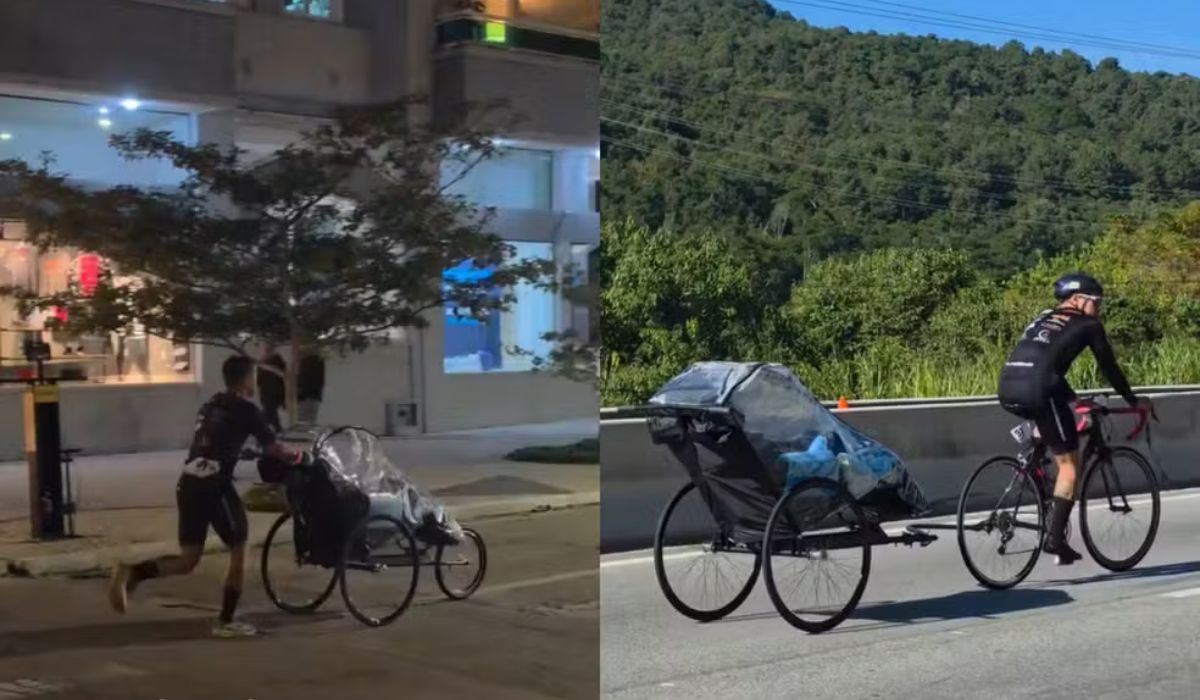
In the run, Gabriel pushed a chair until completing the course.
The planning began before the event.
Gabriel already practiced running but needed to learn cycling and swimming to participate in the Ironman.
The preparation lasted about a year and a half, with training sessions that usually took place twice a day.
Besides conditioning, the routine included tests with the equipment used by Lucca.
Each modality required a different solution for transport, safety, and comfort during the journey.
Adaptations for Lucca during the race
Lucca’s participation required attention to care items, food, hydration, clothing, diapers, and protection against temperature changes.
Gabriel also needed to consider the weight of the equipment used during the race stages.
“At each of the stops I have with him, there are approximately 300 ml of supplementation, plus about 100 ml of water. And I have to have a diaper, a towel in case I need to change his clothes, cold weather clothing. I had a chair weighing approximately 60, 64 kg. And pulling that for 180 km weighs a lot,” Gabriel reported.
The athlete’s statement highlights the structure necessary for the child to accompany the entire course.
Instead of competing only with the usual equipment of a triathlete, Gabriel also transported the items used in Lucca’s care.
During the race, the physical effort was cited by the athlete himself as one of the most difficult points.
Even so, Gabriel stated that his son’s presence served as motivation to continue.
“The strength that has to be exerted is much greater [than that of other athletes], but let’s say I also have a much greater percentage of inspiration. I am carrying my inspiration with me, it’s with me the whole time. So, maybe for me, it becomes even easier. I often joke that it’s not me pushing him, it’s him carrying me through the entire course,” he said.
Cerebral palsy and adapted sports
Cerebral palsy is a neurological condition that can affect movement, posture, and coordination, at different levels.
For this reason, participation in physical activities depends on each person’s conditions, appropriate guidance, and, when necessary, the use of adapted equipment.
In Lucca’s case, his father’s presence allowed him to accompany all phases of the Ironman without performing the movements required of the competitors.
The participation occurred with direct support from Gabriel and with specific adaptations for each section of the race.
Experiences like this are associated with adaptive sports, a modality in which resources, adjustments, and strategies are used to enhance the participation of people with disabilities.
Adaptation, in this context, does not eliminate the need for planning; on the contrary, it requires prior preparation and continuous attention during the activity.
The story also shows the physical aspects involved in long-duration races.
In competitions like the Ironman, athletes need to manage energy, hydration, and nutrition for several hours.
When there is transportation of additional equipment, as happened with Gabriel, the physical demand tends to increase.
The athlete himself, however, stated that Lucca’s reaction during the course contributed to the family’s tranquility.
“What makes me more at ease is that he enjoys the entire race. When he’s not laughing, he’s sleeping,” he said.
Training routine before the Ironman
Gabriel works as a production manager in a company and had to balance preparation with his professional and family routine.
The family lives in Minas Gerais and traveled to Florianópolis to participate in the race.
Preparation for the Ironman involved frequent training and adaptation to modalities that Gabriel had not yet mastered.
Since he already ran, the athlete focused part of the process on learning to swim and cycle, in addition to training with the equipment used to transport Lucca.
Transporting the child required different care in each environment.
In the sea, it was necessary to ensure the stability of the boat.
In the cycling stage, the adapted tricycle needed to withstand the 180 km route.
In the running, the chair had to allow Gabriel to complete the marathon while pushing his son.
The participation also required organization outside the sports routine.
Travel, nutrition, care items, clothing, and planning of stops were part of the duo’s preparation for the event.
Father and son cover the 226 km together
The Ironman is contested individually, but Gabriel’s participation had Lucca as a constant presence in all stages.
The father completed the race by leading his son through the three sections, with different adapted equipment.
The image of the duo crossing the course caught the attention of those attending the event in Florianópolis.
The case also highlighted the participation of people with disabilities in sports activities when there is structure, planning, and support.

Speaking about the experience, Gabriel attributed part of the strength to finish the race to the presence of his son.
The phrase “he is the one who carries me” summed up how the athlete described Lucca’s participation in the course.
At the end of the race, completing the 226 km marked the result of preparation that involved training, care, and adaptation.
In long-duration competitions, such as Ironman, the presence of assistive equipment and family support can expand ways of participating in sports.


