






 Portuguese
  Spanish


Aerial operation in Paraná spreads tons of native seeds and integrates a national reforestation plan by MST, with actions in legal reserves, schools, nurseries, settlements, and degraded areas.
An aerial seeding operation in Paraná launched about 12 thousand kilos of juçara palm and araucaria seeds over legal reserve areas linked to the Landless Workers’ Movement.
The action, carried out with the support of a Federal Highway Police helicopter, is part of MST’s plan to plant 100 million trees by 2030 in different regions of the country.
The image of seed bags being dumped in mid-flight has become associated with the expression “green rain”, used to describe the large-scale dispersion of native species over areas undergoing restoration.
-
China Develops Custom 140-Ton Electric Mining Truck with 770 kWh Swappable Battery, Deploys 290 Units in Xinjiang’s Largest Zinc Mine

-
Meta to Launch Arena, a New Prediction App Targeting 3.56 Billion Users, Competing with Polymarket and Kalshi

-
Scientist Challenges Famous Human Evolution Theory, Argues Homo Sapiens Evolved Gradually Over Thousands of Years
-
15-Year-Old American Builds Ocean Generator with PVC Pipe and 3D-Printed Propeller for $12, Wins National Prize, Presents at White House, and Makes Forbes 30 Under 30 List




The method allows spreading a large volume of seeds in less time than manual planting, especially in extensive or more difficult-to-access areas.
The initiative is part of the National Plan to Plant Trees, Produce Healthy Food, launched by MST in 2020.
The proposal brings together actions for environmental restoration, agroforestry formation, nursery construction, seedling distribution in rural schools, and partnerships with universities, public agencies, and local entities.
According to the movement, by the end of 2023, 25 million trees had been planted, with 300 nurseries created and 15 thousand hectares of degraded areas recovered.
These numbers are part of the balance released by MST itself on the progress of the national plan.
How aerial seeding works in Paraná
The aerial seeding used in Paraná consists of launching seeds in large quantities over selected areas for environmental recovery.
For the technique to be applied, it is necessary to define the species in advance, separate the seed lots, identify the launch areas, and monitor the development of the plants after germination.
Among the species used in the operation are the juçara palm and the araucaria, both associated with Atlantic Forest formations in southern Brazil.
The choice of these plants is related to their presence in native ecosystems and the role they play in feeding wild animals.
The juçara palm produces fruits consumed by birds and other animals, which also participate in the natural dispersion of seeds.
The araucaria, in turn, produces the pine nut, a food source for wildlife species and also present in the food culture of different regions in the South.
Due to the scale, aerial seeding does not replace other stages of reforestation.
Field monitoring remains necessary to verify germination, seedling survival, competition with other plants, soil conditions, and protection of the seeded area.
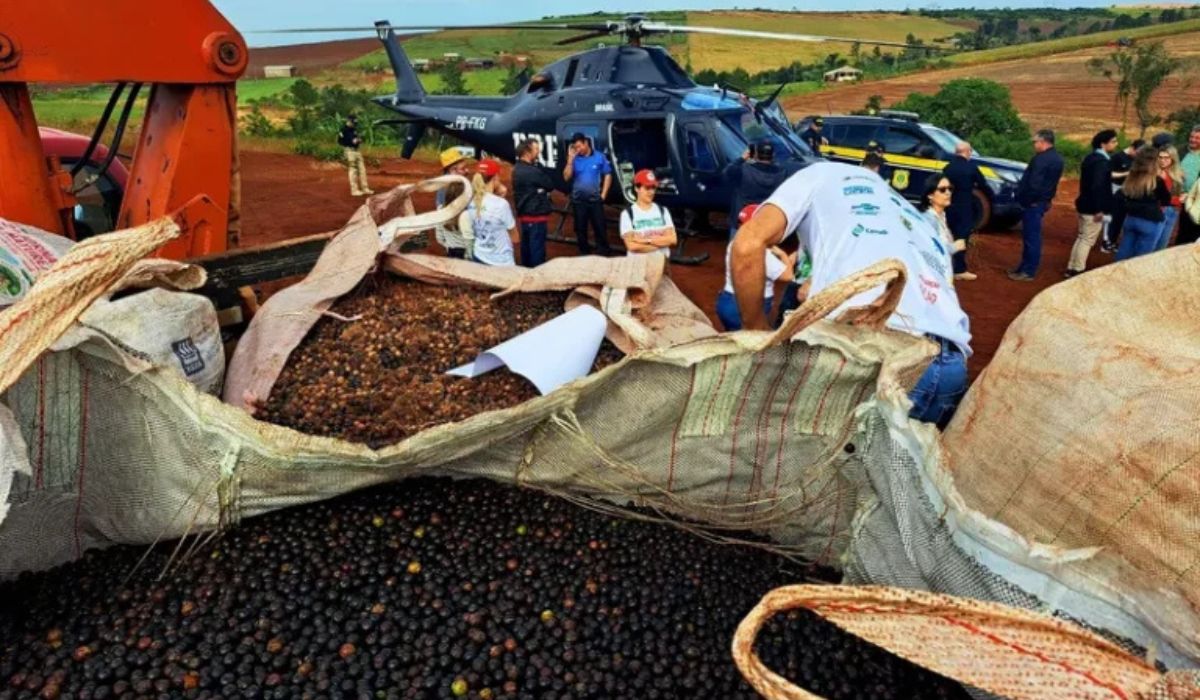
Reforestation experience began in an MST area in Paraná
The proposal to use helicopters to spread seeds gained momentum from experiences in the Dom Tomás Balduíno pre-settlement, in Quedas do Iguaçu, Paraná.
Residents of the region were already manually spreading seeds in reserve areas and began to observe plant germination.
Researcher Josué Evaristo Gomes, the son of settlers and dedicated to studying the juçara palm, participated in formulating the proposal.
In the original account, he stated that the idea seemed “insane” at first, but was embraced by the movement after the initial local experiences.
Tarcísio Leopoldo, from the state leadership of the MST in Paraná, also attributed confidence in the technique to the knowledge accumulated by rural families about the species.
According to him, the residents already knew the behavior of the palm and had observed significant germination in areas near the plots.
The first large-scale experience occurred in June 2023, when about 4 tons of juçara palm seeds were launched.
In the following action, the volume was increased to 12 tons, with the inclusion of araucaria and monitoring of the results from the previous stage.
Researchers monitor seed germination
Academic monitoring was incorporated to assess the effectiveness of aerial seeding.
In areas monitored by researchers linked to the Federal University of the Southern Frontier, thousands of juçara palm seedlings per hectare were identified after the first launch.
According to the data released in the original text, the graduate group in Agroecology and Sustainable Rural Development at UFFS found about 10,000 seedlings per hectare.
In one year, the plants had germinated and reached, on average, 14 centimeters in height.
The measurement does not eliminate the need for longer monitoring.
In restoration processes, the survival of seedlings depends on factors such as rain, light, soil, presence of animals, control of competing plants, and protection against fire or trampling.
In 2026, the Nature Journey in Paraná reached its fourth edition, with plans to distribute and sow 30 tons of juçara palm seeds.
Of the total planned, 18 tons would be launched by helicopter, according to the schedule released by MST.
Nurseries, schools, and agroforests sustain the plan
Despite the visibility of the aerial operation, the national plan of MST also depends on actions carried out on the ground.
Nurseries, planting mutirões, agroforestry systems, and seedling distribution form the permanent base of the environmental restoration strategy.
In the nurseries, seedlings of native and fruit species used in settlements, camps, and preservation areas are produced.
Part of the seeds comes from the use of fruits, such as guabiroba, uvaia, plum, cherry, and jabuticaba, according to reports from movement members.
In rural schools, students receive seedlings to plant at home or in community areas.
In the case of the Itinerant School Vagner Lopes, in Paraná, the original text states that students have already received 15,000 tree seedlings.
Educational actions aim to associate reforestation with the daily life of rural communities.
In this format, planting does not occur only in large-scale events but also in activities accompanied by schools, families, and local organizations.


Partnerships expand reforestation in Brazil
The plan relies on partnerships with universities, environmental agencies, public nurseries, city halls, and other entities.
In Paraná, the Nature Journey brings together institutions such as the Federal University of the Southern Border, Ibama, Itaipu Binacional, the Water and Land Institute, Conab, and Embrapa, as well as local organizations.
According to João Flávio, an agronomist and member of the MST’s reforestation plan organization, part of the actions also occur through agreements mediated by municipal environmental departments.
He mentioned partnerships related to environmental compensations, including in northern Paraná.
On another front, the MST established seed and seedling exchanges with nurseries from Itaipu Binacional, the Water and Land Institute, and municipalities in Paraná.
The movement reports that seeds obtained from fruit pulp extraction are passed on to nurseries in exchange for seedlings.
In the state of São Paulo, a partnership with the University of São Paulo resulted in the Dandara Project, aimed at agroecological transition in agrarian reform territories.
The initiative involved cooperative families from the Dandara and Reunidas settlements in Promissão and implemented agroforestry systems on 13 hectares.
Degraded areas enter the environmental restoration map
The national plan also includes actions in regions affected by environmental degradation.
In Minas Gerais, the MST reports initiatives in areas affected by dam breaks related to mining.
The Mariana disaster in 2015 killed 19 people and impacted the Rio Doce Basin.
In 2019, the Brumadinho dam break left at least 270 dead and affected communities near the Paraopeba River.
After the Mariana disaster, the movement signed an agreement with the government of Minas Gerais and the Renova Foundation, created to implement reparative measures related to the damages caused by the dam break.
The project provides technical assistance to settled families and environmental restoration actions in water recharge areas.
In Brumadinho, the Plant Trees project was launched one year after the dam break.
According to the MST, in an area of 10 hectares previously contaminated by waste, 30,000 fruit seedlings of 34 species were planted.





