






 Portuguese
  Spanish


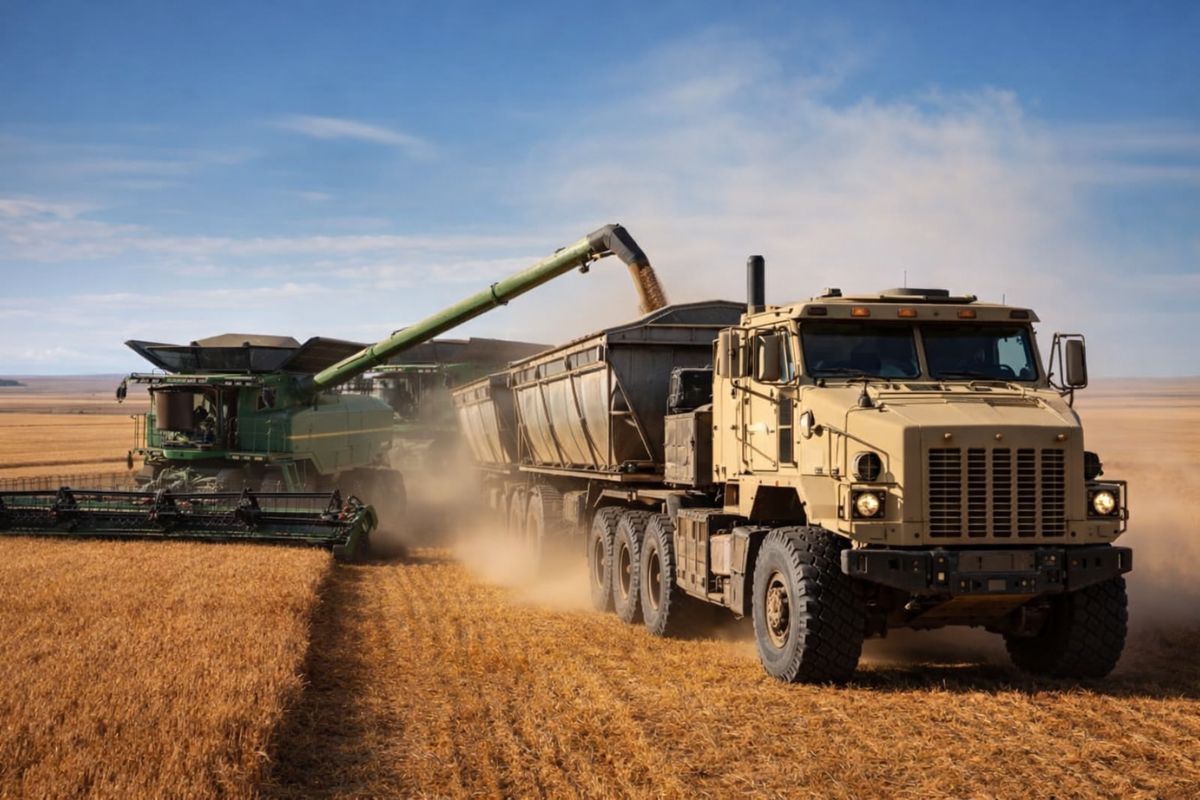


With Power Up to 700 HP and Capacity Close to 70 Tons, the Military Truck Has Left Its Original Role of Moving Armored Vehicles and Started Transporting Harvesters, Planters, and Silage on Extensive Properties, Showing How Rural Logistics Has Incorporated Standards of Robustness, Operational Rhythm, and Quick Response Typical of Modern Militaries.
According to the portal compre rural, the military truck began to gain traction in agriculture when mechanization increased the size of machines and exposed a practical problem: transporting giant equipment without losing crucial hours of operation. On extensive properties, every stop weighs on the final cost, and the priority has become maintaining a continuous flow from the field to the destination.
In the province of Alberta, Canada, the Oshkosh M1070 designed to move tanks like the M1 Abrams appears in rural routines transporting harvesters, planters, and large volumes of forage. The Contrast Draws Attention, but the Logic Is Objective: Load Capacity, Traction, and Operational Predictability in Severe Environments.
From the Battlefield to the Logic of the Harvest

In its original project, the M1070 integrates the Heavy Equipment Transporter System (HETS), a structure designed to transport extremely heavy loads safely and regularly. Upon entering agriculture, the principle does not change: eliminating bottlenecks in the transportation stage during periods of high operational pressure.
-
In Rural Brazil, José Sirval Operates a Water-Powered Mill Grinding 125 Kilograms of Corn Daily Using His Great-Grandfather’s Century-Old Monjolo

-
From Market Stall to Agribusiness: Patagonian Fruit Grower Owns 550 Hectares and Processes 18 Million Kilos of Pears and Apples Annually, Exporting Directly to Brazil
-
At 93, Brazilian Farmer Restores 56 Hectares of Forest and Revives Spring in the Amazon, Installs First Climate Tower in the Region
-
Brazilian Cheesemaker Wins European Award for Ant-Infused Cheese with Nutty Flavor Inspired by Indigenous Tradition


The difference lies in the daily mission. Instead of armored vehicles, large agricultural machines and high volumes of silage come into play. Instead of military convoys, internal routes, unpaved roads, and tight harvest cycles take priority.
The military truck thus operates as a continuity asset: less time stationary, less risk of delays, and more stability in the work window.
Who Is Using It, Where Is This Happening, and Why Has It Advanced
The movement is more visible in large-scale operations, especially where farms depend on heavy equipment and frequent movements between productive areas.
In addition to producers, specialized companies in Western Canada are participating in the adaptation and resale, creating a technical niche for the converted military truck.
The choice of Alberta is not casual. The region combines extensive properties, harsh climate, and a need for performance in difficult soils, with mud, thawing, and uneven stretches.
When the terrain worsens and the load increases, the margin for improvisation disappears, and the military profile begins to meet a demand that conventional transportation does not always cover with the same consistency.
Power in Two Generations: What Changes Between A0 and A1
The M1070 (A0) version is already above the common road standard: Detroit Diesel 8V-92TA engine, 12.06 liters, 500 HP, and approximately 203 kgfm of torque. In heavy agricultural operation, this setup provides significant strength to move robust implements in low-traction terrains.
In the M1070A1, the leap is clear: Caterpillar C18 engine, 18.1 liters, 700 HP, and around 262 kgfm of torque. In practice, the difference appears in starts with extreme loads and in difficult movements, such as mud or snow. More than top speed, the gain lies in delivering useful force under real work pressure.
This technical distinction helps explain why the military truck is not just a visual curiosity. In agricultural environments where weight, distance, and urgency intersect, power and torque cease to be catalog numbers and become concrete productivity.
The Technical Resources That Explain Performance in Agriculture
One of the pillars is the 8×8 traction, which improves grip and load distribution on uneven surfaces. With the M1000 trailer, the combination can reach around 70 tons, a level that repositions the role of transport within the farm. It’s not just about carrying more; it’s about maintaining operational stability safely.
Another critical point is the CTIS, the central tire inflation system. It allows adjusting pressure according to soil type without the driver leaving the cabin, enhancing traction and reducing compaction. Combined with a design for extreme conditions, the military truck maintains performance in intense cold, long journeys, and hostile environments—a rare technical package in conventional agricultural transport.
How Civil Conversion Is Done for Agricultural Use
The adaptation goes beyond changing paint or removing accessories. In many cases, the fifth wheel is replaced by structures ranging from 18 to 21 feet to increase volumetric capacity; the chassis can be extended for better weight distribution; and the cabin is converted to Day Cab configuration, freeing up usable space for rural operation.
Flotation tires, which are even wider, are also common to reduce impact on productive soil. Heavy military winches, which can reach up to 25 tons in dual systems, are often removed to reduce dead weight and simplify maintenance. Every intervention aims for the same goal: transforming military robustness into continuous agricultural efficiency.
There is also an electrical adjustment from 24V to 12V, facilitating integration with civilian implements and auxiliary lighting for night harvesting. This technical adjustment reduces operational friction in daily activities and improves compatibility with existing infrastructure on farms.
How Much It Costs and When the Costs Can Balance
In the market for refurbished units in Western Canada, the converted military truck usually appears between CAD 74,900 and CAD 108,000, varying according to overall condition and mileage.
In investment terms, the value stands out when compared to the acquisition of new heavy transporters of equivalent capacity.
The economic logic, however, depends on the usage profile. The greater the intensity of movement of machines and forage, the greater the chance of costs being diluted through increased availability and reduced delays.
It’s not a universal solution for every property, but it can be a strategic alternative for large operations, with tight cycles and a need for high reliability.
What This Turn Reveals About the New Logistic Standard in Agriculture
The advancement of the military truck in the field is not yet a global phenomenon but signals a concrete trend: large-scale agriculture is entering the era of super logistics.
Larger machines require more robust transport; shorter harvest windows require faster responses; difficult terrains require engineering prepared for continuous stress.
Decommissioned military vehicles gain a second life with productive function. The change does not romanticize military technology but exposes an operational transformation: modern agriculture has begun to treat heavy transport as a critical stage of competitiveness, rather than a secondary support activity.
When a military truck of up to 700 HP steps down from the mission of moving tanks to harvest transport, the message is clear: logistics has become central to agricultural strategy on extensive properties.
The debate is not only about power but about how to maintain pace, reduce bottlenecks, and protect outcomes in increasingly demanding operational scenarios.
In your view, which bottleneck weighs most today in the routine of large farms: moving harvesters, removing silage on time, or maintaining stable operation on difficult terrain? And if you had to choose, would you bet on traditional agricultural fleets or on converted high-capacity platforms?


