Portuguese
  Spanish


Billion-Dollar Rail Project Between Brazil and China Back on the Agenda in 2025 After Years of Political and Geopolitical Uncertainty, Promising to Transform Logistics and South American Integration.
A rail project of unprecedented proportions in South America is back in the spotlight in 2025, after nearly a decade of interruption.
This is the Transcontinental Atlantic-Pacific Railway, planned to connect the Brazilian coast to the Pacific Ocean, boosting logistics, the economy, and international relations of Brazil.
The venture, which was stalled since the impeachment of former president Dilma Rousseff in 2016, has resurfaced with new vigor and billion-dollar investments, marking a new phase in the integration between Brazil and China.
-
180-Year-Old Bridge Disappears from Brazilian Farm, Found 180km Away, Sparks Investigation into Illegal Sale of Historical Heritage

-
Brazil’s Defunct Railway Network Leaves Over 100,000 Properties Abandoned for Nearly 30 Years, Facing Neglect and Safety Risks as Government Struggles to Regulate Assets Amid Degraded Stations and Unlawful Use

-
Belo Horizonte’s Beltway Project Risks Losing $5 Billion to Metro Expansion if Court Doesn’t Act Soon; State Government Plans New Lines with IDB Support

-
Brazil to Auction 9,000 km of New Railways, Aiming to Attract $28 Billion by 2026




Atlantic-Pacific Railway: Interrupted Agreement and Strategic Resumption
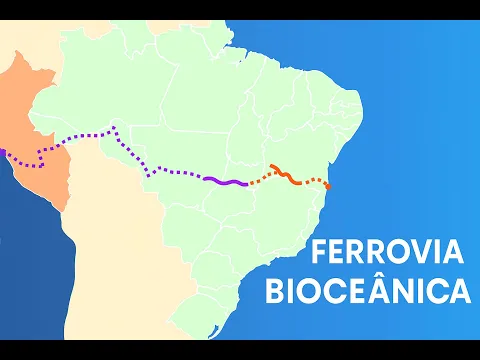
The initial plan, announced in May 2015 during the visit of then-Chinese Premier Li Keqiang to Brazil, envisioned the construction of a bioceanic railway linking the Port of Ilhéus in Bahia to the coast of Peru, passing through important agricultural hubs in the Midwest.
The agreement, formalized at the Palácio do Planalto, included the signing of 30 partnerships between the two countries, highlighting the Chinese commitment to invest about US$ 50 billion in Brazilian infrastructure, especially in railway logistics.
The expectation was that the Atlantic-Pacific Railway would transform the dynamics of cargo transportation, funneling grains, minerals, and other products from the Brazilian agribusiness directly to the Asian market, reducing distances and logistics costs.
According to estimates from the Institute for Applied Economic Research (IPEA) and the Company for Planning and Logistics (EPL), the route could shorten Brazilian exports by up to 40% to destinations like Shanghai, Tokyo, and Busan, eliminating the need to cross the Suez Canal or the Taiwan Strait.
However, the political instability resulting from Dilma Rousseff’s impeachment process, completed in August 2016, completely changed the scenario.
With Michel Temer’s inauguration, the project lost priority, and a decree signed in October of that year halted the advancements of the bioceanic railway.
The measure suspended the bilateral agreements established with China and made it impossible to attract international funding for the project, which had been pointed out as strategic for Brazilian competitiveness.
Geopolitics and International Influence on the Rail Project
The geopolitical context at the time also directly influenced the project’s fate.
The growing rivalry between the United States and China on the international stage contributed to Brazil distancing itself from major Chinese investments in sensitive sectors, such as transportation infrastructure.
Documents and analyses from international organizations suggest that the American posture, coupled with the new positioning of the Brazilian government, moved the country away from an integration agenda with Asia, especially via bioceanic corridors.
Resumption of the Bioceanic Railway and Billion-Dollar Investment in 2025
The resumption of the project in 2025 occurs in a distinct economic and political environment.
After nine years of uncertainty, the federal government has reincorporated the Atlantic-Pacific Railway into the New Growth Acceleration Program (Novo PAC), with estimated investments of R$ 28.7 billion, according to data updated by the Ministry of Transportation in June 2025.
The expectation is to build about 2,700 kilometers of tracks between Bahia, Goiás, and Mato Grosso, interconnecting producing areas and facilitating access to ports in Peru.
The financing will again include significant participation from Chinese institutions, strengthening the strategic partnership between Brazil and China.
The project envisions that the railway line will connect the Port of Ilhéus to the Port of Chancay in Peru, directly linking the Atlantic to the Pacific.
It is estimated that the railway will facilitate the flow of agricultural and mineral commodities from states like Mato Grosso, Goiás, Rondônia, Acre, and Bahia, regions responsible for a large part of the production of soybeans, corn, beef, and minerals exported to Asia.

Logistics, Exports, and Impact on Brazilian Agriculture
In addition to the impact on foreign trade, the new railway is expected to contribute to the modernization of Brazil’s transportation matrix, reducing reliance on road transport and costs associated with fossil fuels.
The expectation is that railway integration will stimulate job creation, increase logistical efficiency, and attract new investments to the country, strengthening Brazil as a key link in the Sino-South American trade route.
The technical study by IPEA highlights that the implementation of the Atlantic-Pacific corridor could result in a savings of up to 8,000 kilometers in cargo transport to China, depending on the chosen route, which represents significant logistical and environmental gains.
For the national agribusiness, the possibility of accessing Asian markets more swiftly and competitively has the potential to increase revenues, consolidate partnerships, and promote regional development.
Regional Integration and the Future of Cargo Transport
The decision to revive the project also paves the way for greater South American integration, bringing Brazil closer to neighboring countries like Peru and Bolivia, with which the railway infrastructure should connect in the coming years.
Authorities in the sector expect that the bioceanic railway will drive route diversification and expand the country’s export capacity, consolidating Brazil as a key player in the trade flow from the Atlantic to the Pacific.
With the reactivation of this mega logistics project, Brazil and China reaffirm their commitment to cooperation on large infrastructure works, despite the historical challenges faced since 2015.
The return of the Atlantic-Pacific Railway to the center of the government agenda reflects the growing interest of both countries in strengthening their economic ties and expanding trade exchanges with Asia, especially in light of the ongoing global transformations.
Will the resumption of the Atlantic-Pacific Railway finally transform Brazilian logistics and consolidate Brazil as a strategic bridge between South America and Asia?