






 Portuguese
  Spanish


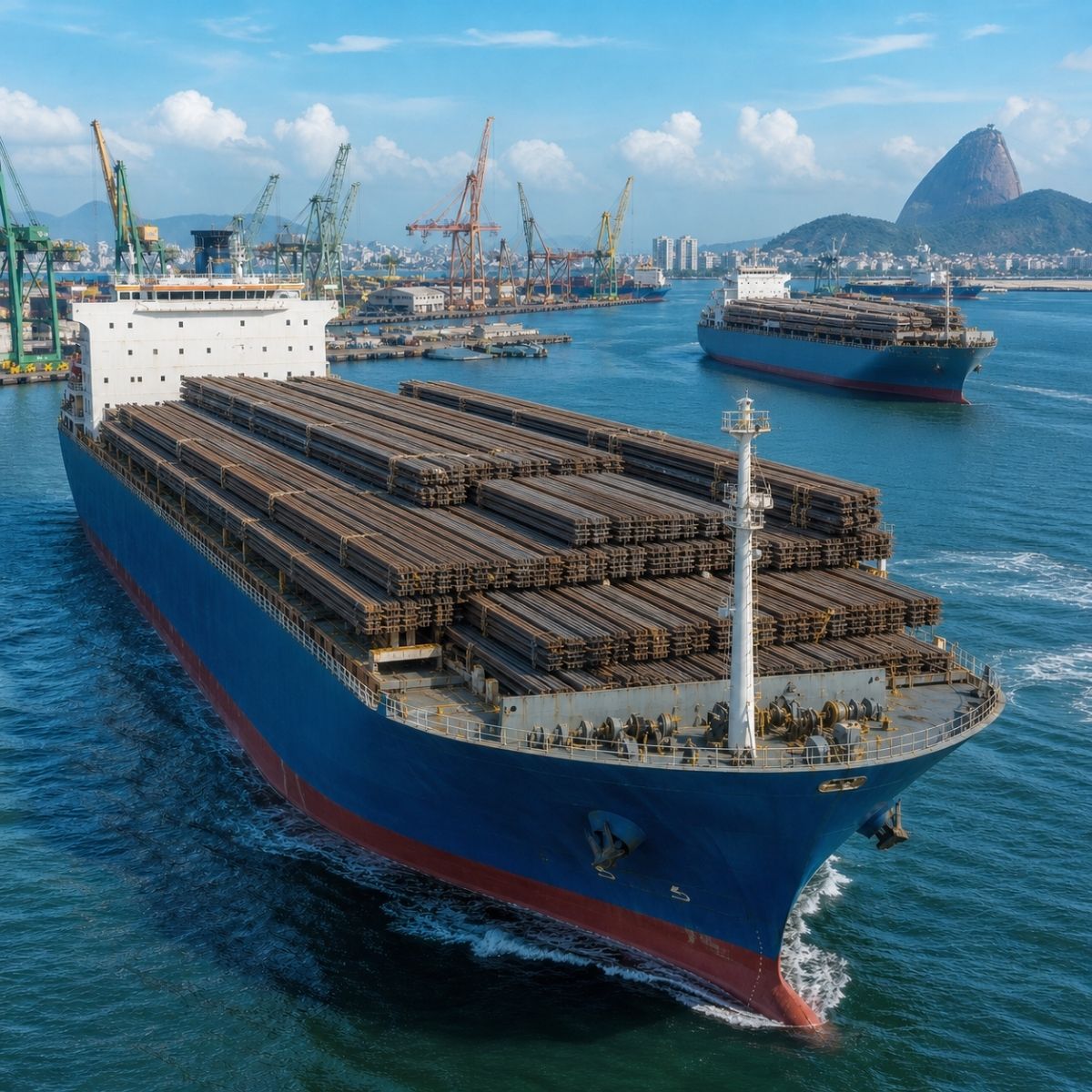


China’s tracks completed the 1,209 km Transnordestina Railway between Eliseu Martins (PI) and Pecém Port (CE) with R$ 8.2 billion invested and the first test run in December 2025, while CRRC installs a factory in Araraquara (SP) with R$ 5.6 billion from BNDES and the national railway sector requests tax equality.
The arrival of the last batch of 34 thousand tons of tracks from China to Brazil in February 2026 concluded the physical assembly of the Transnordestina Railway, a project conceived in 2006 that, after almost two decades of construction and R$ 8.2 billion already invested, is entering the operational testing phase. The imported tracks completed the 1,209-kilometer structure connecting Eliseu Martins, in the interior of Piauí, to Pecém Port, on the coast of Ceará, passing through Salgueiro in Pernambuco, a corridor designed to transport grains, ores, gypsum, containers, and fuels in a region where road transport increases production costs and limits the competitiveness of the Northeastern agribusiness. On December 19, 2025, the railway carried out its first test run with 20 wagons of corn from the company Tijuca Alimentos between Bela Vista (PI) and Iguatu (CE), an experimental operation authorized by an Ibama license issued on December 11, 2025.
The presence of Chinese tracks on the Transnordestina is part of a larger movement that reshapes the relationship between Brazil and China in the railway sector. The state-owned CRRC (China Railway Rolling Stock Corporation), the world’s largest train manufacturer, is preparing to start production at its factory installed in Araraquara, in the interior of São Paulo, with R$ 5.6 billion in financing from BNDES and an expected operation in the second half of 2026, while in the last two years Chinese companies have won bids for six projects involving 128 passenger trains, 728 wagons, and 2 locomotives in São Paulo and Minas Gerais, according to the Brazilian Railway Industry Association (Abifer), according to Carta Capital. The tracks that arrived in the Northeast and the factory being installed in the Southeast are two sides of the same strategy that combines Chinese productive capacity with Brazilian demand for railway infrastructure.
How Chinese tracks arrived at Transnordestina and what they mean for the project

The tracks that completed the Transnordestina were imported in batches over several months, transported by cargo ships from Chinese ports such as Taicang and Zhangjiagang to the port of Suape in Pernambuco. The sea journey for each batch of tracks lasted between 45 and 70 days, and the choice of China as a supplier combined three factors: large-scale production capacity that few countries possess, competitive pricing compared to European and American manufacturers, and alignment with the Brazil-China strategic partnership resumed by the Lula government in 2023. Chinese tracks are not exclusive to Transnordestina: China is currently one of the world’s largest exporters of railway material, with a presence in projects in Africa, Southeast Asia, and Latin America.
-
Brazil’s First Freight Railway Built from Scratch, EF-118 Connecting Espírito Santo to Rio de Janeiro, Goes to Auction in October Attracting Chinese Giant in Multi-Billion Dollar Bid for Southeast Rail Network

-
Trans-Siberian Railway’s New Sister Line, BAM, Stretches 4,300 km Through Permafrost and Seismic Zones in Northern Russia

-
180-Year-Old Bridge Disappears from Brazilian Farm, Found 180km Away, Sparks Investigation into Illegal Sale of Historical Heritage
-
Brazil’s Defunct Railway Network Leaves Over 100,000 Properties Abandoned for Nearly 30 Years, Facing Neglect and Safety Risks as Government Struggles to Regulate Assets Amid Degraded Stations and Unlawful Use



The completion of the track assembly marks the end of one stage and the beginning of another equally complex one. The railway still needs to complete works on signaling, telecommunications, loading and unloading yards, transshipment terminals, and adaptations for the different types of cargo it will transport, which is why the forecast for total completion varies depending on the source: Diário do Nordeste points to 2027, while the schedule of TLSA (Transnordestina Logística S.A.), the responsible concessionaire, indicates 2029. The laid tracks mean that the permanent way is ready, but the railway as an operational logistics system still has a way to go before functioning on a commercial scale.
What the first test run revealed about the future of the railway
The experimental operation on December 19, 2025, was the first time a loaded train traveled on the Transnordestina tracks. The 20 wagons of corn from Tijuca Alimentos departed from Bela Vista in Piauí towards Iguatu in Ceará, a test that served to monitor the performance of the permanent way, operational safety, and the real capacity of the tracks and sleepers under load. “When the railway is fully completed, with the loading and unloading structure finalized, we do foresee a real reduction in costs. It’s practically a dream we’ve always aimed for and which is now beginning to come true,” declared Marden Alencar Vasconcelos, director and partner of Tijuca Alimentos, in an interview published by the Ministry of Integration and Regional Development in January 2026.
The choice of corn as the first cargo is not casual. The Transnordestina was designed to transport agricultural production from the Piauí cerrado, a region that in the last two decades has become a productive frontier for soy and corn but relies on precarious highways to take the harvest to the ports of the Northeast, a logistical cost that reduces producers’ margins and makes competition with the Midwest even more unequal. Besides grains, the railway is expected to transport soybean meal, limestone, gypsum, gypstone, minerals, containers, and fuels, a cargo portfolio that connects the tracks directly with the Port of Pecém, an expanding energy and logistics hub on the coast of Ceará.
What the CRRC factory in Araraquara means for Brazilian tracks
The installation of CRRC in Araraquara represents the first factory of the Chinese state-owned company outside Asia and adds a new dimension to the presence of Chinese tracks and trains in Brazil. President Lula visited the factory’s construction in March 2026, a unit that occupies the former Hyundai facilities in the São Paulo municipality and with financing of R$ 5.6 billion from BNDES is expected to produce passenger trains for the São Paulo Metro and the São Paulo-Campinas Intercity Train, with production set to begin in the second half of 2026. CRRC won contracts to supply 44 trains to the São Paulo metro lines 1-Blue, 2-Green, and 3-Red, in addition to compositions for the Carajás Railway and the Vitória-Minas Railway concessions.
Another Chinese manufacturer, Kangni, opened a factory in Araraquara in January 2026 to produce train and metro door systems. The concentration of Chinese railway sector companies in Araraquara forms an industrial hub that adds to the imported tracks for the Transnordestina and the bids won across the country, a movement that according to Abifer resulted in the growth of the railway industry in Brazil in 2026: 72 locomotives, 1,900 wagons, and 193 passenger cars, increases of 9%, 12%, and 59% respectively compared to the previous year. However, the growth raises a question that divides the sector: how much of this production is genuinely national and how much is assembly of imported components with a foreign brand.
What the Brazilian railway industry says about Chinese tracks and trains
The entry of Chinese companies into the Brazilian railway sector faces organized resistance from the national industry. Abifer and Sindifer (National Railway Industry Union) argue that the importation of wagons, locomotives, and tracks has a tax advantage of up to 30% over national production, a distortion that makes competition unequal and according to the sector prevented the creation of 40,000 jobs in the last two years. The sector calls for an increase in the import tax from 30% to 35% and greater requirement for the nationalization of components so that factories installed in Brazil effectively produce on national soil, not just assemble imported parts.
Vicente Abate, president of Abifer, argues that the Brazilian market can welcome foreign manufacturers as long as they are effectively installed in the country, with local production, job and income generation, and under tax equality conditions with the national industry. The argument is that tracks, wagons, and trains manufactured in Brazil generate Brazilian jobs, pay Brazilian taxes, and feed a productive chain that includes steel, metallurgy, electronics, and services, benefits that direct importation does not deliver even when the final price is lower. The Brazilian railway fleet has about 14,000 wagons over 65 years old, a deteriorated asset that would represent massive demand for the national industry if the renewal were done with internal production.
What the Transnordestina and its tracks mean for the energy sector in the Northeast
The connection between the Transnordestina tracks and the Port of Pecém creates a logistical corridor that directly interests the energy sector. Pecém operates a liquefied natural gas (LNG) terminal from New Fortress Energy, receives petroleum derivatives from Petrobras, functions as an export hub for renewable fuels like ethanol and biodiesel, and is one of the main Brazilian hubs for green hydrogen projects with R$ 100 billion in planned investments, a set that makes the Ceará port a strategic point where the railway tracks meet the national energy chain. The railway transport of fuels between the interior and the coast can reduce distribution costs that currently increase the operation’s expense and limit the competitiveness of production hubs distant from port terminals.
“The Northeast needs this project. The Northeast does not want to be treated as if it were the poor part of Brazil anymore. The Northeast needs to be respected,” declared President Lula at the ceremony announcing R$ 1.4 billion for the Transnordestina works in Missão Velha (CE) on July 18, 2025. The tracks that came from China, the factory being set up in São Paulo, and the bids that Chinese companies win across the country compose a scenario that Brazil is still learning to balance: accepting foreign technology and investment without dismantling internal industrial capacity, and delivering the railway infrastructure the country needs without importing along with it the dependency that history has already shown to be costly.
And you, do you think Chinese railways are a solution or a risk for Brazilian industry? Will Transnordestina finally work? Leave your opinion in the comments.








