Portuguese
  Spanish


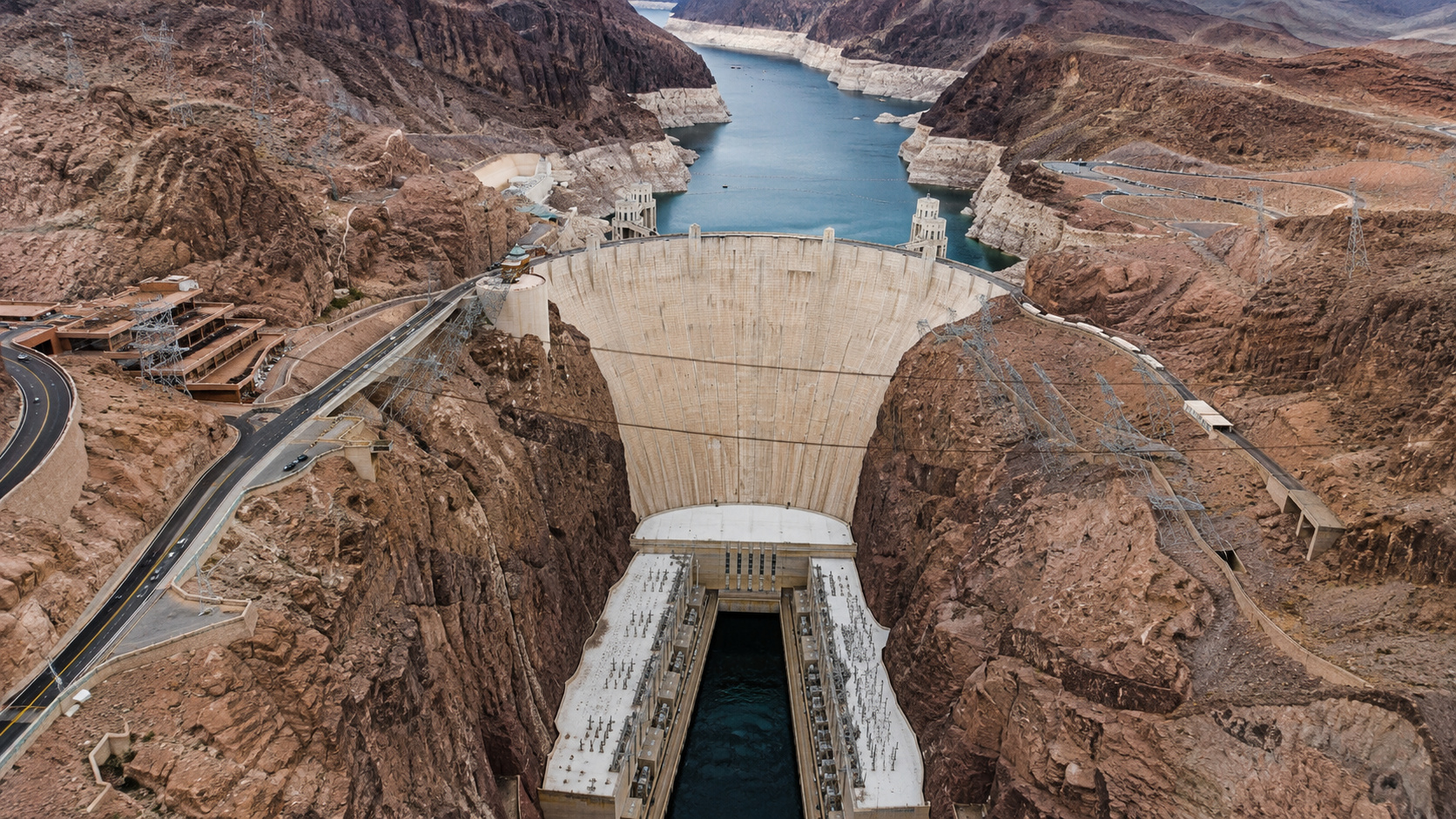

Colossal dam in the USA used over 5 million barrels of cement, 4.36 million cubic yards of concrete, and an ice plant capable of producing 2 million pounds per day to prevent the structure from cracking; discover the absurd engineering of the Hoover Dam
The Hoover Dam, erected in the Black Canyon of the Colorado River, between Nevada and Arizona, became one of the greatest concrete challenges in the history of civil construction. Built between 1931 and 1936, the dam established itself as a symbol of heavy engineering, water control, and energy generation in the United States.
According to the Bureau of Reclamation, the structure is 726.4 feet tall, about 221 meters, and 1,244 feet long, approximately 379 meters. The base reaches 660 feet wide, around 201 meters, a dimension that helps explain the extreme scale of the dam.
Mass concrete transformed the Hoover Dam into one of the most impressive works of the 20th century
The Bureau of Reclamation reports that the dam contains 3.25 million cubic yards of concrete just in the main body. When adding the power plant and associated works, the total reaches 4.36 million cubic yards, a volume that the agency itself compares to a monument of 100 square feet and 2.5 miles high.
-
They seemed sturdy enough to support a 222-meter tower, but three giant bolts broke because invisible hydrogen atoms had weakened the steel.

-
It seemed like just a futuristic metal facade, but curved panels turned into reflectors, heated sidewalks to around 60°C, hit apartments, and needed to be given a matte finish.
-
A giant printer erected each house in an entire neighborhood in southern Mexico in about 24 hours: 50 homes of 46 m² with two bedrooms delivered for $10,000 to families earning $3 a day and paying only $20 per month.

-
Without an earthquake, abnormal wind, or foundation sinking, engineers discovered that rhythmic exercises on the 12th floor caused a 39-story building to vibrate for ten minutes.


This volume helps to understand why the work continues to be studied as a reference in mass concrete. It was not just a large dam, but a structure on an unprecedented scale for the time, executed in an arid, remote region with much greater logistical limitations than those of large current sites.
More than 5 million barrels of cement went into the construction of the dam
The scale of the work becomes even clearer when observing the cement consumption. The Bureau of Reclamation reports that the construction required more than 5 million barrels, with daily demand varying between 7,500 and 10,800 barrels during the dam’s execution.


The National Park Service also records that the construction required 5 million barrels of cement and 45 million pounds of reinforcing steel. The same source states that the mass of concrete used weighed 6.6 million tons, a number that shows the colossal weight of the undertaking.
Cooling system with ice was decisive to prevent thermal damage to the concrete
The most impressive point of the Hoover Dam is in temperature control. In mass concrete structures, cement releases heat during curing, and this heat, if retained excessively, can cause internal thermal differences capable of generating severe cracks.
To tackle this problem, engineers embedded more than 582 miles of 1-inch steel pipes within the concrete. Through these pipes circulated chilled water from a refrigeration plant capable of producing 1,000 tons of ice in 24 hours, equivalent to about 2 million pounds of ice per day.
According to the Bureau of Reclamation, the cooling was completed in March 1935. The solution allowed for accelerated heat dissipation and prevented the dam from relying solely on natural cooling, which would be too slow for such a large mass of concrete.
Dam was built in interlocking blocks to avoid giant cracks
The Hoover Dam was not executed as a single continuous block of concrete. The Bureau of Reclamation explains that the structure was built in vertical blocks with dimensions ranging from about 60 square feet on the upstream face to about 25 square feet on the downstream face.

The same source states that the dam is formed by about 215 blocks, locked by a system of vertical and horizontal keys.
After each section cooled, a mixture of cement and water, the grout, was injected into the spaces created by contraction to transform the assembly into a monolithic structure.
This methodology shows that the secret of the construction was not only in the volume poured but in the simultaneous control of temperature, shrinkage, joints, and structural fittings. It was this logic that allowed hundreds of blocks to be converted into a single resistant mass of concrete.
Before concreting, the Colorado River needed to be diverted
Before erecting the dam, the builders had to divert the Colorado River. According to the Bureau of Reclamation, the diversion was done through four tunnels of 50 feet in diameter, two on each side of the canyon, with a combined length of 15,946 feet, approximately 3 miles.
The Bureau of Reclamation reports that these tunnels had the capacity to conduct more than 200,000 cubic feet of water per second. The diversion of the river through the tunnels on the Arizona side occurred on November 14, 1932, an essential step to clear the main area of the dam.
Hoover Dam required a support city, railway, highways, and transmission line
The project was not just a concrete site. According to the Bureau of Reclamation, before the main operation, it was necessary to build Boulder City to house workers and crews, as well as a paved road of 7 miles between the city and the dam.
The preparation also included a railway of 22.7 miles between Las Vegas and Boulder City, plus 10 miles to the dam site, as well as a transmission line of 222 miles from San Bernardino, California, to supply power to the construction.
These numbers show that the Hoover Dam required a parallel infrastructure as ambitious as the dam itself.
Hoover Dam remains a lesson in engineering more than 90 years later
The Bureau of Reclamation reports that the dam, the power plant, and the associated works were completed in five years, although the contractors had a deadline of seven years from April 20, 1931.
The National Park Service highlights that the project was completed ahead of schedule and helped consolidate the reputation of U.S. dam engineering.
More than 90 years after construction began, the Hoover Dam continues to impress because it solved, with 1930s technology, problems that still today require high-level engineering.
With millions of cubic yards of concrete, millions of barrels of cement, cooling pipes spanning hundreds of miles, and an ice plant operating against the heat of curing, the dam demonstrated that building on a colossal scale depends less on brute force and more on technical mastery of each stage of the concrete process.