






 Portuguese
  Spanish
  5 min of reading
  0 comments


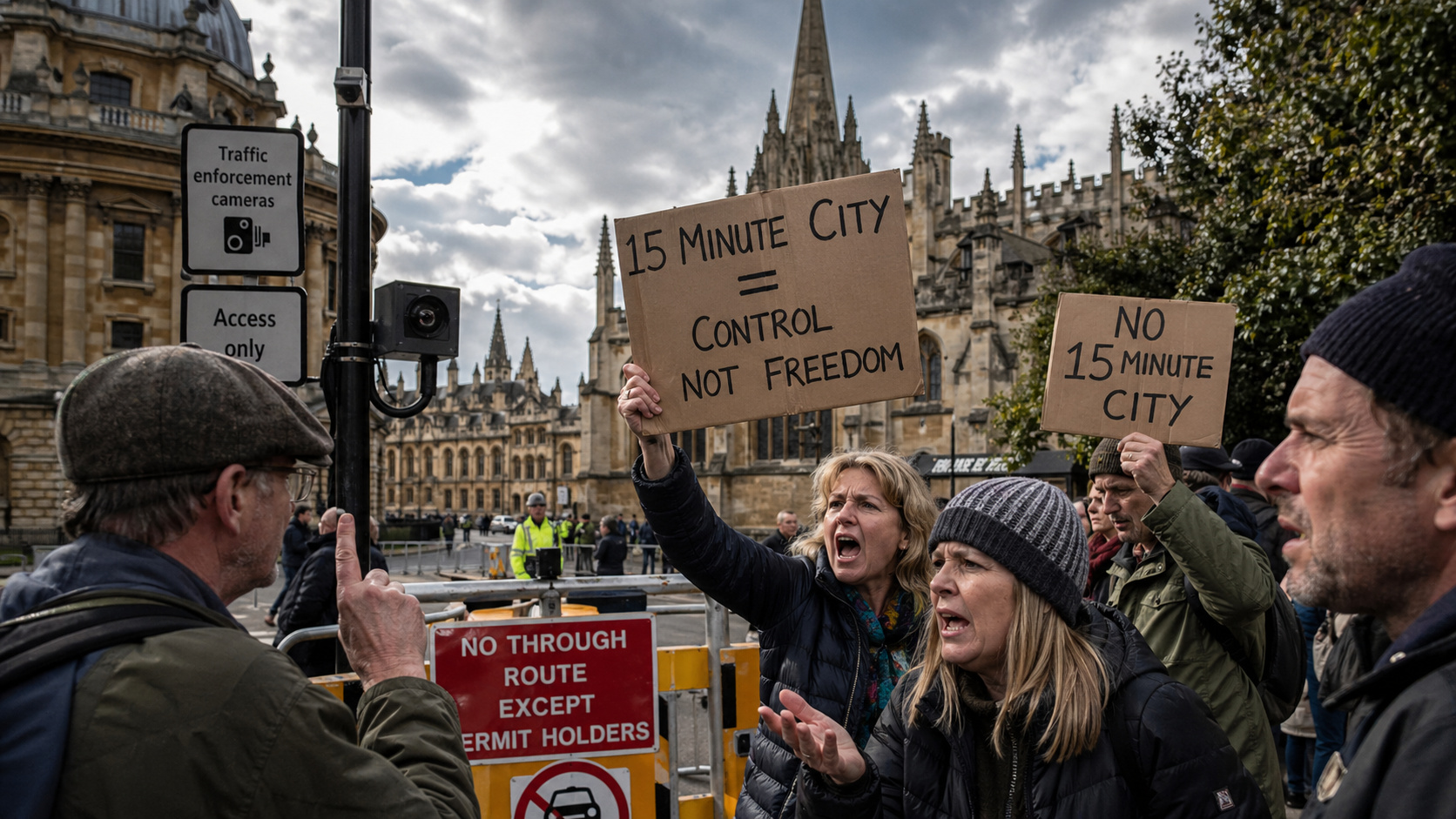
The 15-minute city became a global case in Oxford after an urban mobility proposal was associated with climate imprisonment, fear of confinement, protests, threats to authorities, and weariness in how public policies are explained
The 15-minute city in Oxford became a symbol of a dispute that moved from traffic to the realm of fear. An urban proposal linked to shorter commutes ended up being treated by conspiracy groups as a sort of climate imprisonment.
The investigation was published by Associated Press, news agency. The case showed that the traffic filters in Oxford did not prevent residents from leaving the city, but the narrative of confinement gained traction and turned a mobility policy into a public crisis.
The impact was real. The controversy sparked protests, threats to local authorities, and made the term 15-minute city so worn out that it started to be avoided by part of the public authorities.
-
Forget the Eiffel Tower: the largest steel bridge on the planet has 25.8 thousand tons of metal, a height equivalent to 100 floors, a record-breaking arch of 580 meters, and spans mountains 310 meters above the river.

-
With 181 meters, 12,000 tons, and 46 years in service, the French helicopter carrier concealed a mission that involved 5 types of helicopters and global presence.
-
New free RG in Brazil requires only three documents, replaces CPF as a single identity, and prompts the government to accelerate biometrics: over 55.8 million have already issued the new CIN, with QR Code, Gold access on GOV.BR, and free issuance in all states.
-
As Havan approaches 200 megastores in Brazil, the city of São Paulo still has no unit; Luciano Hang attributes the absence in the country’s largest metropolis to bureaucracy and explains why the network’s expansion prioritized inland municipalities.


The concept of a 15-minute city was born as an idea for a more practical neighborhood, but became a target of fear in Oxford
The 15-minute city is a simple urban proposal. The idea is for residents to have access to essential services near home, such as commerce, school, health, leisure, and transport.
In practice, this means reducing long trips to handle daily tasks. The focus is on bringing people closer to services and improving circulation on foot, by bicycle, and by public transport.


In Oxford, this concept was mixed with local traffic filters. From this confusion, part of the public began to believe that the city would be divided into closed zones.
The term climate imprisonment gained traction precisely at this point. A proposal linked to mobility was presented as if it were a plan for social control.
Traffic filters were seen as confinement barriers by conspiracy groups
The traffic filters were part of a policy to reduce congestion and improve the movement of buses, cyclists, and pedestrians in Oxford.
The measure did not mean confining residents to neighborhoods. Nor did it create a general prohibition on leaving home, moving around the city, or accessing other regions.
Even so, the conspiracy theory turned the filters into supposed confinement barriers. Fear gained ground because the urban policy became linked to permanent lockdown and climate control.
This was the most absurd point of the story. An urban mobility action turned, in the imagination of part of the public, into a plan to incarcerate residents within their own city.
Associated Press showed that the idea of climate imprisonment distorted urban policy
Associated Press, news agency, detailed that the 15-minute city is about more walkable neighborhoods with nearby services, while the traffic filters had a different role within traffic organization.
The confusion between the two topics completely changed the debate. Instead of discussing buses, cars, bicycles, and pedestrians, the conversation shifted to surveillance, blockades, and loss of freedom.
The expression climate lockdown also helped fuel suspicion. It was used by groups associating urban policies with strict pandemic measures.
As a result, a technical idea of urban planning was repackaged in emotional language. The outcome was a moral panic around a more walkable city.
Protests and threats showed that the conspiracy theory moved from the networks to the streets
The reaction against the 15-minute city in Oxford was not limited to the internet. The controversy generated protests and increased pressure on local authorities.
Councilors began to receive threats. The debate on urban mobility lost space to accusations of social control and confinement.
This type of reaction shows how a false narrative can affect public decisions. Even when policy does not create imprisonment or total lockdown, popular perception can change the course of the discussion.
The case also exposed a communication failure. When an urban measure is not explained simply, rumors can fill the space left by a lack of clarity.
The expression ’15-minute city’ became toxic and started to hinder urban planning
One of the strongest effects of the controversy was the erosion of the expression itself, 15-minute city. The term, previously used to describe practical and accessible neighborhoods, began to carry suspicion.
Authorities began to avoid the expression in some contexts. This shows that the dispute affected not only a specific policy, but also the language used in urban planning.
When a word becomes a symbol of fear, explaining its real meaning becomes more difficult. The public stops listening to the proposal and starts reacting to the negative image created around it.
Oxford became a global example of this problem. The city showed how a traffic policy can be hijacked by a conspiratorial narrative and cause damage to public trust.
The Oxford case shows that urban mobility also depends on trust
The episode left a clear lesson. Measures regarding traffic, buses, bicycles, and circulation need to be explained in simple words, before they are taken over by false interpretations.
For the average resident, any change in the street affects routine, time, money, and sense of freedom. Therefore, communication needs to clearly state what changes and what remains permitted.
The main consequence in Oxford was the erosion of an urban policy that sought to improve commutes. Instead of being discussed as a mobility solution, it became a symbol of control.
The crisis also reinforces that urban planning does not depend solely on technical projects. It depends on trust, public listening, and clear information.
The 15-minute city in Oxford became a global case because it showed how an idea of a more practical neighborhood can be transformed into collective fear. What began as a debate about mobility ended up associated with climate lockdown, protests, and threats.
The episode remains important because it reveals the risk of public policies losing their own narrative. When the explanation doesn’t arrive simply, conspiracy theories can take the place of information.
Do you think more walkable cities can still convince the population after cases like Oxford, or has the fear of social control already contaminated this debate? Share your opinion in the comments.






-

1 person reacted to this.