Portuguese
  Spanish


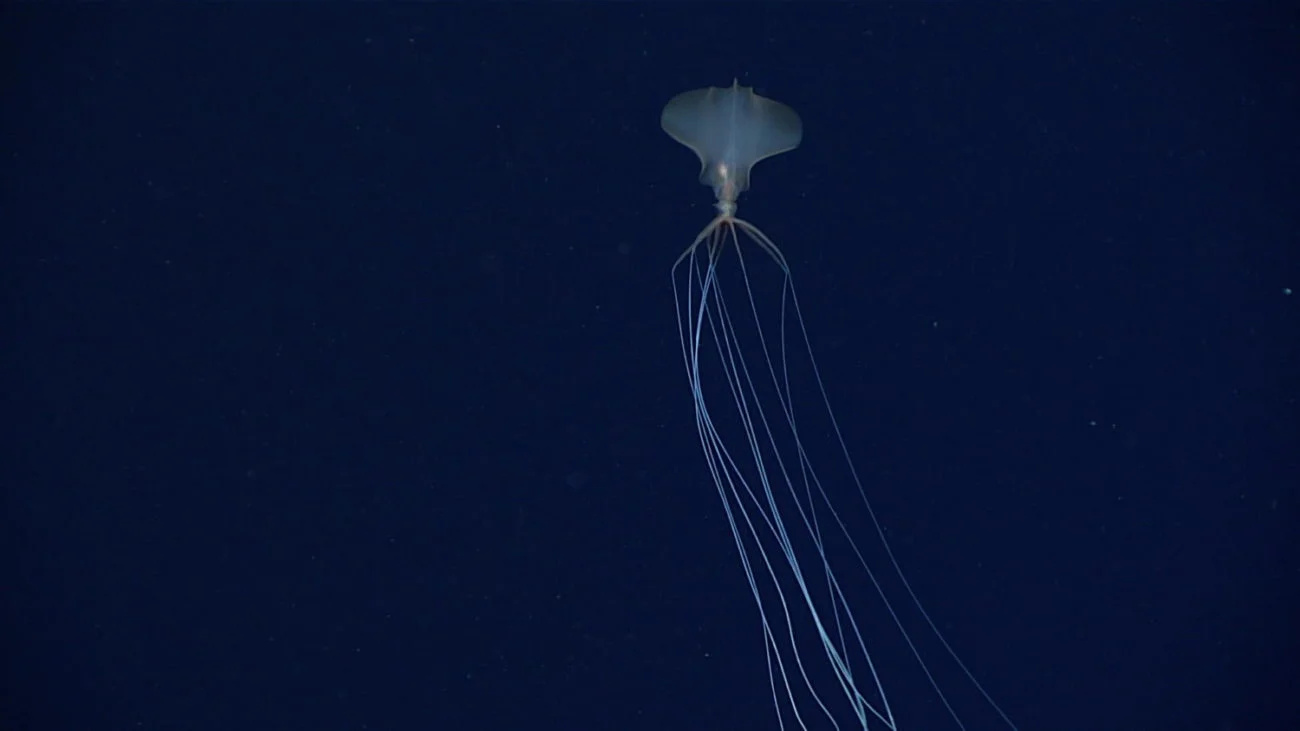


Magnapinna Squid Is Filmed at 3,000 Meters with Tentacles Folded at an Angle and Almost Motionless Hunting Behavior That Intrigues Marine Biologists.
Few people know, but some of the strangest creatures on the planet live in a place we hardly ever see: the deep ocean, below the zone where sunlight can still penetrate. It is in this cold, dark, and high-pressure environment that one of the most enigmatic squids ever recorded by modern science was filmed. This is the Magnapinna, also known as bigfin squid, a cephalopod whose tentacles can exceed several meters and which, instead of swimming frantically, adopts a rigid and minimalist posture as if patiently waiting for the ocean itself to bring food to it.
The images recorded by remotely operated vehicles (ROVs) showed the squid at about 3,000 meters depth, with its tentacles extended downward and curved at almost a perfect angle, resembling “folded arms.” This pattern caught the attention of marine biologists not for its visual extravagance but for its behavioral strategy: few movements, low energy, and a posture suggesting a hunting method different from what we see in coastal squids.
The Deep Zone: Darkness, Cold, and Energy Economy
To understand the Magnapinna, it’s important to comprehend the environment in which it lives. From about 1,000 meters deep, we begin to enter the so-called bathyal zone, and around 3,000 meters, we are approaching abyssal areas. At these depths:
-
Scientists Convert Food Waste into Aviation Fuel, Successfully Test 50% Blend with Conventional Kerosene to Cut Emissions and Promote Sustainable Flights

-
OnePlus N6 Smartphone to Launch in India with 8,000mAh Battery and 45W SuperVOOC Charging, Lasting Up to Three Days
-
Scientists Plan to Release Air Bubbles Underwater to Protect Antarctica’s “Doomsday Glacier” from Melting

-
Chinese R6000 Drone Combines Airplane and Helicopter Features, Carries Up to 12 People for Multiple Missions



- there is no sunlight,
- the temperature is close to 2 °C,
- the pressure can be hundreds of times greater than at the surface,
- the availability of food is extremely low.
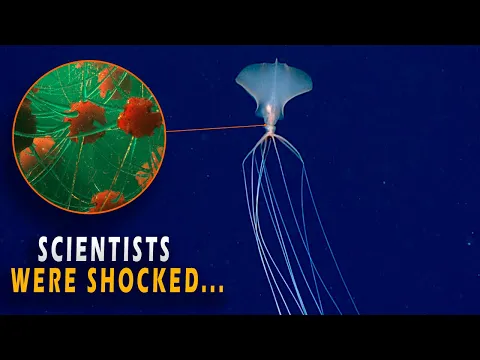

This means that any animal found there needs to be energetically efficient. Unlike coastal squids that actively chase schools of fish, the Magnapinna seems to bet on the opposite strategy: minimizing energy expenditure.
The motionless posture observed in various records suggests that it may simply wait for small prey to come close to its tentacles.
Long, Curved, and Articulated Tentacles: The Anatomy of Behavior
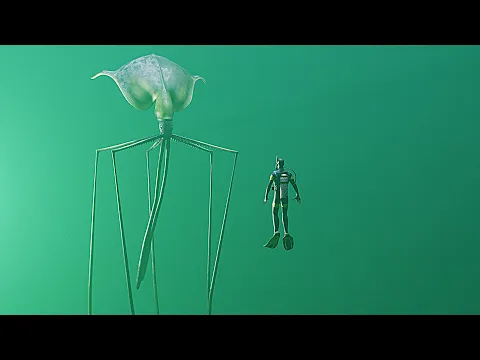
What makes the Magnapinna so recognizable is its morphology. Unlike lumias, loligos, or squids used as commercial references, this species has extremely thin and long arms and tentacles, with lengths that can reach several meters. They do not extend forward or sideways, as in other squids, but downward, often forming right angles.
In high-resolution cameras, this pattern repeats:
- the squid’s body remains almost static,
- the tentacles descend vertically,
- the tips make small changes in orientation,
- the arms appear articulated along their length.
Marine biologists have speculated that these tentacles are covered in adhesive structures or sensory cells capable of detecting microorganisms, small crustaceans, and biological particles. This makes sense in the deep sea: it is more advantageous to “filter” what passes by than to spend energy chasing prey.
This idea, though plausible, is still not consensus, because there has never been a complete anatomical study of a Magnapinna in perfect condition. Most of what we know comes from visually recorded observations from a distance.
ROVs, Cameras, and the Advancement of Underwater Filming
The footage that made the Magnapinna famous was captured by ROVs (Remotely Operated Vehicles) connected by cables and operated by scientists on research vessels.
These devices can descend thousands of meters without being crushed by pressure, filming, collecting chemical data, and mapping the ocean floor.
Before ROVs, the deep sea was mainly studied using trawl nets. The problem is that gelatinous and delicate animals, like the Magnapinna, do not withstand physical contact, losing tentacles and becoming unrecognizable even before they reach the surface. This explains the lack of intact samples in scientific collections.
That’s why, today, much of the information about the Magnapinna comes from:
- ROV videos from scientific expeditions,
- declassified military images from submarines,
- records from oil companies on offshore platforms.
This combination of sources has revealed that the Magnapinna is not an isolated case but a group of poorly documented species.
This has led scientists to speculate that it uses a strategy comparable to an “inverted fishing line,” where each tentacle functions as an extremely long rod waiting for contact with food.
This interpretation makes sense in low-energy environments, but there is no definitive consensus, because no direct observation has shown the moment of capture. What we have are behavioral cues and hypotheses based on comparisons with other deep-sea organisms.
Rarity, Mystery, and Scientific Gaps
Despite its recent fame, the Magnapinna remains shrouded in scientific gaps. Among the open questions are:
- How many species truly exist?
- What is the maximum size of the tentacles?
- How do they reproduce?
- What is their exact diet?
- Where are the areas of highest concentration?
The answers are difficult because:
- the deep sea is vast,
- access depends on expensive technology,
- the animals are fragile and rarely found,
- there is no way to keep them alive in a lab.
Many records come from the Gulf of Mexico, the Pacific, and Australian oceanic areas, but there are no complete “distribution maps.”
Why the Discovery Matters for Science
Finding and filming animals like the Magnapinna serves not just for visual curiosity — it helps to understand:
- how life evolves under extreme pressure,
- what energetic strategies are possible in dark environments,
- how food chains function without sunlight,
- what morphological adaptations the deep ocean allows.
There is also a larger implication: the deep sea is the planet’s largest biome yet the least studied. With each expedition, new organisms are found, many of which do not fit into familial classifications.
The Magnapinna reminds us that nature does not solely follow the models of coastal or terrestrial animals — it experiments with morphologies and behaviors that only make sense in extreme contexts.
In the end, the image of a motionless squid with folded tentacles at 3,000 meters raises a simple question: if this creature exists and almost no one knows about it, how many others are still waiting in the darkness of the deep ocean? And that is precisely why science continues to return to the ocean floor.