





 Portuguese
  English
  Spanish
  3 min of reading
  0 comments


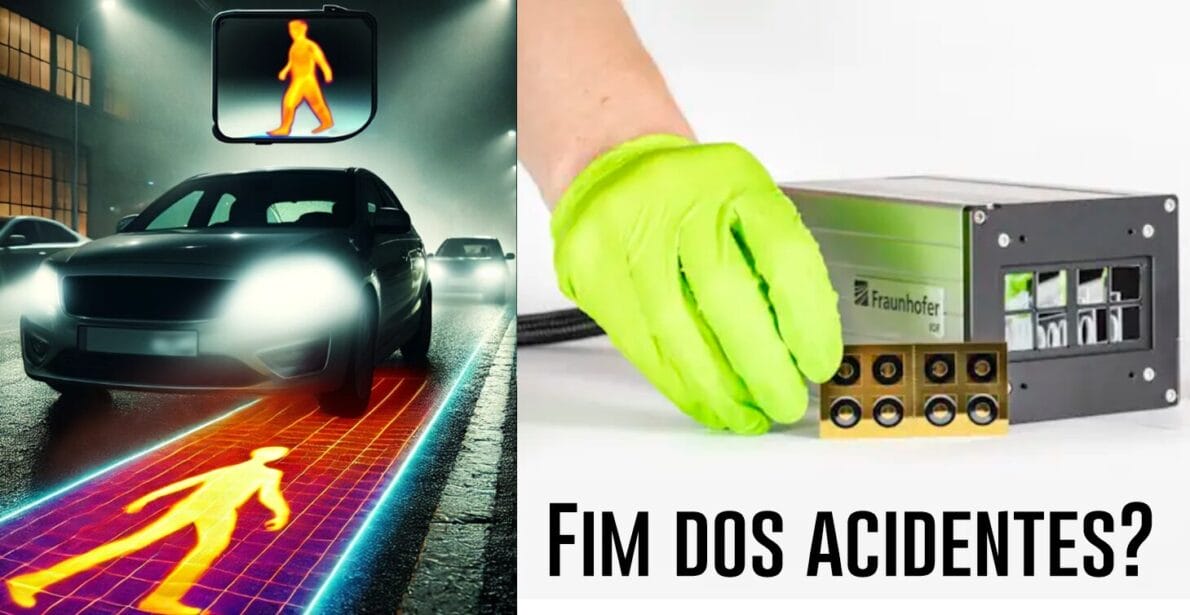
End Of Nighttime Accidents? A New Infrared Camera Developed By German Researchers Can Detect Humans In Low-Light Conditions, Functioning Perfectly Day Or Night. Discover How This Technology Can Save Lives!
Traffic safety is a crucial issue, especially in low visibility situations, such as dense fog or at night. In a promising advance, a team of German researchers has developed an affordable and innovative infrared camera designed for autonomous vehicles that promises to enhance road safety.
The technology, developed at the Fraunhofer Institute for Applied Optics and Precision Engineering IOF, is capable of detecting thermal radiation emitted by humans, even in low light conditions.
This technological innovation arises at a time when autonomous vehicles are gaining traction and face the challenge of navigating safely without human drivers’ supervision. The thermal camera can thus complement other detection systems, such as LIDAR and RADAR, which are often less effective in adverse conditions, such as heavy rain or total darkness.
-
Mitsubishi surprises the Brazilian market with cuts of up to R$ 55,000, expands bonuses for trade-ins, and pressures rivals in SUVs and pickups.

-
It is not the oil-bathed belt: Chevrolet Sonic addresses complaints from Onix owners with an unprecedented change in the design, new suspension, MTV technology in the shock absorbers, and fuel consumption of up to 14.8 km/l. Chevrolet Sonic addresses complaints from Onix owners. And it is not the belt.

-
Chevrolet Onix Plus 2027 does 11.1 km/l with ethanol, gains an exclusive ECO version, accelerates from 0 to 100 km/h in 10.5 seconds, has a trunk capacity of 500 liters, and is priced at R$ 103,990 to compete with the HB20S.
-
Colossal ship departs from China, crosses the ocean in 10 days with 4,809 BYD cars on board, and docks in Melbourne, Australia.



Technology That Detects Humans
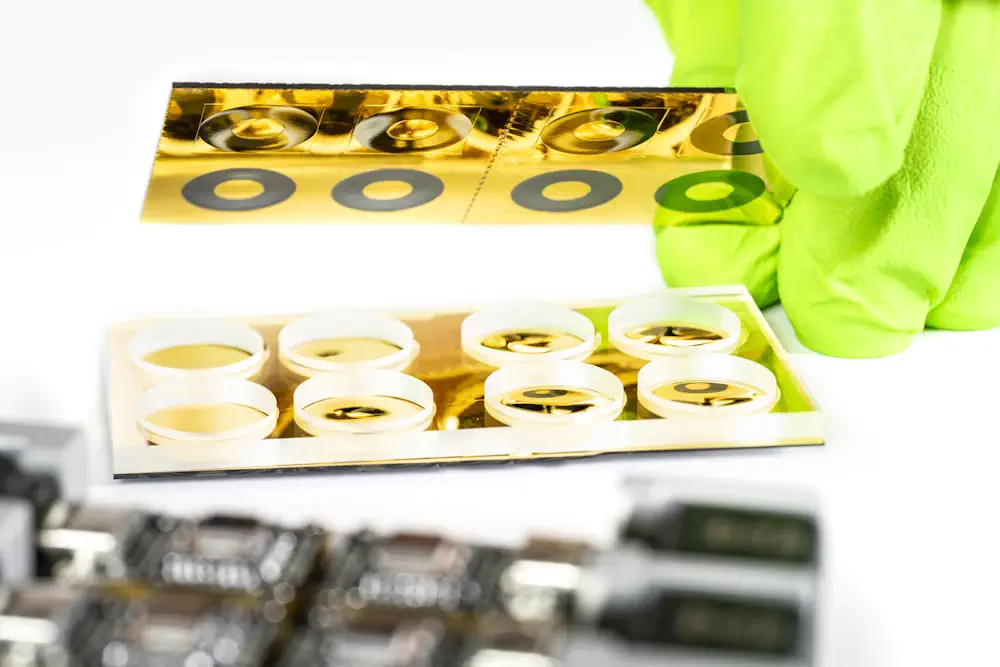
The major innovation of this infrared camera lies in its ability to operate in the wavelength range of 8 to 14 micrometers. This enables accurate detection of humans, day and night, making roads safer for pedestrians, cyclists, and other vulnerable users.
“This technology can significantly improve road safety and prevent accidents,” said Martin Hubold, project manager at the Fraunhofer IOF. Hubold also emphasized that the device provides this safety without the need for active lighting, something that many other sensors require.
The camera is the result of extensive experience by the team with multi-aperture systems, which has now been applied to this new device.
The construction relies on small uncooled bolometers, which are cost-effective and efficient. The software used combines the images obtained by these small sensors into a single high-resolution image, currently achieving 530 x 210 pixels, with a field of view of 34 x 13 degrees.
Efficient Design And Various Applications
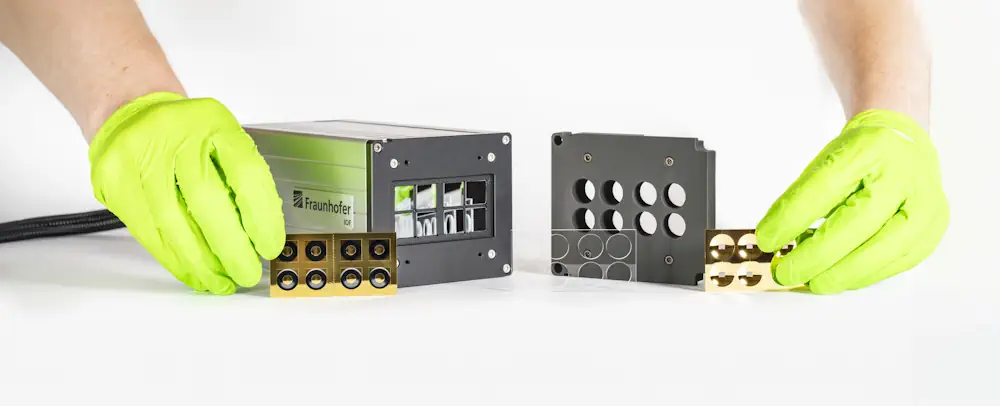
In addition to the human detection technology, the camera’s design is a noteworthy engineering feat. With just 10 millimeters in thickness, thanks to the use of a catadioptric optical system—a combination of mirrors and prisms—the device is highly compact.
The production of the camera has also been designed to be scalable, using lithographic methods and materials commonly used in the automotive industry, helping to keep manufacturing costs low.
The collaboration with the Fraunhofer Institute for Silicon Technology ISIT was crucial to turning this efficient production process into reality. This approach allows the infrared camera to be manufactured on a large scale, facilitating its introduction to the market in high volume and at affordable costs.
Although initially designed for autonomous vehicles, the camera has a much broader range of applications. With an expanded horizontal field of view, it is also ideal for driver assistance systems and can be used in contexts that go far beyond the roads.
Hubold noted that the device can be applied in firefighting operations, monitoring industrial processes, and even in controlling heat loss in buildings. This multifunctional potential reinforces the technology’s versatility.
The German innovation promises to transform the transportation sector and beyond, offering more safety and efficiency in a variety of scenarios. As autonomous vehicles continue to evolve, solutions like this thermal camera demonstrate how technology can help address critical safety challenges, reducing accidents and saving lives.
The accessibility and versatility of the device indicate that it could become an essential tool across various industries in the near future.




Be the first to react!