Portuguese
  Spanish


Watching Surgical Videos Allows ‘Medical Robots’ to Acquire Precise Skills, Equating Them to Human Doctors
Imagine a future where complex surgeries can be autonomously performed by medical robots, with precision and safety equivalent to human experience. This scenario, which once seemed like science fiction, is now a step closer to reality, thanks to impressive advances in machine learning and surgical robotics.
The Innovation of Imitation Learning in Medical Robots
The idea of teaching a robot by observing videos is both simple and revolutionary. Think of the number of movements a surgeon makes during an operation: each cut, stitch, and instrument movement is orchestrated with precision.
Traditionally, for a robot to perform such a task, it would be necessary to program it with each of these movements – a time-consuming and complex process. But now, thanks to imitation learning, the robot can “absorb” the movements of surgeons by observing and understanding how each task should be performed.
-
Brazilian project based on nanotechnology transforms the recovery of degraded areas in the Amazon, receives international recognition, and uses research in 9 states to accelerate the growth of native species and increase carbon capture.

-
The battery that promises to change cell phones and electric cars still has a microscopic enemy: researchers discover how lithium dendrites pierce the solid electrolyte and are already testing ways to prevent cracks and short circuits.
-
An old ferry rusted for more than 10 years in New York, almost sank after the engine room was flooded, and now volunteers are rushing to clean the hull, remove wires, life jackets, and loose paint before sinking it in the Atlantic to become an artificial reef full of marine life.

-
SpaceX launch turned Falcon 9 into a giant jellyfish in the night sky, with a colorful plume illuminated by the Sun at high altitude, confusing observers and showing how a routine flight can become a rare spectacle of atmospheric physics over Earth.


The Technology Behind the Innovation
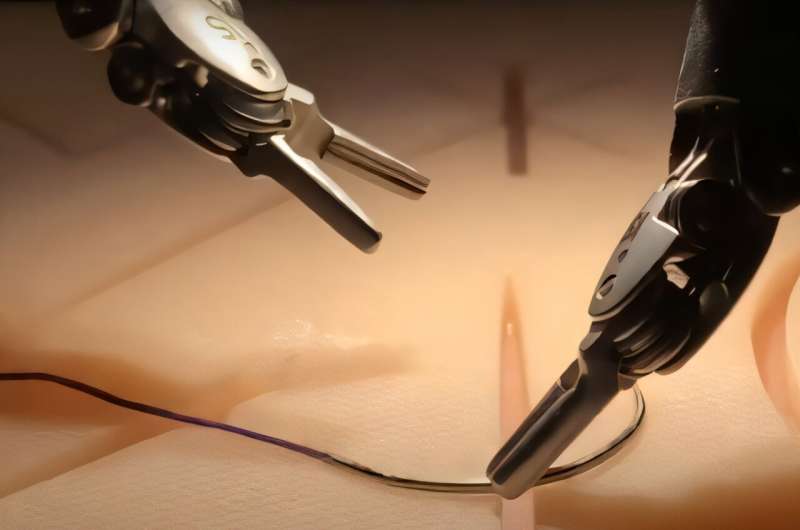
To achieve this feat, a team used the famous da Vinci robotic system, a device widely utilized in hospitals and clinics around the world. Although the da Vinci system is one of the most advanced in the field, there are still challenges – it is not as precise as one would like.
Instead of programming the robot to replicate specific and absolute movements, the researchers discovered that training it to replicate related movements (in relation to the environment and the specific task) was the key to success.
This breakthrough offers a creative solution to an age-old problem: how to empower robots to perform complex medical tasks with precision and safety? Axel Krieger, one of the senior authors of the study, explains: “Having this model is really magical. We feed the system data from cameras, and it can predict the necessary robotic movements for a surgery.”
Performance and Skill in Practical Surgeries
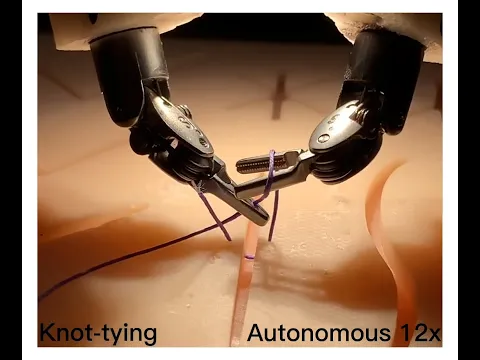
The robot’s training included fundamental tasks such as needle manipulation, tissue elevation, and suturing – basic elements of many surgeries. In all cases, the robot trained on the team’s model, performing tasks with the same skill as a human surgeon. Krieger shares an interesting anecdote: in one of the training sessions, the robot accidentally dropped a needle, but surprisingly it picked it up again and continued suturing without the need for human intervention.
This type of technology promises to accelerate the training of robots for various procedures, reducing development time and increasing accessibility to robotic surgery. Previously, modeling a suture could take years, requiring manual input for each movement.
With imitation learning, this time can be limited to days. Imagine the impact of this on health care: fewer medical errors, faster and more accessible procedures, and greater precision in operations that unlock a higher level of detail elevated.

Next Steps: Complete Surgeries Performed by Robots
A team of researchers is already planning the next step: using the model to train robots in complete surgeries, not just isolated tasks. With the potential to revolutionize the way we perform medical procedures, the positive impact of this technology can be enormous, especially in areas with limited access to specialist doctors.
The journey of medical robotics is still in its early stages, but the potential is undeniable. With more than 7,000 da Vinci robots in use worldwide and a vast database of surgical videos, the future of robotic medicine looks promising.
The idea of a robot that observes, learns, and executes could redefine our understanding of medical assistance and open doors to a world where robots and humans work together, side by side, to save lives and improve the quality of treatments.