






 Portuguese
  Spanish


Discarded food at Ceasa undergoes composting, supplies green areas, and helps reduce environmental impacts caused by waste
Spoiled food at Ceasa in Campinas has found a sustainable destination before reaching landfills.
The waste goes to the Green Plant of Campinas, where it undergoes composting and transforms into organic fertilizer.
The produced fertilizer supplies urban gardens, parks, and public flowerbeds in the São Paulo municipality.
-
Brazil’s Gross Public Debt Surges to 81.1% of GDP in May, Raising Concerns with $107.5 Billion in Interest Payments

-
Financial Worries Surpass Health, Family, and Work Concerns in Brazil, as Credit Cards, Debt, and Lack of Savings Cause Sleepless Nights

-
Without Scalable Industrial Capacity, Brazil Risks Falling Behind, Warns Avibras Aeroco CEO as Company Resumes Missile and Drone Production and Prepares New Tactical Cruise Missile Launch
-
As 9,215 Brazilians Join Millionaire Ranks by 2025, 69% of Adults Still Have Less Than $10,000, Keeping Brazil Among World’s Most Unequal Nations


The initiative also reduces maintenance costs, prevents improper disposal, and returns important nutrients to the soil.
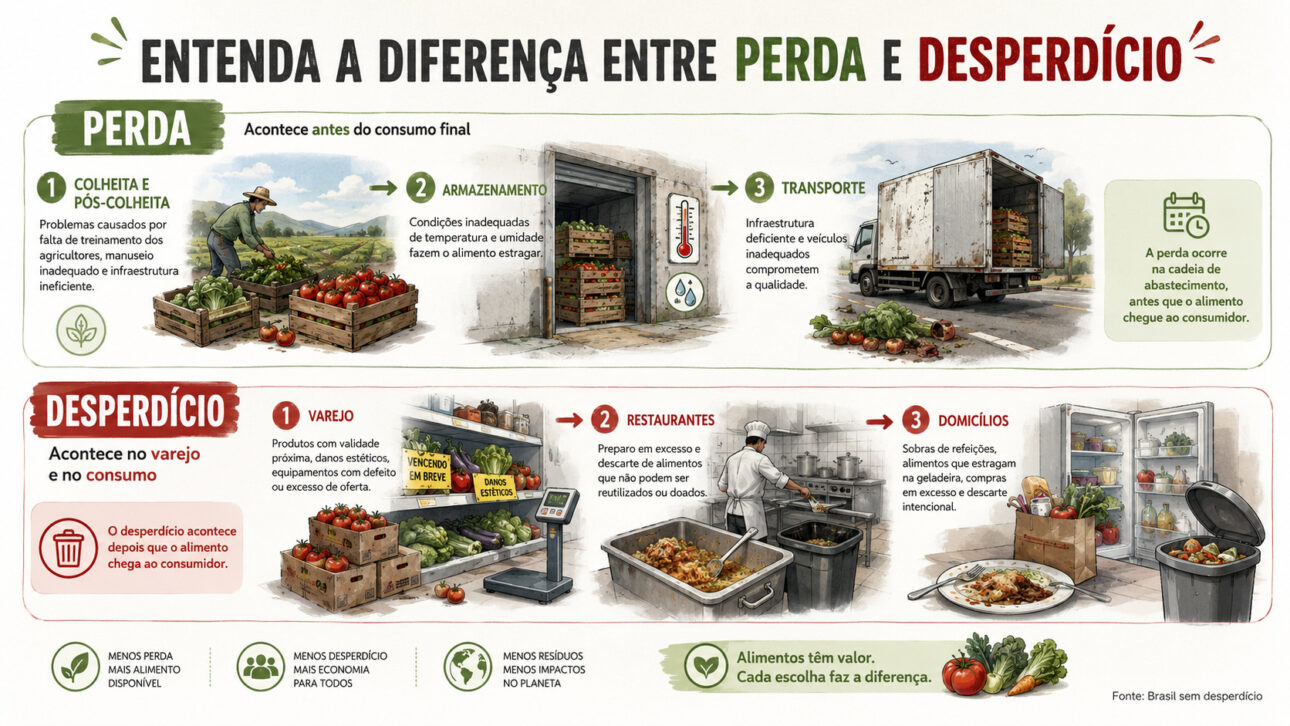
Food waste causes environmental and economic impacts
The United Nations Environment Programme released the Food Waste Index on March 27, 2024.
The survey estimated that approximately 1.05 billion tons of food were wasted worldwide during 2022.
The disposal causes financial losses, increases pollution, pressures prices, and worsens food insecurity.
The decomposition of organic waste in landfills releases methane, one of the gases associated with the greenhouse effect.
The process also produces leachate, a liquid capable of reaching the soil and contaminating groundwater.
Data from UNEP indicate that losses and waste account for 8% to 10% of global greenhouse gas emissions.
Composting transforms organic waste into fertilizer
The Green Plant receives spoiled food from Ceasa in Campinas.
The waste initially goes through a separation according to the condition of each product.
The organic material then proceeds to the composting stages and no longer occupies space in landfills.
The process allows the remains to return to the earth as compost, closing a sustainable cycle of reuse.
The city is thus able to reduce leachate formation, decrease emissions, and recover nutrients present in food.
Food banks help combat hunger and waste
Almost 7 million Brazilians still face hunger, according to the data presented in the survey.
The Brazilian Institute of Geography and Statistics recorded 18.9 million households with some degree of food insecurity in 2024.
Food banks collect surpluses from farms, supermarkets, markets, and supply centers.
Each product goes through a screening before distribution to social organizations.
Only foods considered suitable for consumption reach the families served.
The Solidarity Institute for Food Programs operates within the Campinas Ceasa and receives support from permit holders.
The Sesc Mesa Brasil also collects products in supermarkets and directly from farms in different regions of the country.
Since 2023, the federal government has allocated R$ 25 million to modernize food banks, according to the Ministry of Social Development.
The Pact Against Hunger points out, however, that only 1% of people in food insecurity receive redistributed products.
Technology and management reduce losses in crops
Reducing waste also depends on techniques applied during agricultural production.
Alfacitrus uses manual harvesting to identify the right time to pick oranges, lemons, and tangerines from the trees.
Plastic boxes reduce the risk of contamination and damage during transport.
Suitable fruits are sanitized and sold fresh.
Products with blemishes or non-standard sizes are used for juice production when still fit for consumption.
Spoiled fruits undergo composting and return to the fields as fertilizer.
An artificial intelligence system records about 30 images of each fruit during screening.
The technology assesses the conditions of each unit and helps to define the most appropriate destination.
Pests, diseases, frosts, and droughts remain among the main causes of losses in agricultural production.
Should composting and food banks receive more investments to reduce waste and hunger in Brazil? Share your opinion.


