Portuguese
  Spanish


In an interview with Estadão, Sami Hassuani details the restructuring of the country’s largest defense industry after four years of paralysis and advocates for the integration between BNDES, federal budget, and technological innovation
According to a report published by Estadão, signed by journalist Marcelo Godoy, Defense Minister José Múcio Monteiro Filho had recently warned that Brazil lacks adequate defense. Now, it’s Sami Youssef Hassuani’s turn, CEO of Avibras Aeroco — the largest defense industry in the country — to issue a similar warning: without stockpiles and scalable production capacity, Brazil will be defeated in a potential modern conflict. According to him, it is necessary to link resources allocated to innovation with BNDES money and the federal budget, organizing companies in the defense industrial base around structured projects — a movement that, in the executive’s view, has become necessary in light of the new global geopolitical reality.
Hassuani leads an industrial complex of 2.7 million square meters, with 18 manufacturing units, located in the middle of the Serra do Mar, near the Tamoios Highway. There, security is strict: no cell phones or computers are allowed, no one moves between units without tight control, and the company’s engineering server does not communicate with the internet. Nothing is copied without prior authorization.
From paralysis to recovery: R$ 300 million and 90% of the chain reestablished
The company’s recent trajectory is marked by a significant turnaround. The former Avibras remained inactive for four years due to debts and a judicial recovery process. The restructuring began in August 2025, with the change of company control and the creation of Avibras Aeroco, a new company that inherited all assets, intellectual property, and technological legacy of the former Avibras.
-
As 9,215 Brazilians Join Millionaire Ranks by 2025, 69% of Adults Still Have Less Than $10,000, Keeping Brazil Among World’s Most Unequal Nations

-
Entrepreneur Sells Car to Launch Healthy Meal Business, Now Runs Mr. Fit with 880 Stores in 3 Countries and $40 Million Annual Revenue

-
End of an Era: Renault Plans Major Overhaul, Cutting Jobs to Compete with Chinese Rivals and Transform Engineering by 2027
-
Brazil’s Largest Grain Port Faces Delays in the Hinterlands, Missing Rail Link Costs Agribusiness Billions


“This is a process that we started in August 25 with the change of control of Avibras and, subsequently, within the judicial recovery process, Avibras Aeroco was created, a new company that inherited all the assets of Avibras,” Hassuani explained to Estadão.
The company received R$ 300 million from investors, including brothers Joesley and Wesley Batista, from JBS. With this investment, ninety percent of the supplier logistics chain has already been reestablished, and the industrial sector has just resumed its activities after the long period of paralysis. According to Hassuani, all classic diligences — legal, accounting, financial, technological, and industrial — found that the company’s technology remained intact: servers, intellectual property, designs, and machinery, all preserved. “We found that the technology was intact, servers, intellectual property, designs, everything was intact and the industrial part, also all the machinery, the entire park was intact,” he stated.
Rockets, Missiles, and the Race to Deliver Before the United States
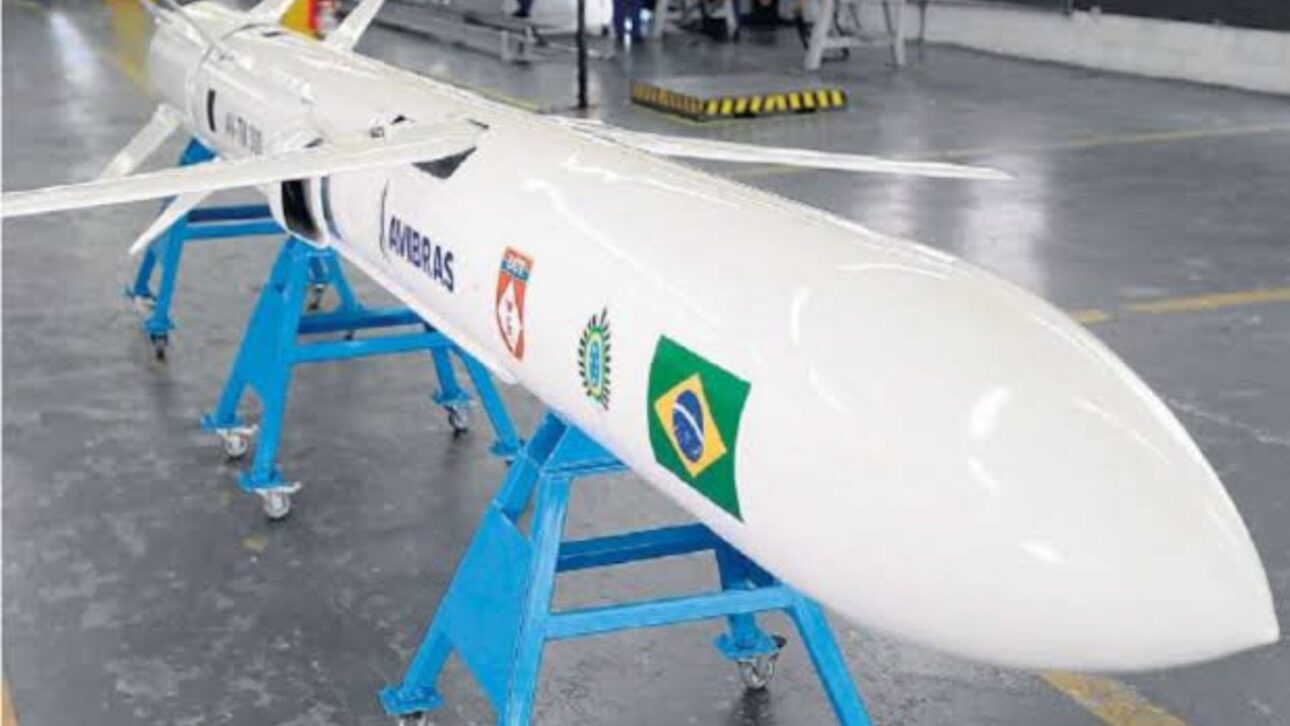
In the manufacturing units, Estadão followed the resumption of production of steel stretchers — a cold process essential for the construction of rockets and missiles. There are only five machines of this type in all of Brazil, and four of them belong to Avibras. The production capacity can reach up to 5,000 enveloped rockets per month.
Among the products seen during the visit are the SS-80 and SS-40 rockets, intended for the Army, the Brazilian Air Force, and clients in the Persian Gulf, as well as the 70 mm rockets of the Skyfire-70 system, used by the Super Tucanos exported by Embraer and by Brazilian military helicopters. In an isolated area of the complex, on the banks of the Jaguari reservoir, were two units of the new Tactical Cruise Missile (MTC) in the preparation phase, with a launch scheduled for November.
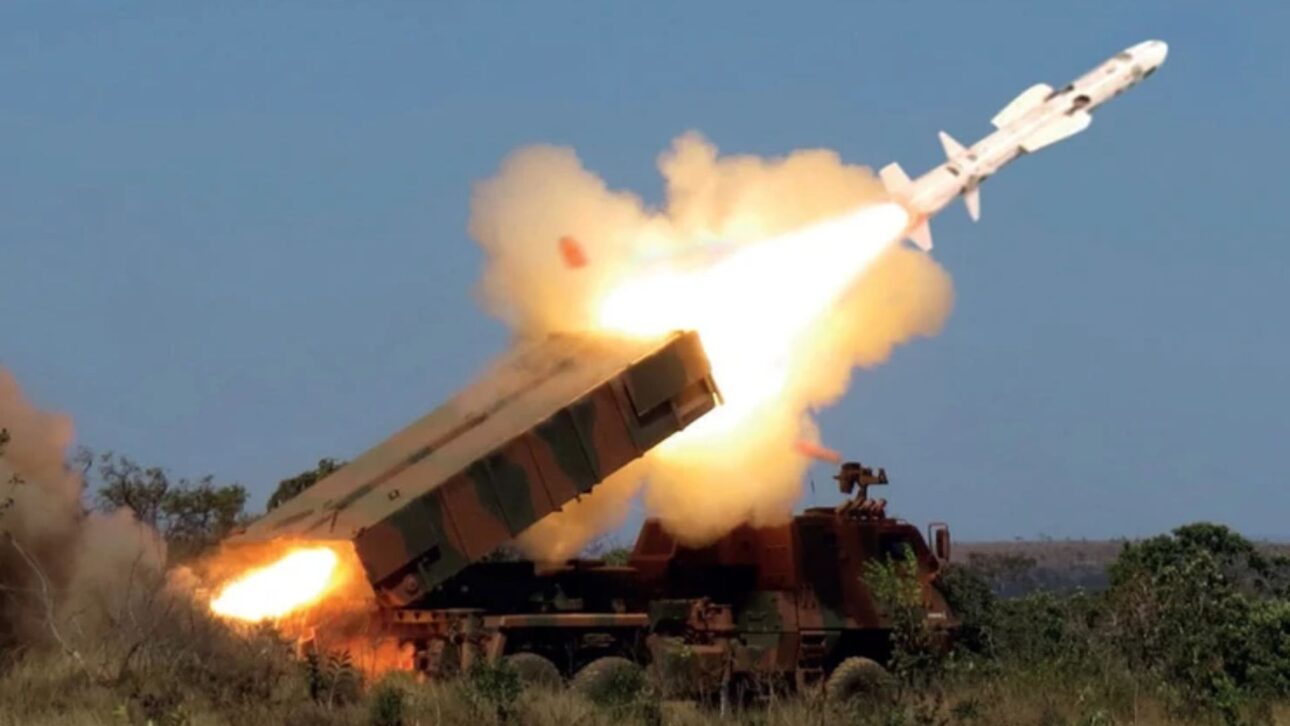
The MTC has an initial range of 300 kilometers, capable of hitting targets up to 450 kilometers with a precision of 9 meters, according to data released by the company itself. Three more flights are needed to complete the certification process. The missile is fired by the Astros artillery system, also produced by Avibras, and the expectation is to sell up to 200 units per year, with exports aimed at countries in the Gulf and Southeast Asia.
“The Americans are delivering only in 2032 what is ordered now. We will be able to deliver for export in two years,” said Hassuani, comparing Avibras’s delivery time with that of international manufacturers.
New Products: Hypersonic Missile and Drone Portfolio
Besides the MTC, the company is developing, in partnership with the Brazilian Army, the S+100 Tactical Ballistic Missile — a cheaper, hypersonic product with a range of 120 kilometers. Unlike the MTC, which navigates by waypoints, the new missile will follow a direct trajectory to the target, a model of engagement widely used in the Ukraine and Gulf conflicts in recent years.
Avibras also plans to open a portfolio of drones, focusing on equipment with greater range and flight autonomy, aimed at both surveillance and attack. “All our clients want drones,” summarized Hassuani. According to the executive, drones are cheaper than missiles and enhance battlefield surveillance capabilities, with an almost immediate response time for target engagement. The company already has a UAV prototype ready, as well as an anti-drone system designed to deter coordinated attacks through a curtain created by explosive fragmentation in the sky.
The forecast is that, by 2027, the company will deliver new orders to both the Army and the Brazilian Air Force, in addition to making the first deliveries to international clients. “We will be in full swing in 2028, when our forecast is to earn R$ 500 million. In 2029, we will start working in dollars,” projected Hassuani. Currently, the company already has 500 employees, two months after reopening, and in July it should start assembling new rockets and cutting plates for Army armored vehicles.
The central argument: industrial sovereignty as a strategic tripod
For Hassuani, however, the most important point of all this recovery goes beyond production numbers — it is a paradigm shift about the very concept of national sovereignty. According to him, the world has come to understand that sovereignty depends on three interconnected pillars: diplomatic negotiation capacity, equipped and trained Armed Forces, and industrial capacity to quickly replenish stocks in times of conflict.
“Industrial sovereignty defines a modern conflict. A country needs not only negotiation capacity and prepared and equipped Armed Forces. It is necessary to have stocks and the capacity to produce in a perennial and scalable way,” stated the executive. According to him, recent wars — including the conflict in Ukraine — have shown that stocks are quickly depleted in prolonged combat scenarios. “Those without industrial capacity are losing the war, despite having negotiation capacity and initial capacity to face the conflict. But after 4 days, you’re disarmed,” he explained.
In this sense, Hassuani argues that national companies like Avibras, SIATT, and Mac Jee should establish partnerships and consortia, following the model already adopted by European countries, so that research resources — managed by Finep and the National Fund for Scientific and Technological Development (FNDCT) — are integrated with BNDES industrial financing and the Ministry of Defense budget. According to him, this type of integration is already required by European countries as a condition for releasing innovation funds: without a clear industrialization and delivery schedule, financing is simply not approved.
“You can’t cooperate without having a program, which originates from the Forces and must include innovation, industrial capacity, and procurement,” summarized the CEO of Avibras Aeroco, advocating for Brazil to unify its defense industrial base around shared strategic objectives, rather than keeping companies operating in isolation.
The Brazilian Navy, for example, already uses the Astros system from Avibras to launch the Mansup anti-ship missiles through the coastal defense batteries of the Marine Corps — equipment manufactured by SIATT, a company with a 50% stake from the Edge Group of the United Arab Emirates. Recently, Avibras also participated in Eurosatory, a defense fair held in Paris, where Hassuani maintained contact with suppliers and potential international partners, including MBDA, Rheinmetall, the French KNDS, the Turkish Aselsan, Baykar, the Israeli Elbit, among other companies in the sector.
In the face of a global scenario of conflicts that drag on for years and consume military stocks at an accelerated pace, the revival of Avibras Aeroco raises a question that goes beyond the company itself: will Brazil actually be able to integrate innovation, industry, and budget in time to build the defense capability that Hassuani describes as indispensable — or will the country continue repeating the fragmented model that, according to him, no longer serves for 21st-century conflicts?