Portuguese
  Spanish


New Strategy Combines Modular Assembly, Remote Updates, and LFP Batteries to Create Faster, Cheaper, and More Efficient Electrics, Starting with a $30,000 Pickup
Ford announced on Monday (11) an important change in its manufacturing strategy. The automaker introduced a new assembly model that promises to reduce costs and accelerate the production of electric vehicles.
The innovation combines adaptable platforms and software integration with remote updates, allowing the same system to manufacture everything from SUVs to trucks.
In addition, the company breaks with the traditional concept of a single assembly line, adopting what it calls a “tree of assembly.” In this format, multiple lines operate simultaneously and merge at the end of the process.
-
End of an era in Brazil: beloved sedan by Brazilians is discontinued despite having a 2.0 engine with 151 hp, CVT transmission, 466-liter trunk, and up to 650 km of range.

-
New Law Proposal in Brazil Could Heavily Penalize Drivers: Dangerous Overtaking May Become a Serious Offense with Fines Increased Tenfold and a 12-Month License Suspension; Update on 2026 Progress

-
Electric Revolution: Watts W125 Motorcycle Offers 160 km Range, 90 km/h Speed, and Affordable Price Starting at $3,000
-
General Motors Replaces Over a Thousand Workers with 50 Cobots at Electric Vehicle Plant, UAW Union Criticizes Move Amid Industry’s Automation Push



Universal Platform and Production in Kentucky
During the press conference, Ford confirmed that the new structure will be implemented in its factory in Kentucky, United States.
The goal is to create a “family” of low-cost electric vehicles, all built on a universal platform.
This base will be scalable, adapting to different categories of vehicles such as pickups, vans, SUVs, and trucks. Thus, the company aims to optimize the use of facilities and simplify production.
Another differentiator is the definition of vehicles by software. This means that performance adjustments and updates can be made remotely, eliminating the need to take the car to the dealership.
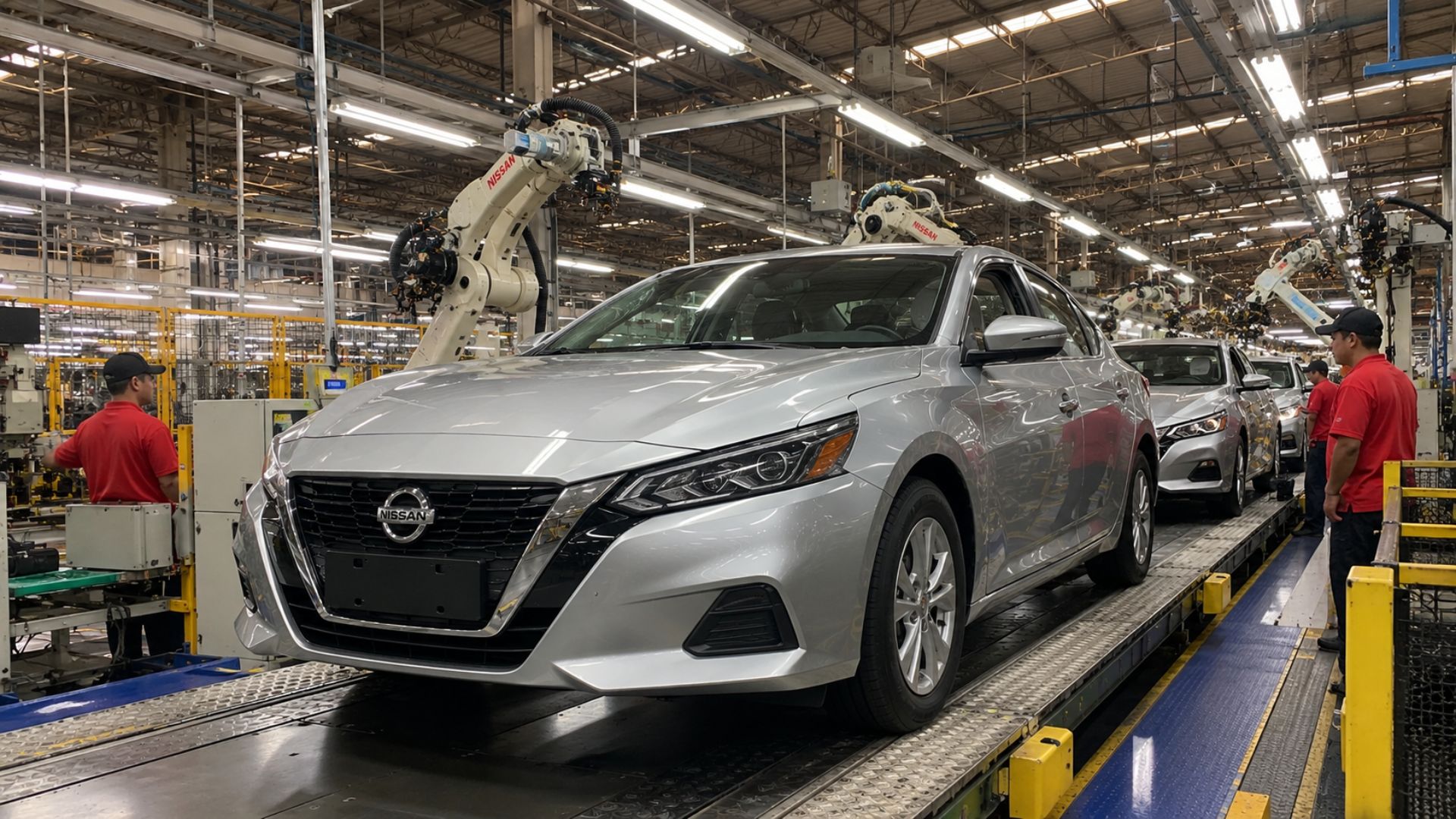
The End of the Single-Line Model
Ford became globally known for Fordism, the mass production system with a single line.
Now, the company is betting on a different scheme. Instead of a continuous conveyor, three subsets will work separately: front, rear, and the central part where the battery is located.
These parts come together at the end, forming the complete vehicle. The design was developed from scratch, inspired by the classic line but adapted for greater flexibility and efficiency.
The total investment to make the project viable reaches $5 billion, securing 4,000 jobs in the state. Of this, $2 billion will be allocated to the Kentucky plant.
More Speed and Less Costs
According to the automaker, the modular platform and the tree of assembly use 20% fewer parts than a vehicle produced in a traditional way. The process also requires 25% fewer fasteners and 40% fewer workstations.
The most important thing is that the total assembly time will be 15% faster. This represents a direct productivity gain and cost reduction.
Ford estimates that the ownership cost of the new electric vehicles, over five years, will be lower than that of a used Tesla Model Y with three years of usage.
Cheaper and More Durable Batteries
The new batteries will have lithium iron phosphate (LFP) chemical components. This technology promises greater durability, lower cost, and faster charging.
As the battery is the most expensive item in an electric car, this change should significantly contribute to reducing the final price.
Another advantage is the simplification of the electrical system. The new platform allows for a more streamlined network of wires and cables, reducing weight and facilitating repairs.
First Model: Affordable Pickup
Although the automaker has not disclosed all the details, it confirmed that the first vehicle of the new line will be a mid-size pickup with four doors. The estimated price is $30,000, about R$ 160,000 in direct conversion.
Production is scheduled for 2027. And, even with the focus on lower costs, Ford guarantees that it will not compromise performance.
The promise is acceleration from 0 to 100 km/h in approximately 4.5 seconds, performance comparable to some Mustang models.
With this strategy, Ford aims to broaden access to electric vehicles while repositioning itself in an increasingly competitive market.
With information from Olhar Digital.