Portuguese
  Spanish


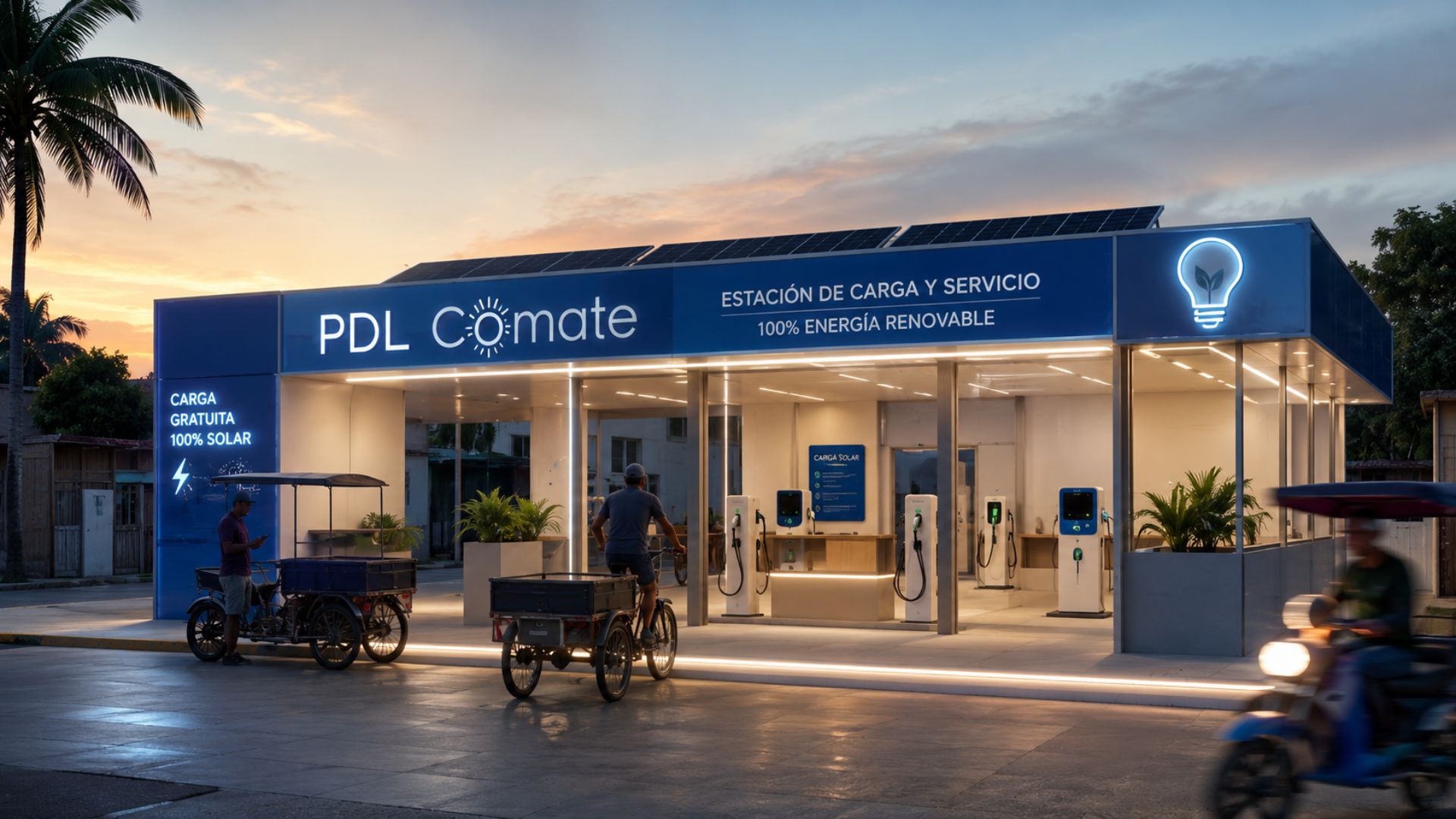


According to information from EL PAÍS, Cuba’s first free solar charging station operates in Santa Clara and is already attracting residents from cities 70 kilometers away who face chronic blackouts and cannot charge their electric tricycles at home, on an island where energy has become the most scarce and disputed resource of daily life.
In Cuba, electricity has ceased to be a basic service and has become a survival item. Blackouts that drag on for hours interrupt the routine of entire families, paralyze small businesses, and make it impossible to charge electric tricycles that have multiplied as an alternative to scarce fuel. Charging a single electric tricycle requires up to ten hours connected to the outlet, a time that the grid simply does not guarantee. In this scenario, a businessman, Alexandre Gutiérrez, from Santa Clara decided to inaugurate what is believed to be the country’s first free solar charging station, informally named solinera, and the impact on the community was immediate.
The news spread quickly. Residents from neighboring cities, some coming from up to 70 kilometers away, began to travel to Santa Clara just to get power for their vehicles. The solinera became a meeting point, a refuge against blackouts, and a symbol of a solution that the government itself has not yet been able to offer at scale. Nearby residents report that the place has changed the neighborhood’s dynamic: when the grid power goes out, the solar charging station continues to operate, and some even bring pots to cook there while waiting for their vehicle to charge.
Chronic Blackouts and the Collapse of Daily Life in Cuba

Cuba’s energy crisis is not recent, but it has dramatically worsened in recent years. The energy embargo imposed by the United States restricts the island’s access to fossil fuels, and the aging and overloaded electricity generation infrastructure cannot meet demand. The result is blackouts that can last from four to twelve hours a day, forcing families to reorganize their entire domestic routine around the brief intervals when power returns.
-
The large jar blender has a rival: Oster Ultra Power bets on 1,000 W, six stainless steel blades, and two portable cups with leak-proof lids.

-
Tesla injected an additional $250 million into the German factory, doubled the battery cell target, and opened its own production line for startups.

-
No more TV stuck on the wall: Samsung The Freestyle+, the new projector with over 400 lumens projects on walls, floors, and ceilings, bringing cinema to any corner of the house.
-
A Japanese governor single-handedly stalled the construction of the world’s fastest train for nine years, and only now has he agreed to allow a tunnel excavated at a depth of 1,400 meters.



The expression that best translates this daily life comes from Cubans themselves: when the power returns, everyone rushes to cook, wash, charge cell phones, and turn on fans before the next blackout begins. “Quickly, before the power runs out” has become the involuntary refrain of millions of people. Those who live near the Santa Clara solinera say that this pressure has significantly decreased, because now there is a reliable power point powered by the sun that does not depend on the national grid. In Cuba, having access to a stable electricity source has ceased to be a comfort and has become a strategic survival advantage.
The Solinera: Free Solar Charging That Became a Lifeline

The solar charging station inaugurated in early April in Santa Clara operates with photovoltaic panels that capture solar energy and make it available for free to those who need to charge electric vehicles. The model is simple, but the impact is profound in a country where most residents cannot afford to install their own solar system. The businessman Alexandre Gutiérrez, who conceived the solinera, transformed a private investment into a public service, offering for free something that the Cuban state has not yet been able to deliver affordably.

For electric tricycle owners, the station solves a problem that seemed insoluble. Charging the vehicle’s battery requires ten uninterrupted hours of power, and in Cuba, blackouts fragment this period unpredictably. With solar charging, the process no longer depends on the unstable grid and instead relies on the sun, a resource that the Caribbean island has in abundance almost all year round. The solinera not only charges vehicles: it restores mobility to people who were literally trapped at home due to lack of power to leave.
70 Kilometers for a Charge: The Journey from Cienfuegos

The most emblematic case of the transformation brought about by the solinera comes from Cienfuegos, a city located 70 kilometers from Santa Clara. Residents like Yudelaimys Barrero, who recently acquired an electric tricycle with her husband, could not complete the round trip between the two cities because the battery would run out on the way back. Santa Clara is a mandatory destination for shopping and medical appointments for their children, but without enough energy for the full journey, the family remained isolated.
With the inauguration of the solar charging station, this barrier disappeared. Barrero now makes the journey, recharges her electric tricycle for free at the solinera, and returns to Cienfuegos with a full battery. For her, the station “solved many problems for many people”, a phrase that summarizes the feeling of dozens of families who have come to depend on the solar charging point as an essential part of their domestic logistics. In Cuba, where fuel is expensive and scarce and the electricity grid is unpredictable, traveling 70 kilometers to access free energy is not an exaggeration; it’s a rational calculation for survival.
Solar progress, real limits, and Cuba’s energy future


The Cuban government recognizes the severity of the crisis and has intensified the installation of solar panels in recent years. Renewable sources already account for about 10% of the island’s electricity generation, a significant advance compared to the 3.6% recorded in 2024. This growth, however, still does not translate into universal access. Distribution remains concentrated in government and industrial projects, and few ordinary citizens have the resources to acquire their own photovoltaic systems.
It is in this gap that initiatives like Santa Clara’s solinera gain disproportionate relevance to their size. A single free solar charging station does not solve Cuba’s energy crisis, but it demonstrates that the model works and that the demand is real. If the format is replicated in other cities, solar charging could become the backbone of a decentralized energy network that bypasses the limits of the national electricity grid and reduces the impact of blackouts on the mobility and daily lives of millions of Cubans. The electric tricycle, a vehicle that has already established itself as popular transport on the island, would be the biggest direct beneficiary of this expansion.
And you, what do you think about this initiative in Cuba? Do you believe that free solar charging stations could work in other countries with energy problems and frequent blackouts? Leave your comment and say whether the solinera model should be replicated as a solution for electric mobility in regions with fragile infrastructure.