Portuguese
  Spanish


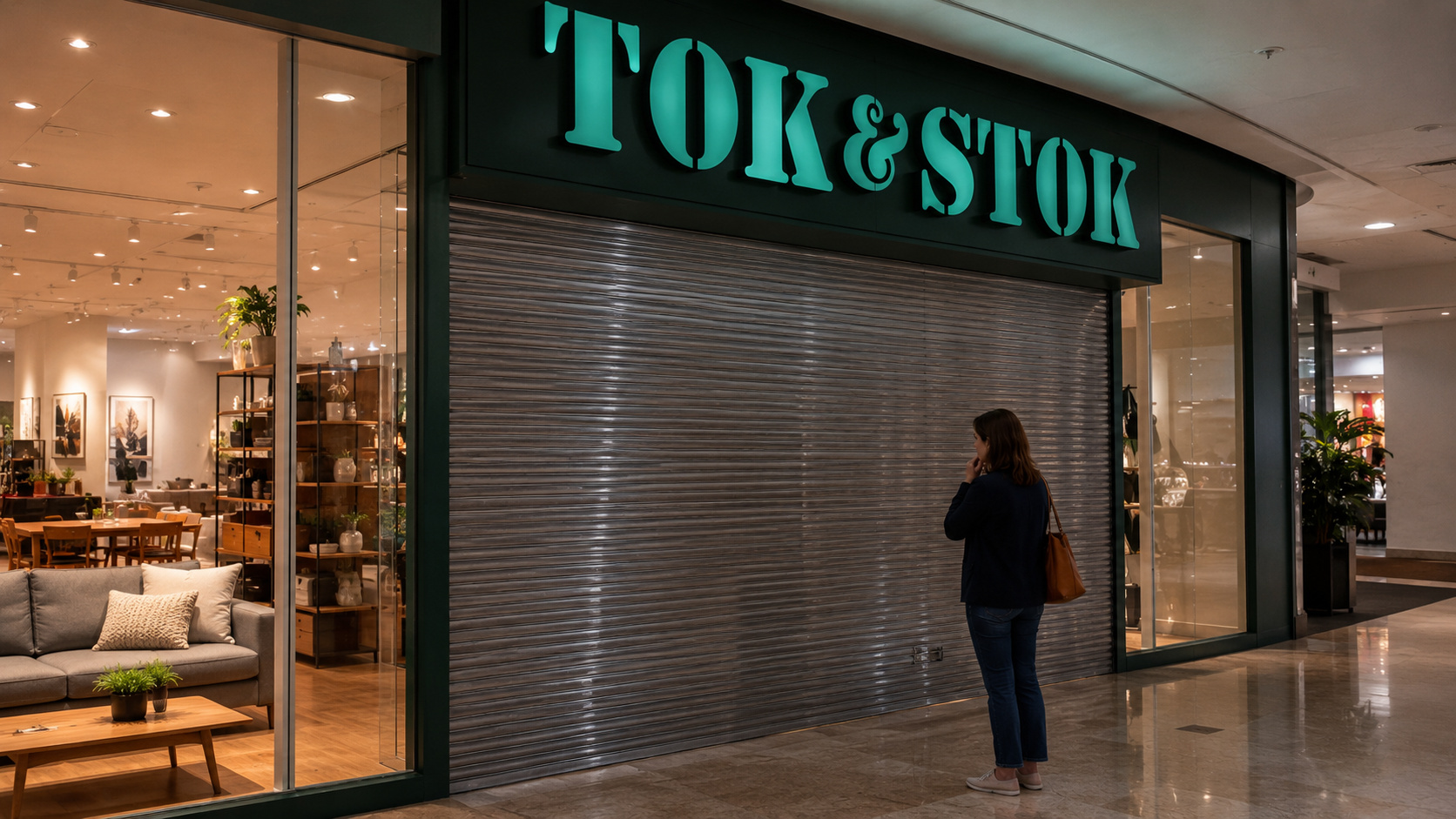

Tok&Stok closes stores, liquidates stock with up to 70% discount, and faces judicial recovery request from Grupo Toky.
Tok&Stok, one of the most well-known brands in Brazilian retail for furniture and decoration, has entered a critical phase of store closures, stock liquidation, and financial reorganization. The chain started offering discounts of 50% to 70% in units that are being closed, according to a report by Exame published on May 21, 2026. This move comes after Grupo Toky, the controller of Tok&Stok and Mobly, filed for judicial recovery in São Paulo. The debt reported in the articles and process documents is around R$ 1.1 billion, amid cash pressure, high interest rates, restricted credit, and a drop in furniture and decoration consumption.
Tok&Stok closes stores in São Paulo and Bahia while liquidating stock with discounts of up to 70%
Exame reported that the Tok&Stok store in D&D Shopping, in the south zone of São Paulo, was included in the list of operations closed by the chain, with discounts of 50% to 70% to liquidate stock before closing. The report also mentioned closures in the Pompeia and Shopping Cidade São Paulo units.


Outside São Paulo, the unit at Salvador Shopping, in Bahia, also ceased operations on May 16. The store had been inaugurated in 2021 and was part of a more recent model of the brand, focusing on experience, decoration, and home utilities.
-
Family Quietly Transforms Old Sawmill into $700 Million Business, Opens 25 Stores in Two Years Across 22 Brazilian States

-
Couple Sold Their Home to Save Business, Now Run Platform Handling $180 Million Monthly and Managing Over 51 Million Listings
-
Brazil’s 2026 Tax Refund: Record 9.58 Million Filers in Largest Payout Ever, But a Key Detail on Priority Recipients Draws Nationwide Attention

-
Itaú Alters Hybrid Work Model, Increasing Office Days from 2028, Prompting Employees to Adjust to New Routine




Grupo Toky filed for judicial recovery with billion-dollar debt and control over Tok&Stok and Mobly
Grupo Toky is the result of the merger between Tok&Stok and Mobly, consolidated after Mobly acquired control of Tok&Stok in 2024. Less than two years later, the holding that brings together the two brands filed for judicial recovery.
According to Money Times, the company attributed the crisis to a difficult macroeconomic environment for the furniture and decoration sector, with high interest rates, household debt, more restricted credit, and postponement of purchases by consumers.
The group also pointed to temporary stock restrictions and pressure on short-term liquidity. In practice, the company states that it needs to reorganize debts and preserve cash to keep operations, suppliers, workers, and sales channels functioning.
Debt of R$ 1.1 billion and blockage of R$ 77 million worsened the pressure on the company
UOL reported that Grupo Toky filed for judicial recovery on May 12, 2026, with a reported debt of R$ 1.1 billion. According to the same report, the court was still awaiting additional documents but granted urgent protection to shield the company from executions and cutting off essential services for 60 days.
Another critical point was the blockage of R$ 77 million in credit card receivables by SRM, mentioned in reports about the process. Toky claims that the blockage compromised cash flow and would be much higher than the overdue debts, estimated by the company at around R$ 1.3 million.
This blockage appears as one of the factors that increased the urgency of the judicial request because it would affect resources used to maintain operational payments, salaries, suppliers, logistics, physical stores, distribution centers, and digital channels.
Network had 63 physical stores and 2,278 employees when it filed for judicial protection
According to iG, at the time of the judicial recovery request, the group had 63 physical stores and 2,278 employees. The report also states that 13 of these stores were located in the city of São Paulo and that 747 employees worked in the São Paulo capital.
The same survey indicates that the process involves the main company and five other companies in the group. The company still had to present documents required by law to continue the judicial recovery process.

Tok&Stok crisis shows how the furniture retail sector was pressured by interest rates, credit, and changes in consumption
The Tok&Stok crisis did not arise only with the judicial request in May. The Toky Group had already been trying to reorganize liabilities, and Tok&Stok itself had undergone extrajudicial recovery before the merger with Mobly.
The furniture and decoration sector is especially sensitive to credit, disposable income, and consumer confidence. When interest rates are high and families postpone larger purchases, items like custom furniture, sofas, tables, shelves, and decorations are more easily cut.
The company itself cited this environment as part of the pressure on sales and liquidity. Even so, it is not correct to say that the crisis was caused by a single factor, because the process involves indebtedness, difficult integration, corporate dispute, blocking of receivables, and cash deterioration.
Tok&Stok shrinks physical operation while trying to preserve brand, remaining stores, and digital sales
Despite the closure of units, Tok&Stok has not disappeared from the market. The company continues with remaining operations and digital channels, while the Toky Group tries to reorganize debts under judicial protection.
The difference is that the large physical store model, with inventory, showroom, and high operational cost, is under pressure in a retail increasingly dependent on scale, efficient logistics, and strong cash flow.
The case is symbolic because it involves a brand founded in 1978, known for turning furniture and decoration into a desirable product for the Brazilian urban middle class. Now, the same brand is associated with aggressive liquidations, closed stores, and a billion-dollar debt.
Closure of Tok&Stok stores becomes a warning for traditional Brazilian retail brands
Tok&Stok still has a strong brand, national recognition, and a consumer base built over decades. But the request for judicial recovery shows that a well-known brand alone does not sustain an operation pressured by debt, high fixed costs, and weak consumption.
What is at stake now is the Toky Group’s ability to keep the operation alive while negotiating with creditors and reducing structure. For the consumer, the most visible sign is the closing stores and heavy discounts. For retail, the message is harsher.
When a brand of this size needs to shrink to survive, the question is no longer just about Tok&Stok: how many traditional companies can still sustain large stores, expensive debts, and consumers buying less?