Portuguese
  Spanish


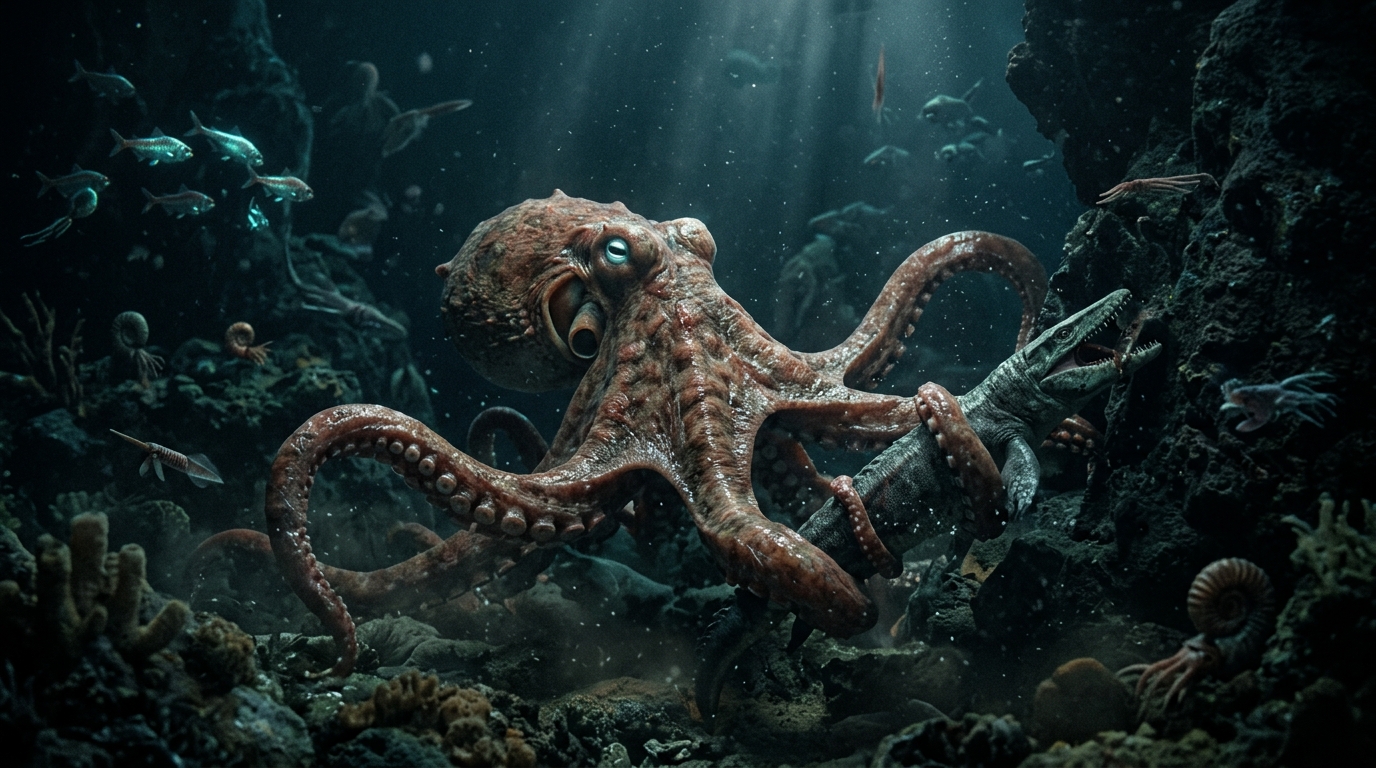

Scientific study reveals impressive details about prehistoric creatures with powerful jaws that dominated the seas in the Cretaceous period and challenge what we knew about the marine food chain
The idea of giant octopuses dominating the oceans might seem like science fiction. However, new scientific discoveries show that this reality existed about 100 million years ago, during the Cretaceous period. And, surprisingly, these animals not only existed but also occupied the top of the marine food chain.
The information was released by the scientific journal Science, based on a detailed study that used 3D technology to analyze extremely rare fossils. According to researchers, these creatures — known as Nanaimoteuthis — could reach an impressive 19 meters in length, placing them among the largest predators of their time.
3D technology reveals powerful jaws and surprising eating habits
To better understand these prehistoric creatures, scientists resorted to advanced techniques of 3D digital reconstruction. With this, they were able to analyze fossilized structures that had been preserved within solid rocks for millions of years.
-
Sixth-grader in Miami wins Lemelson Young Inventor Prize for creating water-absorbing concrete using discarded oyster shells and charcoal.

-
Brazilian Researchers Develop Portable, Painless, Radiation-Free Breast Cancer Tracker Using Microwaves, Costing Around $200 and Potentially Replacing $240,000 Mammograms
-
Beer as a Vaccine? Scientist Develops Experimental Method with Live Yeasts, Tests Own Brew, and Publishes Results on Zenodo

-
Brazilian Researchers Develop ‘Rapha’ Device Using Natural Latex and LED Light to Heal Diabetic Foot Ulcers and Prevent 50,000 Annual Amputations


These analyses revealed a fundamental detail: the jaws of the giant octopuses showed intense signs of wear, indicating that they fed on hard prey, such as shells and even bones. In other words, they were not just large — they were extremely efficient predators.
Furthermore, researchers identified that these cephalopods possessed a structure adapted for crushing tough food, which further reinforces their position as dominant predators in the marine environment.
Consequently, this discovery completely changes how we understand the dynamics of ancient oceans. Previously, it was believed that other groups, such as large marine reptiles, occupied the top of the food chain. Now, octopuses strongly enter this scenario.
What this discovery changes in science and the history of marine life
This discovery is not just curious — it has a direct impact on science. After all, finding such well-preserved fossils of soft-bodied animals, like octopuses, is extremely rare. This happens because, unlike bones, soft tissues decompose quickly.
Therefore, each new record of this type offers a unique opportunity to understand the evolution of marine life. In this case, the analyzed fossils show that octopuses already possessed highly sophisticated adaptations 100 million years ago, which indicates a much more complex evolution than previously imagined.
Furthermore, scientists emphasize that these discoveries help reconstruct ancient ecosystems with greater precision. This way, it becomes possible to understand how different species interacted and competed for food.
Finally, it is worth noting that this study is part of a series of recent discoveries that are expanding knowledge about Earth’s past. In fact, recent research identified fossils up to 512 million years old, containing 153 different species, of which about 59% were completely unknown to science until then.
Do you believe there are still unknown giant creatures hidden in the oceans today?